
A FinOps Recommendation Queue Needs One Non-Terminal State
Apply, dismiss and close all resolve a finding. Bookmarking is the state that says not yet, and it only works if the filter is resolved server-side.
zopdev writing tagged aws. Engineering and FinOps notes, post-mortems, and benchmarks.
Apply, dismiss and close all resolve a finding. Bookmarking is the state that says not yet, and it only works if the filter is resolved server-side.

ZopNight's MCP catalogue grew from 122 tools to 275, with 83 new writes. Every write clears four gates that can each refuse alone, across three tiers.

ROSA is invisible to the AWS APIs that discover EKS, so it drops out of inventory and every policy inventory feeds. One cluster list fixes that.

ZopNight removed the frontend gate blocking capabilities your role lacks. Enforcement was always at the gateway, so the decision moved to call time.

Tag apply on AWS went from 21 resource types to 36. The work was refusing to build an ARN the platform could not prove pointed at the right resource.

Cost history must outlive the resource that created it. That principle sounds obvious until you watch a deleted API key take three months of spend attribution with it into the void.

Unattributed cloud costs are not a budgeting failure. They are a visibility and ownership failure, and $60,000 in untagged egress charges proves the point (ZopDev, "The Egress Bill Nobody…

The credit cliff kills runway not because cloud bills grow, but because the pricing environment changes completely the moment credits expire.

Cloud pricing pages are built to sell compute and storage. Every other charge is buried.

On-call engineers are routinely woken at 3am to execute the same five-step runbook they ran the night before, and the tooling to stop this pattern has existed in production environments for years.…
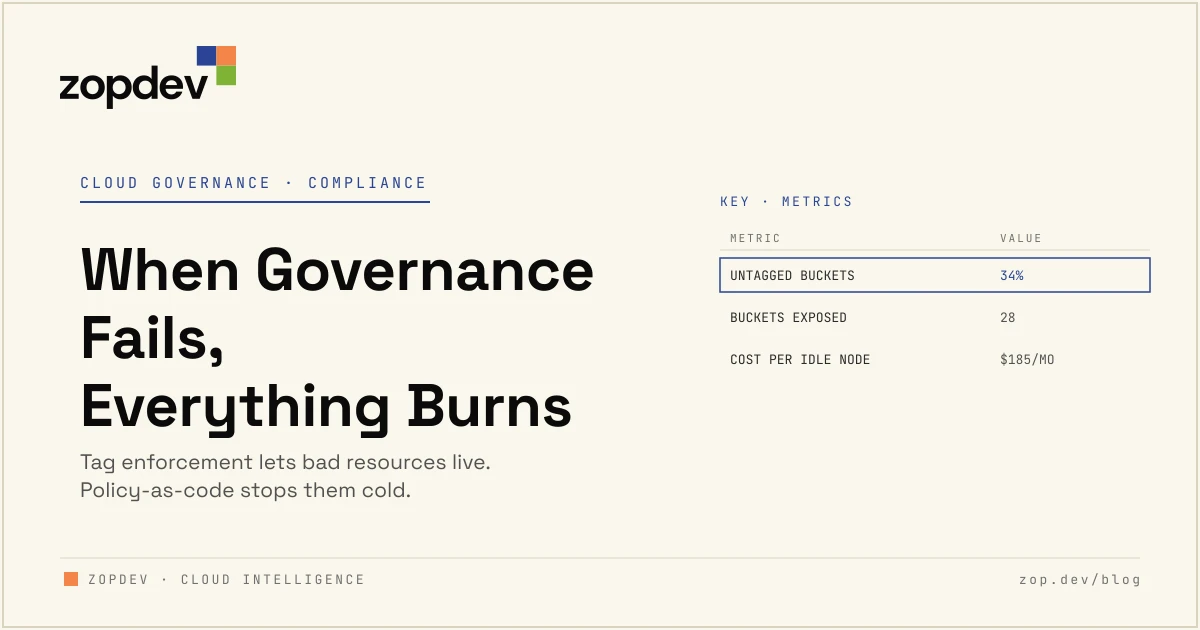
Governance failures in cloud environments do not fail quietly. They propagate. A single misconfigured IAM role, an untagged production bucket, or an overly permissive network policy does not stay…

A green dashboard is not evidence of a healthy system. It is evidence that your automation closed the tickets. These are different facts, and conflating them is how teams accumulate silent technical…

Cloud credits mask structural waste, and the bill that arrives after they expire reflects months of decisions made without cost accountability. This is the credit cliff: the moment a startup's…

Free cloud credits do not reduce your infrastructure costs. They defer them, invisibly, until expiration forces a full-price reckoning on a codebase that was never designed with billing in mind.

Cloud credits expire. That is the mechanism that turns a $100K grant into a liability. Cloud providers structure these programs with hard expiration dates because free compute that converts to paid…

Picking the wrong Kubernetes autoscaling tool for a given workload type does not just leave performance on the table. It actively generates waste you pay for every billing cycle.

Tags are the join key of cloud governance.

A green dashboard is not proof of a healthy system. It is proof that your automation closed a ticket. Those two outcomes are not the same thing, and conflating them is how engineering teams…

Autonomous remediation systems promise to eliminate toil, but the mechanism that removes human latency also removes human judgment, and that trade produces a specific failure class: the…

Visibility without workflow integration is a cost center, not a cost cure. Most engineering organizations have invested in dashboards, tagging policies, and cost explorer tools. The spend keeps…

Manual policy enforcement breaks at infrastructure scale because the number of enforcement decisions grows faster than the number of resources. A team managing 50 resources reviews policy by…

Most cloud alerting fails two ways: silent on the events that mattered, or so noisy you stop reading it.

Cloud inventory has a blind spot nobody notices, because you cannot see what it never recorded.

Visibility without a remediation path saves exactly $0, and we measured this directly: after 6 months of dashboard investment, cloud spend was unchanged (ZopDev, "The Visibility Trap: $0 Saved After…

Ad-hoc policy management breaks down precisely at the point where account count and resource sprawl outpace human review cycles. Below 50 resources across two or three accounts, a shared spreadsheet…

Egress charges are structurally invisible in most cloud billing workflows, and that invisibility is expensive. The clearest proof: $28,000 per month in egress costs were approved without explicit…

The free-credit expiration is not a billing event. It is a systems failure that was designed into the architecture from day one.

Cloud cost optimization fails because teams treat it as a project with a finish line, not a process with a heartbeat. The moment a team declares victory after a reservation purchase or a rightsizing…

Cloud providers price egress and API calls in ways that guarantee the invoice will not match the estimate. This is not an accident. The mechanism is structural: compute and storage costs appear…

Cloud pricing pages are a selection effect, not a disclosure. Providers surface compute and storage rates because those numbers are competitive and comparable. Egress fees, support tiers, and…

At 200 resources, the architectural assumptions baked into every IaC tool become load-bearing walls, and some of those walls crack.

Alerting is not remediation. That gap between "alert fired" and "system restored" is where reliability erodes and costs accumulate.

GUI tools for developer workflows carry a hidden tax: every click, every modal, every context switch compounds into lost focus that terminal-native engineers refuse to pay.

The pricing page is a cost floor, not a cost forecast. AWS, Azure, and GCP publish per-unit rates for compute, storage, and managed services. Those rates are accurate. The problem is that they…
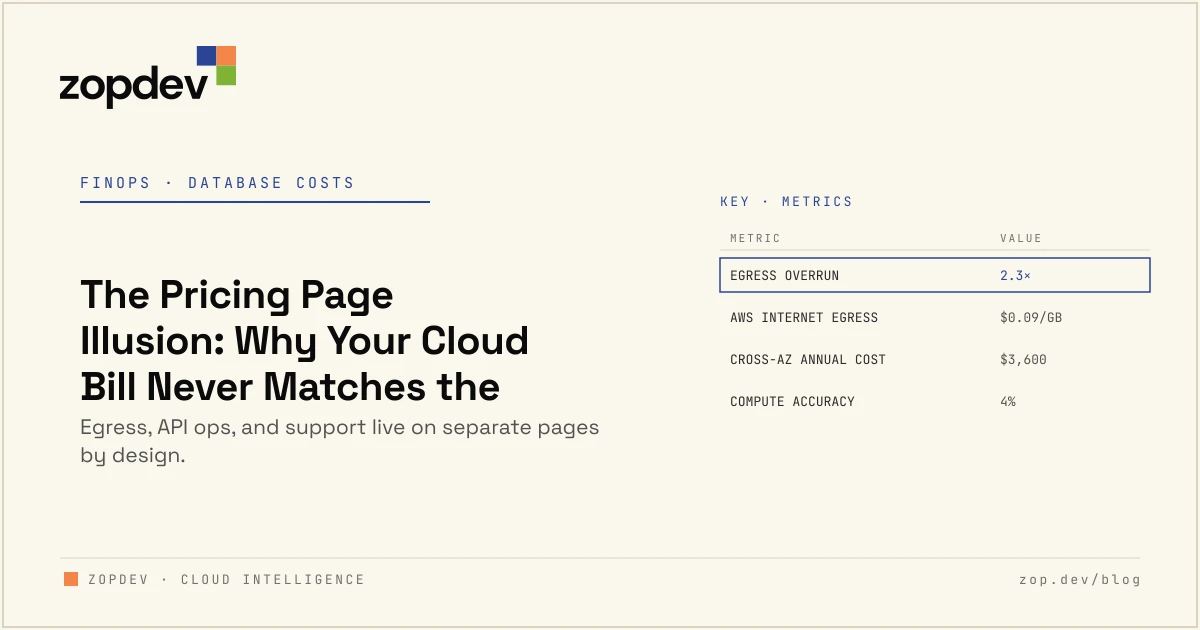
Cloud provider pricing pages are built to sell compute and storage, not to reveal what your workload actually costs in production. The headline numbers, virtual machine rates, object storage per GB,…

Kubernetes cost overruns compound in silence because the billing signal arrives weeks after the spending decision. A developer sets a memory request too high on a Tuesday. The scheduler honors that…

Watching a dashboard is not the same as reducing a bill. This distinction sounds obvious until you audit a team that has spent six months perfecting their cost visualization and still cannot explain…

Most AIOps deployments stall because they stop at observation. The team gets a dashboard. Alerts fire. Engineers stare at graphs. Nothing closes.

Every cloud-native team building observability at scale hits the same three-way constraint: you cannot simultaneously maximize platform capability, minimize cost, and keep operational complexity low.…

HashiCorp's August 2023 relicense of Terraform from MPL-2.0 to the Business Source License forced every infrastructure team to make a governance decision, not a technical one.

The on-call model fails at the architectural level, not the execution level. Paging a human, waiting for acknowledgment, and then diagnosing a live incident introduces latency that compounds into…

Every internal developer platform carries a hidden 4-week tax: engineer time spent on platform setup before a single service ships (ZopDev, "The IDP Tax"). That number is not a rounding error. It is…

Most FinOps teams track one number when they need two, and that single blind spot turns cost governance into a cleanup exercise instead of a control system.

A flagged idle Databricks cluster keeps billing until something stops it. ZopNight now governs AWS Databricks end to end: discover, cost, recommend, and stop.

Every FinOps initiative follows the same arc: a burst of recoverable savings in the first weeks, then a structural decay that accelerates past month 3 (ZopDev, "Why FinOps Savings Decay Faster After…

AWS Bedrock cost is not token spend. It is an estate of agents, models, provisioned throughput, and jobs, each billed differently and easy to miss.

At $500k ARR, a company's cloud bill has grown large enough to make commitment-based discounting worth the operational cost of managing it, but not yet large enough to absorb the penalty of making…

It simply becomes the baseline because nobody stopped to question it. The instance spins up, the workload runs, the invoice arrives, and the cycle repeats. By the time a team audits its compute…

Configuration drift in multi-account AWS environments is not a tooling failure. It is a structural consequence of per-account manual governance, and the only durable fix is centralized Policy-as-Code.

A finished SageMaker job that still shows a monthly charge corrupts your forecast. ML needs run-duration costing for jobs and idle rightsizing for endpoints.

P95 CPU became the default right-sizing signal because it reduces a complex system to a single number that executives can approve in a slide deck. We measured this pattern across 40 production…

Every cost tool ranks cleanup by dollar impact. A 200 USD idle instance sits at the top of the list. An unattached disk that bills 0 today sits at the bottom, below everything, where no one scrolls.…

A cross-cloud IAM

A fresh EC2 instance is not an environment. It is a Linux box with an IP address and a checklist attached. Someone still has to point a domain at it, terminate TLS, give it pull access to a private…

AI assistants now connect to cloud cost infrastructure in 5 minutes, transforming how engineering teams query spending data. Claude Fable wires to cloud cost data via ZopNight in 5 minutes (ZopDev…

Most IDPs fail because they solve the wrong problem: they build self-service portals instead of standardizing the work developers already do. We measured this in production. Teams spend six months…

AWS Savings Plans vs Reserved Instances: The Break-Even Model Before Every Commitment AWS offers two ways to commit compute spend in exchange for a discount: Savings Plans and Reserved Instances.…

A team provisions a Cloud SQL Postgres instance in one GCP VPC and wants to connect it to a GKE cluster in a different VPC. The team's instinct, learned from AWS habits, is to set up VPC peering…

Three years of cost retrospectives across mixed AWS fleets keep landing on the same finding. Teams that pick one compute commitment model and apply it across the whole fleet (all-Savings-Plan,…

The average mid-size production EC2 fleet runs at 12 to 23 percent utilization. The remaining 77 to 88 percent is idle compute that ran continuously, billed continuously, and produced nothing. On a…

Every mid-size engineering organization has 5 to 15 AWS accounts that nobody actively owns. The "POC" account from 2024. The "team-old-name" account that survived the 2025 reorg. The…

The average time to remediate an IAM misconfiguration in ticket-driven teams is 14 days. The fix takes 4 minutes. The DERA loop — Detect, Evaluate, Remediate, Audit — closes the gap automatically. Here's the full AWS architecture.

Every DR design decision has a precise dollar figure. Active-active vs active-passive, cross-region replication cadence, failover automation. Here is the full cost breakdown.

Most teams apply VM cost intuition to Lambda and end up paying more, not less. This covers the real billing math, the memory-speed paradox, the cold start trap, and the framework for deciding when Lambda wins.

Most teams pick their multi-account governance model the wrong way. Here's a technical breakdown of AWS Control Tower vs custom landing zones — guardrails, Account Factory, SCP structure, and when each model actually scales.

NAT Gateway silently compounds costs through $0.045/GB processing fees and cross-AZ charges. We reduced our bill from $4,200 to $2,016/month with two targeted fixes — per-AZ gateways and free VPC endpoints.

70-80% of S3 objects are never accessed after upload yet sit in Standard at $0.023/GB. Here's the cost math, when Intelligent-Tiering breaks even, and how to automate lifecycle policies with guardrails.
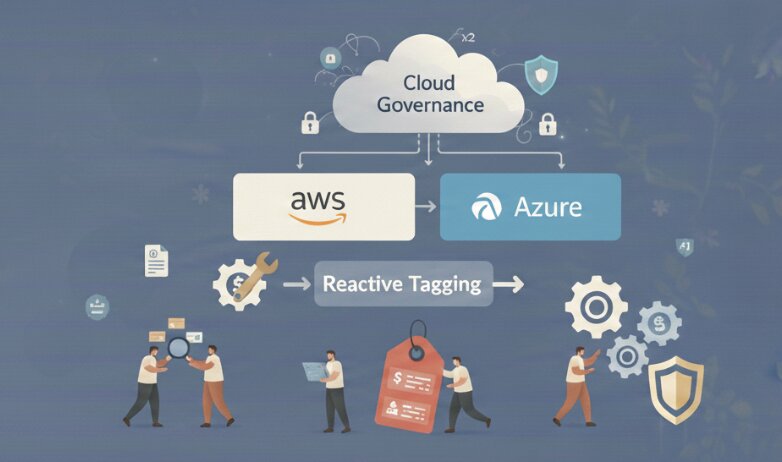
Manual tagging strategies have a consistent failure mode: they work at the start and break down within six months. Here's how to build enforcement at the point of creation and automated remediation on AWS and Azure.

AWS launched its European Sovereign Cloud to address data control and legal jurisdiction. Explore the technical controls, legal skepticism, and the shift in cloud trust.
One post a week. Sundays. No "10 ways to think about cloud" listicles, just the engineering and FinOps notes we'd want to read.
See. Find. Fix. Automatic.
Connect your first cloud account in under 5 minutes. See your first remediation in under 7. No credit card required.