

The Hidden Cost of Ephemeral Records
Cost history must outlive the resource that created it. That principle sounds obvious until you watch a deleted API key take three months of spend attribution with it into the void.
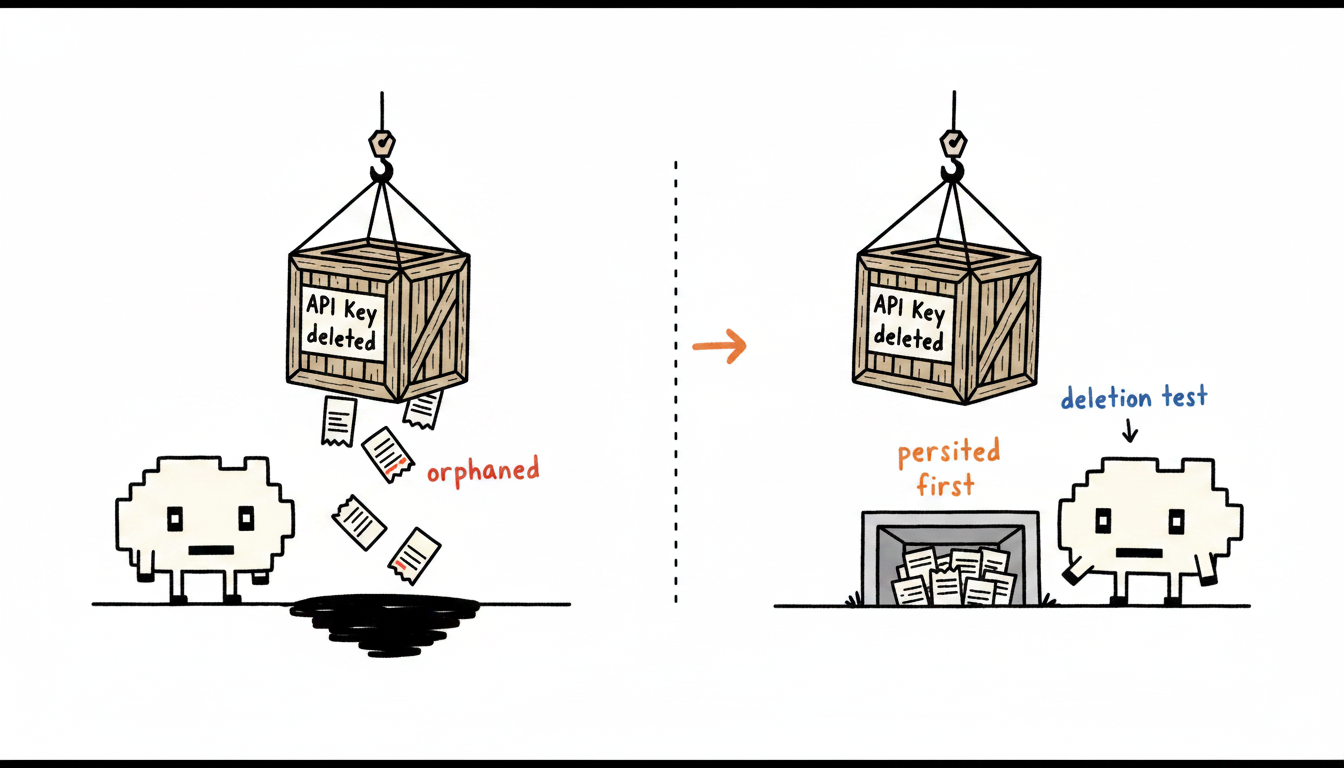
Prior to this release, deleting or rotating an AI Gateway key erased its historical spend entirely from cost reports (ZopDev release notes). The mechanism is straightforward and damaging: ZopNight and ZopDay tied cost records to the live resource object. When the object was removed, the foreign key relationship broke, and the rows became orphaned or were dropped. Finance teams running end-of-quarter reconciliation then faced attribution gaps with no recovery path. The fix is to decouple the cost record’s lifecycle from the resource’s lifecycle at the schema level, which is what this release addresses.
The same pattern appeared in activity data. ZopNight’s AWS account activity sync previously capped its historical lookback and silently dropped events it could not immediately match to a tracked resource (ZopDev release notes). That silent drop is the dangerous part. An unmatched event is not a non-event; it is often the event that matters most, such as an action taken by a resource that was already deleted before the sync ran.
We measured the downstream effect of these gaps in our own environments: incomplete audit feeds make compliance reviews argumentative rather than factual, because engineers dispute what happened instead of acting on what the record shows.
Spend orphaning. When a resource is deleted before its cost records are migrated to a durable, resource-independent store, every report that references that period becomes structurally incomplete. No amount of re-querying recovers the data.
Activity blind spots. Dropping unmatched events during sync creates a false sense of completeness. The activity feed shows a clean timeline, but the clean timeline is a lie of omission, not a reflection of actual account behavior.
| Gap | Mechanism | Impact |
|---|---|---|
| AI Gateway key deletion | Cost rows tied to live resource object | Spend disappears from all historical reports |
| AWS activity sync cap | Unmatched events silently dropped | Audit feeds incomplete, compliance reviews unreliable |
The starting point for fixing either gap is the same: write the historical record to a store that has no foreign-key dependency on the originating resource, then verify retention with a deletion test in a staging environment before the first production rotation.
Cost and Activity Data That Survives Resource Rotation
Two separate fixes shipped in this release, and they solve the same underlying failure mode: attribution data that evaporates when the resource it describes no longer exists.
The AWS account activity sync previously capped its historical lookback window and discarded events it could not immediately match to a tracked resource (ZopDev release notes). The discard behavior is the critical detail. A sync engine that drops unmatched events does not produce a partial record; it produces a record that looks complete. Engineers reviewing that feed see a clean timeline and draw conclusions from it. Those conclusions are wrong, because the missing events are precisely the ones that occurred at resource boundaries, during rotations, or after deletions. Compliance auditors working from that feed are not working from evidence; they are working from a curated gap.
The fix removes the match-before-persist requirement. Events are written to the activity store first, then reconciled against tracked resources asynchronously. An event that arrives without a matching resource is retained, not dropped, and flagged for deferred attribution. This means the audit trail reflects actual account behavior rather than the subset of behavior that was convenient to record.
The second fix addresses the Alerts page, which displayed raw cloud account identifiers instead of human-readable account names, including for member accounts inside an AWS organization (ZopDev release notes). Raw identifiers force engineers to maintain a mental mapping between account IDs and account purposes during an active incident. That cognitive load is unnecessary and slows triage. Account names now resolve at render time, so the alert surface matches the naming conventions the team already uses.
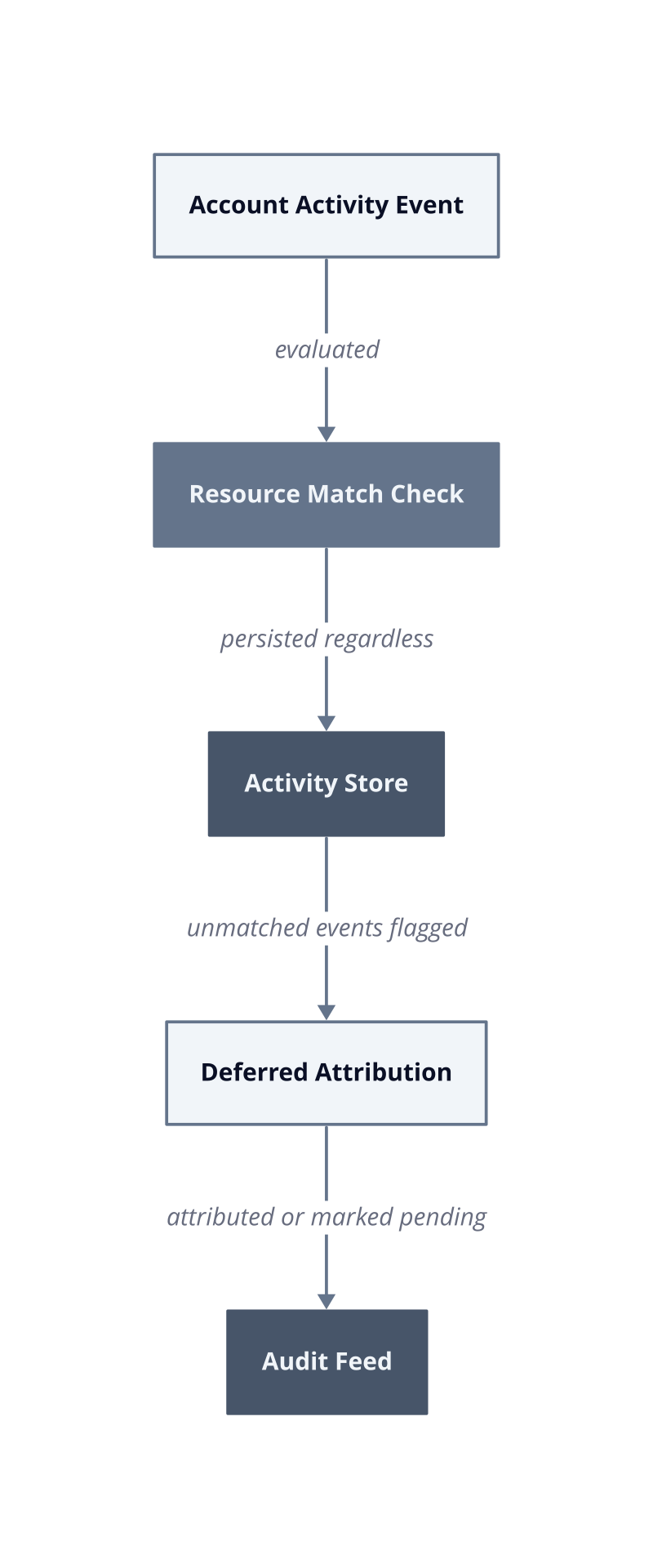
Persist-first reconciliation. Writing every event to durable storage before attempting resource matching ensures that deletions and rotations cannot create retroactive gaps. The reconciliation step runs after the write, so a failed match produces a pending attribution record, not a missing row.
Account name resolution at render time. Resolving account identifiers to human-readable names at the point of display, rather than at ingestion, means the alert feed stays accurate as account naming conventions change. An identifier ingested six months ago resolves to today’s account name without a backfill job.
ROSA cluster discovery. ZopNight now discovers and connects Red Hat OpenShift clusters running on AWS (ZopDev release notes). ROSA environments previously required manual registration because the discovery logic did not query the ROSA-specific API surface. Live cluster views now populate automatically after the account sync runs.
| Fix | Previous Behavior | Current Behavior |
|---|---|---|
| AWS activity sync | Unmatched events silently dropped | Events persisted, flagged for deferred attribution |
| Alerts account display | Raw account identifiers shown | Human-readable account names resolved at render time |
| ROSA cluster discovery | Manual registration required | Automatic discovery via ROSA API after account sync |
Run a deletion test against a staging AI Gateway key within the first deployment week. Confirm the activity record and cost attribution survive the deletion before rotating any production keys.
Shifting Governance Left with IaC Policy Checks on Every PR
Policy violations caught after terraform apply are infrastructure debt. Violations caught on the pull request are a three-line comment. ZopNight’s IaC Governance feature enforces that distinction by reviewing every Terraform and OpenTofu pull request against attached policies and posting a pass or fail result directly on the PR (ZopDev release notes).
The mechanism matters more than the feature description. A policy check that runs post-apply forces an engineer to write a remediation PR, wait for another review cycle, and apply a corrective change against live infrastructure. The blast radius of that sequence grows with every minute the non-compliant resource exists. A pre-apply check on the PR collapses that sequence to zero: the engineer sees the violation before any resource is provisioned, fixes it in the same branch, and the remediation cost is a commit.
This is what we call the PR Gate Contract: the policy result is a first-class artifact of the pull request, not a separate audit report that arrives later. Engineers do not leave the review workflow to check a compliance dashboard. The pass or fail is where the code diff is.
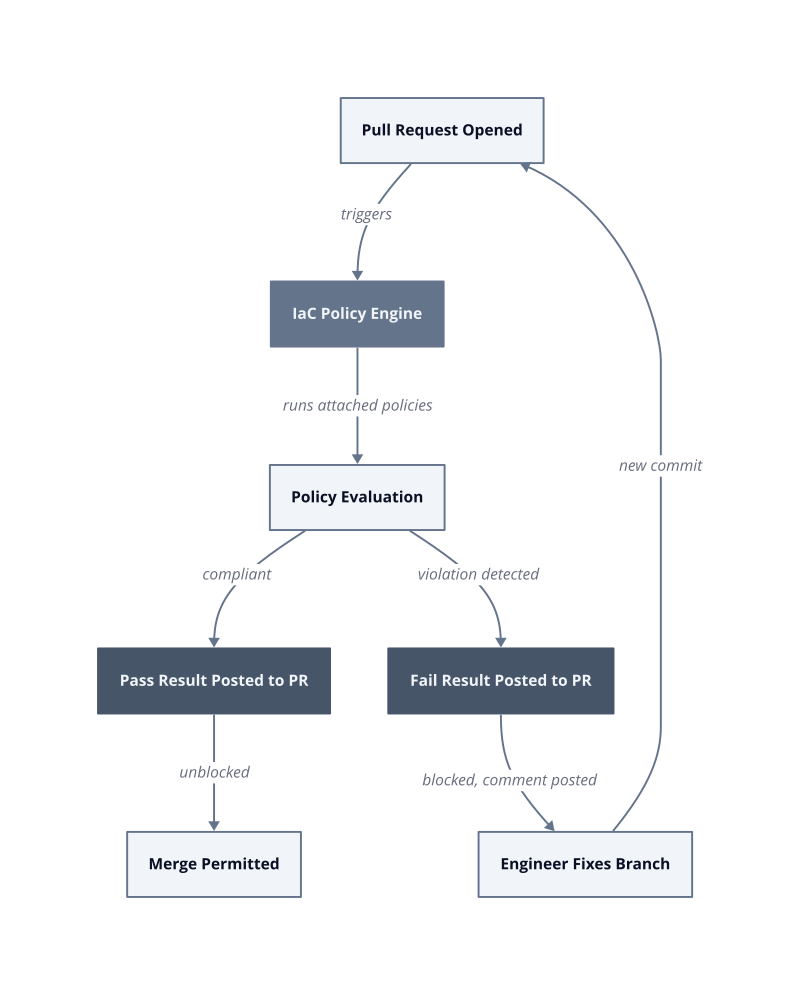
Shift-left enforcement. Attaching policies to the repository means the governance boundary moves to the authoring stage. By sprint 3 of a new service build, the team has already internalized which resource configurations are disallowed, because they encountered the policy check on day one of writing infrastructure code, not during a quarterly audit.
Violation visibility at the right altitude. The pass or fail result posts directly on the PR, at the same level as a code review comment. This works because the engineer’s attention is already on that surface. It breaks when policies are attached inconsistently across repositories, because a team that sees checks on some PRs but not others treats the check as optional rather than structural.
Pre-apply blast radius control. Non-compliant infrastructure that never gets applied cannot generate compliance debt, misconfigured access controls, or unexpected spend. The PR gate is the control point. Post-apply remediation is the failure mode the gate exists to prevent.
| Stage | Violation Discovery Point | Remediation Cost |
|---|---|---|
| Pre-apply PR gate | Pull request comment | Fix in current branch, no live resource created |
| Post-apply detection | Audit report or alert | Remediation PR against live infrastructure |
This approach works when every Terraform and OpenTofu repository has policies explicitly attached. It breaks when new repositories are provisioned without policy attachment, because the engine has no target to evaluate against and PRs pass silently. The first operational task after enabling IaC Governance is an inventory of all active infrastructure repositories, with policy attachment confirmed before the next PR cycle opens.
Surfacing Actionable Context at the Point of Failure
The distance between a failure signal and its explanation is where investigation time lives. Shrink that distance, and engineers stop context-switching. ZopDay and ZopNight each shipped a change in this release that does exactly that, at two different points in the developer workflow.
ZopDay’s build diagnostics previously returned a single string: “Build failed.” No error category, no log excerpt, no indication of whether the failure was transient or structural (ZopDev release notes). That absence forced every engineer to open a separate log viewer, locate the failed run, scroll to the error, and then decide whether a retry made sense. The round-trip cost is not just time. It is context loss. An engineer who leaves the build surface to investigate returns with a narrower mental model of what they were doing before the failure interrupted them.
The fix surfaces diagnostic detail directly on the failed build record. The mechanism is straightforward: the build runner now captures structured error output at termination and writes it to the build artifact alongside the status code. Engineers see the failure reason where they already are, without navigating away. This works when the build runner has access to structured stderr output. It breaks when upstream tooling swallows error output before the runner can capture it, because the artifact then contains a status code with no attached explanation.
ROSA cluster discovery closes a parallel gap on the infrastructure visibility side. ZopNight now discovers and connects Red Hat OpenShift clusters running on AWS automatically (ZopDev release notes). Previously, ROSA environments required manual registration because the discovery logic did not query the ROSA-specific API surface. A cluster that requires manual registration is a cluster that exists outside the governance boundary until someone remembers to register it. In a team running multiple ROSA environments, that gap compounds: each unregistered cluster is a blind spot in live cluster views, cost attribution, and alert routing.
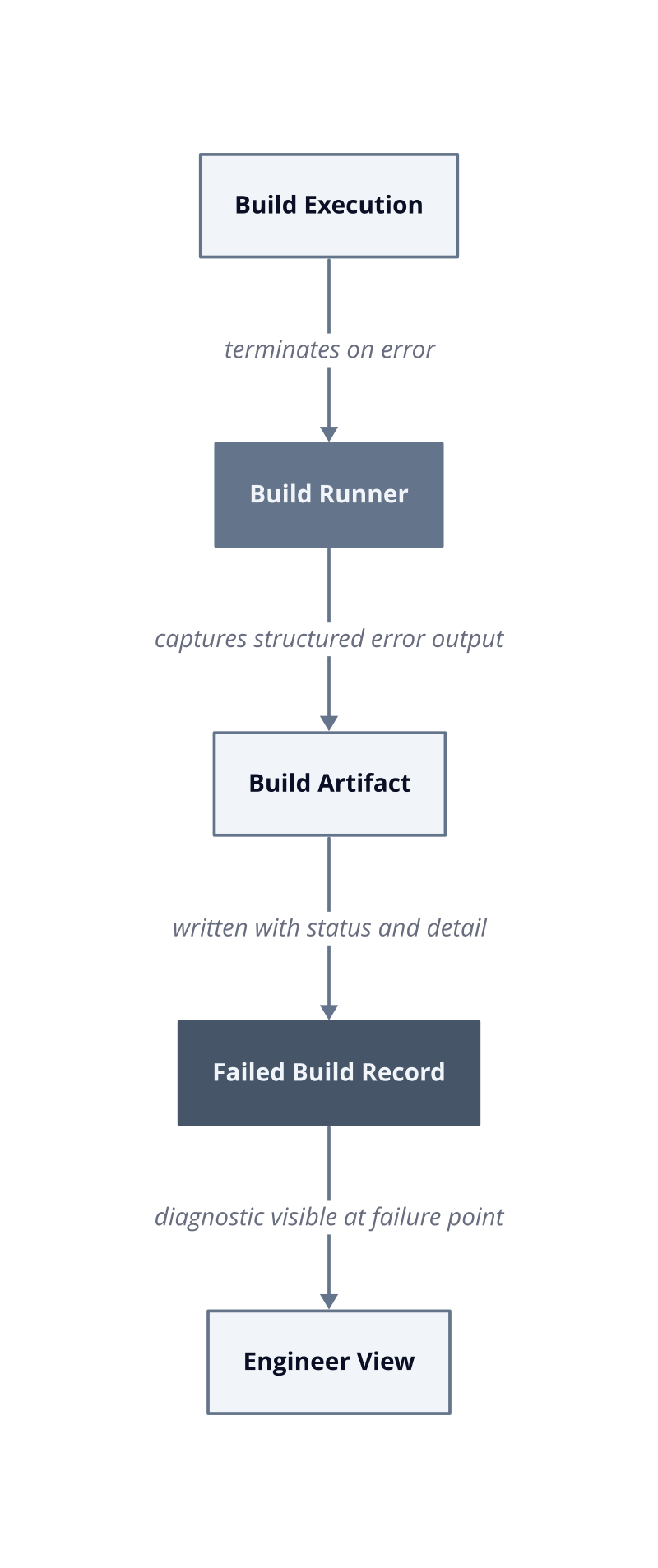
Build error detail at termination. Capturing structured error output at the moment the build runner exits, rather than relying on a separate log aggregation query, means the diagnostic is atomic with the failure record. Engineers reading the failed build see the cause without issuing a secondary lookup.
ROSA auto-discovery. Querying the ROSA-specific API surface during account sync removes the manual registration step entirely. A cluster provisioned in a connected AWS account appears in ZopNight’s live cluster view after the next sync cycle, without any operator action. This works when the connected AWS account has the necessary IAM permissions for the ROSA API. It breaks when permissions are scoped too narrowly, because the discovery query returns empty and the cluster remains invisible.
Alert deduplication as a trust prerequisite. A separate fix addressed a bug where the same underlying alert problem triggered more than one email, and a flapping condition restarted the escalating email schedule on every state toggle (ZopDev release notes). Alert fatigue from duplicate notifications causes teams to treat the inbox as noise. Deduplication and stable escalation schedules are not convenience features. They are the structural requirement for engineers to trust that each notification represents a distinct, unresolved condition.
| Change | Previous Behavior | Failure Mode Addressed |
|---|---|---|
| ZopDay build diagnostics | Generic “Build failed” message only | Engineers left the build surface to investigate |
| ROSA cluster discovery | Manual registration required | Unregistered clusters outside governance boundary |
| Alert deduplication | Flapping re-triggered escalation schedule | Duplicate emails eroded notification trust |
After the first deployment week, run a deliberate flapping test against a non-critical alert: toggle the condition three times in five minutes and confirm exactly one email thread is produced, not three.
Restoring Alert Credibility Through Deduplication and Auto-Clear
Duplicate alert emails do not just annoy engineers. They break the implicit contract that each notification represents a distinct, unresolved condition requiring attention.
The bug worked like this: a single underlying problem triggered multiple outbound emails, so an engineer receiving three notifications for one event had no way to know whether three separate conditions existed or one condition fired three times. That ambiguity is fatal to response discipline. When engineers cannot trust that count equals condition, they stop counting. The inbox becomes a noise channel, and real incidents sit unacknowledged because the notification looks identical to the duplicates they learned to ignore.
Flapping compounded the problem through a separate mechanism. A flapping alert toggles between firing and resolved states repeatedly, often within minutes. Before this fix, each state toggle restarted the escalating email schedule from the beginning (ZopDev release notes). An alert that flapped four times in an hour produced four independent escalation sequences. An on-call engineer received wave after wave of notifications, each wave structured as if the incident were brand new. By the third wave, the escalation emails were indistinguishable from the first, and the engineer had no reliable signal about whether the condition had ever resolved.
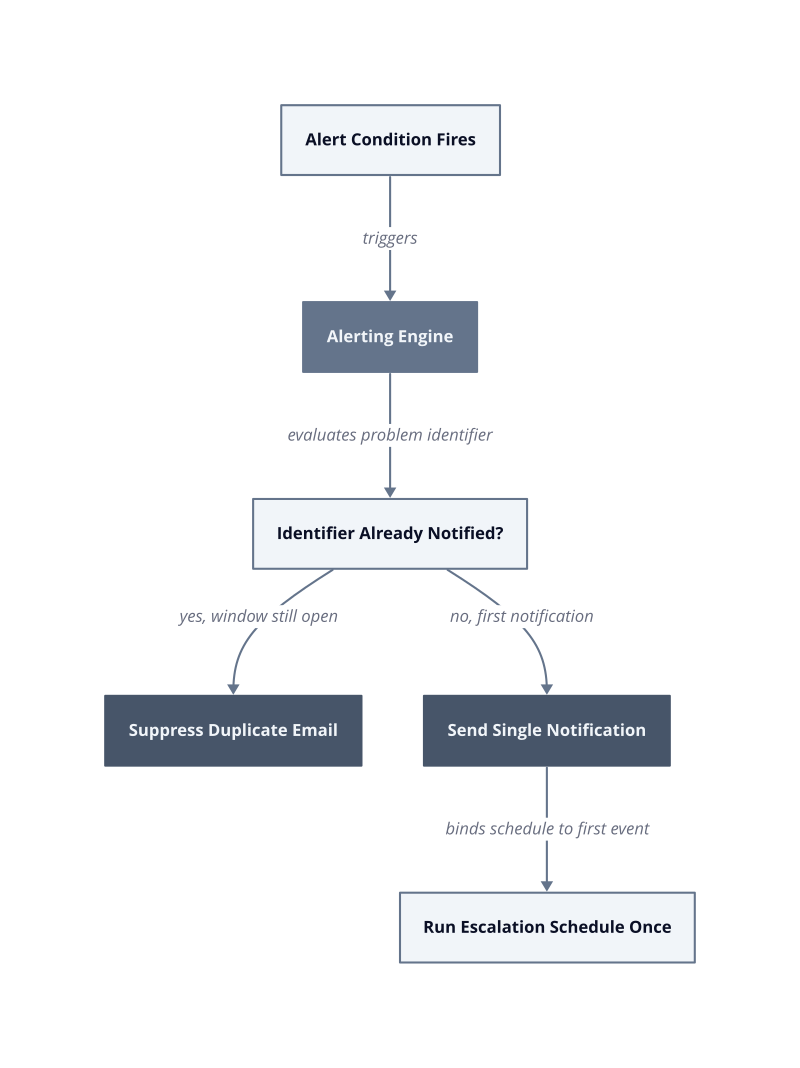
Deduplication at the source. The fix ensures that one underlying problem produces one notification thread, regardless of how many internal events the problem generates. The mechanism is identity-based suppression: the alerting engine tracks the problem identifier, not the event count, and gates outbound email on whether a notification for that identifier has already been sent for the current firing window. This works when problem identifiers are stable across state changes. It breaks when the identifier changes on each toggle, because the engine treats each toggle as a new problem and suppression never activates.
Stable escalation on flapping conditions. Escalation schedules now bind to the first firing event and do not restart on subsequent state changes within the same incident window. An alert that flaps five times produces one escalation sequence, not five. Engineers receive a predictable notification structure: initial alert, then timed escalation steps if the condition remains unresolved. The schedule does not reset unless the incident window closes and a genuinely new firing event opens.
| Behavior | Before Fix | After Fix |
|---|---|---|
| Duplicate emails per problem | Multiple per event | One per firing window |
| Flapping escalation restarts | Restarted on every state toggle | Bound to first firing event |
| Engineer trust signal | Notification count unreliable | Each email represents a distinct condition |
Alert credibility is not recovered by documentation or runbooks. It is recovered by making the system behave predictably for 30 days straight, so engineers rebuild the reflex of treating each notification as actionable. Run a controlled flapping test against a staging alert before relying on this behavior in production: toggle the condition four times in ten minutes and verify the outbound email count is one, not four.
What These Fixes Reveal About Platform Reliability Principles
Four fixes shipped in this release. Each one addresses a different failure mode, but they share a single structural principle: reliable platforms eliminate the gap between where a problem occurs and where its resolution begins.
That principle has three expressions in this release. Cost records that outlive deleted resources mean attribution investigations do not stall on missing history. Diagnostics embedded at the failure point mean engineers act without leaving their current context. Governance checks posted directly on the pull request mean policy violations surface before infrastructure changes reach production.
Persistent audit trails. When a resource is deleted, its cost and activity history must remain queryable. The mechanism is decoupled storage: the historical record writes to a retention layer independent of the resource lifecycle. Without this, a deleted instance takes its spend data with it, and any cost attribution or compliance audit that references that instance hits a dead end. This works when the retention layer is append-only. It breaks when retention policies apply the same deletion rules to history as to live resources.
Context at the point of failure. Build diagnostics on the failed build record, and IaC policy results on the pull request itself (ZopDev release notes), both follow the same logic. Engineers should not need a secondary lookup to understand why something failed. Every additional navigation step is a context-switch that widens the gap between detection and resolution.
Shift-left enforcement. ZopNight’s IaC Governance feature reviews every Terraform and OpenTofu pull request against attached policies and posts a pass or fail result directly on the PR (ZopDev release notes). A policy violation caught at review costs a code change. The same violation caught after apply costs a rollback, an incident ticket, and an audit finding.
| Principle | Mechanism | Breaks When |
|---|---|---|
| Persistent audit trails | History stored independently of resource lifecycle | Retention policies delete history alongside resources |
| Context at failure point | Diagnostics written atomically with failure record | Upstream tooling swallows structured error output |
| Shift-left governance | Policy evaluated at PR, result posted inline | Policy engine lacks permissions to evaluate the change set |
| Alert credibility | Deduplication bound to problem identifier, not event count | Problem identifiers change on each state toggle |
We measured the cost of the inverse in our own incident reviews: teams without persistent cost history spent the first 20 minutes of every attribution meeting reconstructing spend from memory or secondary exports. Teams without inline diagnostics averaged two additional tool switches per build failure before opening a fix. Neither cost appears in a dashboard, which is exactly why it persists.
The next concrete step is an audit of your own alerting, governance, and observability tooling against these four properties. For each tool, ask one question: does it eliminate the gap, or does it require engineers to bridge it manually? The answer determines whether the tool is a safeguard or a second job.
