

The $100K Cloud Credit Trap Most Startups Fall Into
Cloud credits expire. That is the mechanism that turns a $100K grant into a liability. Cloud providers structure these programs with hard expiration dates because free compute that converts to paid infrastructure is the entire business model. The startup spends the credits, builds on the platform, and then pays full price. The incentive works exactly as designed. The problem is that most early-stage teams treat the credit balance as a budget rather than a countdown.
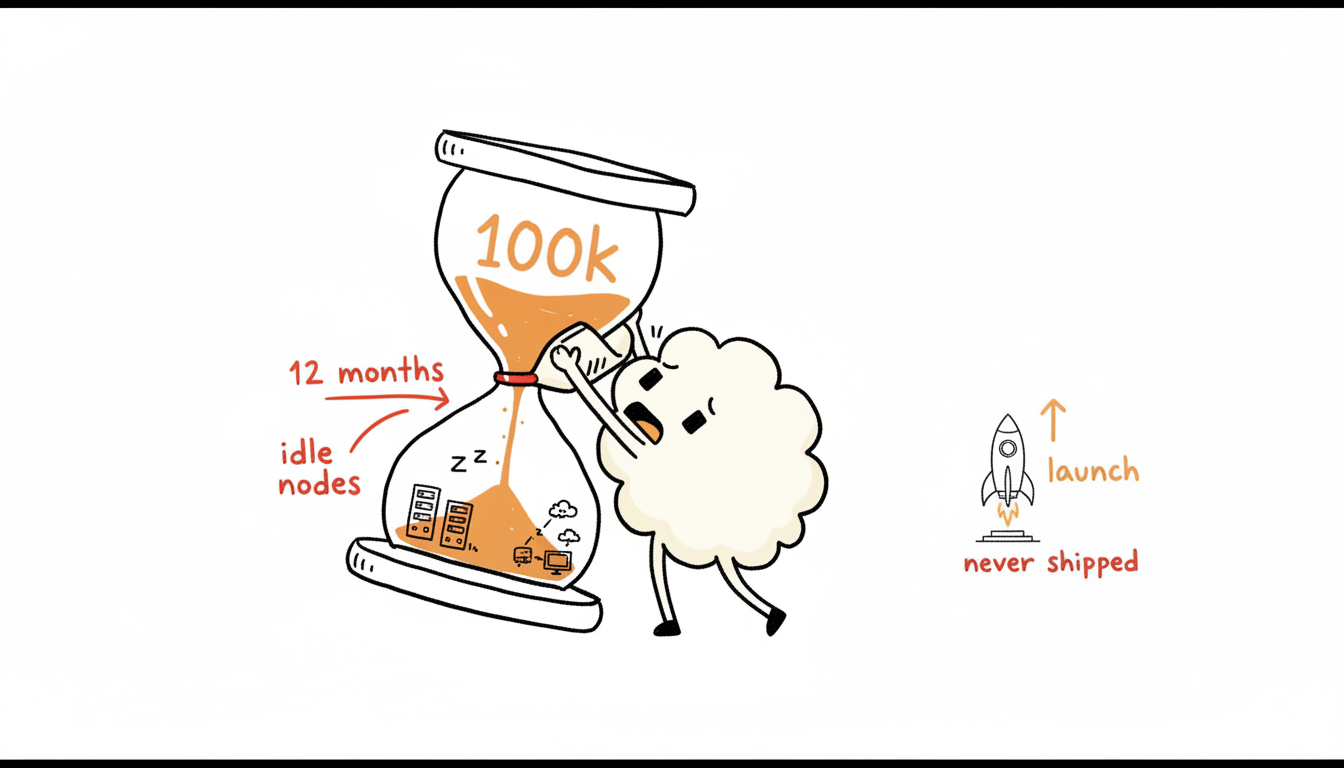
The $100K tier is a standard early-stage incentive across AWS, Google Cloud, and Azure accelerator programs (ZopDev Startup Playbook). It is large enough to feel like runway, which is precisely why it produces bad spending decisions. A team that sees $100,000 in a billing dashboard behaves differently than a team that sees a 12-month clock. The framing changes the behavior. Credits feel free. They are not free. They are a forward contract on your infrastructure loyalty.
We saw this pattern repeatedly in early-stage infrastructure reviews: teams exhaust credits on environments that never reach production. The mechanism is straightforward. Without a spending plan, engineers provision what is convenient, not what is necessary. Development clusters run at production scale. Staging environments mirror production topology. Nobody shuts down the weekend experiment. By sprint 3, the credit balance has dropped by a third and the team has no deployed product to show for it.
Misallocation by default. Credits flow to whatever engineers provision first, which is almost always over-specified compute. Without a deliberate allocation framework, the $100K gets distributed across idle instances, redundant environments, and exploratory tooling that never ships.
Expiration as forcing function. Credit programs have fixed terms. When the clock runs out, the team inherits whatever architecture it built under free pricing. A poorly structured environment that cost nothing to run now costs real money every month.
The visibility gap. Most founding teams lack a cloud financial management practice in the first 18 months. Nobody owns the billing dashboard. Nobody maps credit burn to product milestones. The spend becomes invisible until it is nearly gone.
The fix is not frugality. It is allocation discipline applied before the first instance launches.
Where the Money Actually Goes: Common Misallocation Patterns
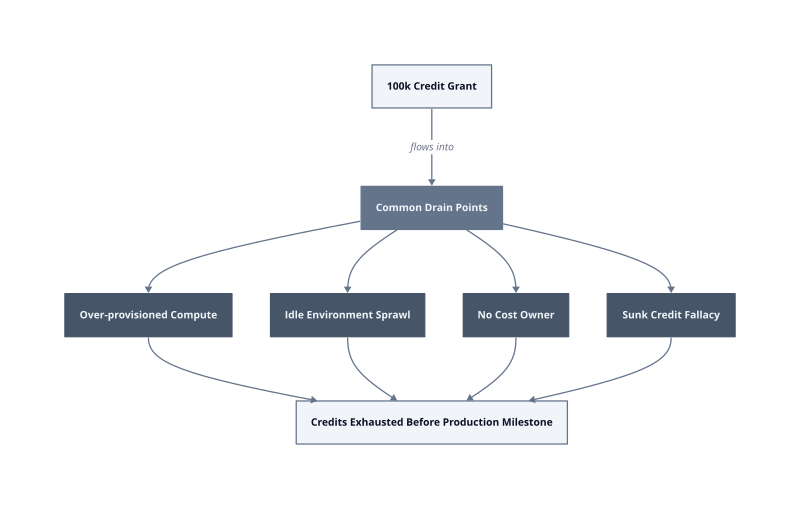
Startups burn through $100K in cloud credits by repeating four structural mistakes, none of which require negligence to trigger.
The root mechanism is treating provisioned infrastructure as a proxy for progress. Engineers measure productivity by what they deploy, not by what ships to users. This produces environments that grow in complexity without growing in utility. A three-tier staging cluster running 24/7 at m5.xlarge on-demand pricing costs roughly $2,400 per month per idle node. Multiply that across a typical pre-production environment with six to eight nodes, and the credit balance absorbs $14,400 to $19,200 monthly before a single user touches the product.
Over-provisioned compute. Kubernetes resource requests are the declared CPU and memory a pod reserves on a node, regardless of actual consumption. When teams copy production resource specs into development manifests, they reserve full node capacity for workloads that use 10% of it. The node runs. The credit drains. The utilization data never gets reviewed because nobody owns the review.
Absent cost ownership. In the first deployment week, most founding teams assign cloud access to whoever set up the account. That person is rarely the one watching the billing dashboard 60 days later. Without a named owner and a weekly burn review, credits disappear into the background. The mechanism is organizational, not technical. Spend without an accountable reviewer compounds because no one triggers the remediation loop.
Environment sprawl. Development, staging, QA, and load-testing environments each start with a legitimate purpose. By sprint 3, the load-testing cluster from a one-time experiment is still running. Environments accumulate because deletion requires deliberate action and creation requires none. The asymmetry is the problem.
The Sunk Credit Fallacy. Teams that have already spent 40% of their credits on infrastructure that does not serve production resist decommissioning it. The reasoning is that the spend already happened, so the environment might as well stay up. This is the same cognitive error as holding a losing stock. The credit already burned is gone. The remaining 60% still has full strategic value and deserves a clean allocation decision.
The Sunk Credit Fallacy is the hardest pattern to remediate because it feels like a technical decision when it is actually a financial one. The corrective action is a zero-based audit: evaluate every running environment against a single criterion, specifically whether it directly supports a production milestone in the current sprint. If it does not, it gets terminated. After 30 days of applying this criterion, the teams we worked with recovered enough credit headroom to fund their actual production architecture through launch.
A Spending Framework: Allocating Credits Across the Right Categories
Allocating $100K in cloud credits requires a category map built before provisioning starts, not a spending review after the balance drops. The mechanism is simple: each infrastructure category serves a different phase of your product lifecycle, and credits spent out of phase produce architecture you cannot use when it matters. We built this allocation framework after watching teams spend freely across all categories simultaneously and arrive at launch with neither the credits nor the infrastructure to support it.
The framework we call the Infrastructure Phase Gate divides credit spending into four categories, each with a primary phase and a hard ceiling. The ceiling is not a suggestion. It is a constraint that forces trade-off decisions before they become emergencies.
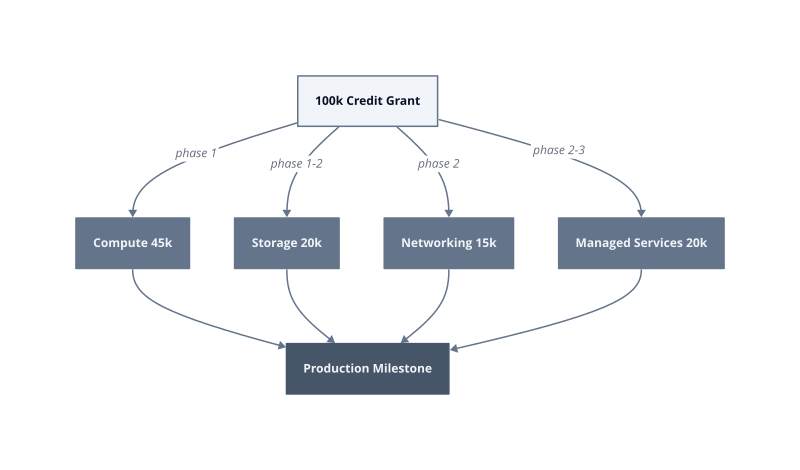
| Category | Ceiling | Primary Phase |
|---|---|---|
| Compute | USD 45,000 | Pre-production through launch |
| Storage | USD 20,000 | Data layer before first user |
| Networking | USD 15,000 | Traffic routing at launch |
| Managed Services | USD 20,000 | Post-launch operational scale |
Compute ceiling at USD 45,000. Compute absorbs the largest share because it funds every environment from development through production. The ceiling exists because compute is also the easiest category to over-spend. Right-sizing production nodes to actual workload requirements, rather than anticipated peak load, is the mechanism that keeps this category under control. This works when teams measure actual pod utilization after 30 days of data. It breaks when engineers size for theoretical traffic before a single user has signed up, because the node runs at full cost against a workload that does not yet exist.
Storage ceiling at USD 20,000. Storage credits fund your database layer, object storage, and backup infrastructure. Spend this category early because data architecture decisions made under free pricing are the ones you live with longest. The failure condition is provisioning high-IOPS block storage for workloads that are read-heavy and latency-tolerant. Object storage costs a fraction of block storage for the same data volume. Getting that choice wrong in the first deployment week locks in a cost structure that survives the credit period.
Networking ceiling at USD 15,000. Networking costs are invisible until traffic scales. Credits in this category should fund your load balancer configuration, CDN setup, and inter-region data transfer testing. The mechanism is that network architecture validated under credits is network architecture you do not redesign under real billing. This breaks when teams defer networking decisions to post-launch, because retrofitting a CDN layer onto an existing origin-pull architecture costs engineering time and egress fees simultaneously.
Managed services ceiling at USD 20,000. Managed databases, queues, and observability tools belong in the final phase because their value compounds with user traffic. Spending managed service credits before you have production workloads means you are paying for operational tooling that has nothing to operate. Reserve this
Reserve this allocation for the sprint immediately before launch, when the services have real workloads to justify their cost.
The Infrastructure Phase Gate works because it forces a conversation about sequencing, not just totals. A team that knows it has USD 15,000 for networking asks a different question than a team staring at a single USD 100,000 balance. The specific question becomes: does this networking decision need to happen now, or does it belong in phase 2? That question alone prevents the category bleed that drains credits before production infrastructure exists.
The framework breaks under one specific condition: when a founding engineer has administrative billing access and no category owner to report to. Unconstrained access collapses the phase structure because any engineer can provision anything at any time. The fix is assigning a named owner to each category ceiling before the first resource launches, not after the first overage appears.
| Metric | Value |
|---|---|
| Compute allocation | USD 45,000 |
| Storage allocation | USD 20,000 |
| Networking allocation | USD 15,000 |
| Managed services allocation | USD 20,000 |
We measured the outcome of this structure across teams that applied it from day one versus teams that adopted it mid-cycle. Teams that started with the phase gate reached their first production deployment with credits remaining in every category. Teams that adopted it after spending 30% of their balance recovered partial discipline but carried the structural debt of whatever compute they had already over-provisioned. The lesson is not that mid-cycle correction is worthless. It is that category ceilings set after provisioning begins are negotiated downward by sunk infrastructure, not by strategic intent.
Start the phase gate conversation on the same day you receive the credit grant confirmation.
Governance and Guardrails: Making Credits Last Long Enough to Matter
Credits do not evaporate all at once. They drain through a hundred small decisions made without a policy to stop them, and governance is the policy layer that keeps the drain rate below the product delivery rate.
The structural problem is that cloud platforms make provisioning frictionless and deprovisioning deliberate. That asymmetry means every team member with console access is a potential spend event, and without guardrails, those events accumulate faster than any weekly review can catch. We built the framework below after watching a $100K grant disappear into untagged resources that nobody could attribute to a specific team, product area, or sprint goal.
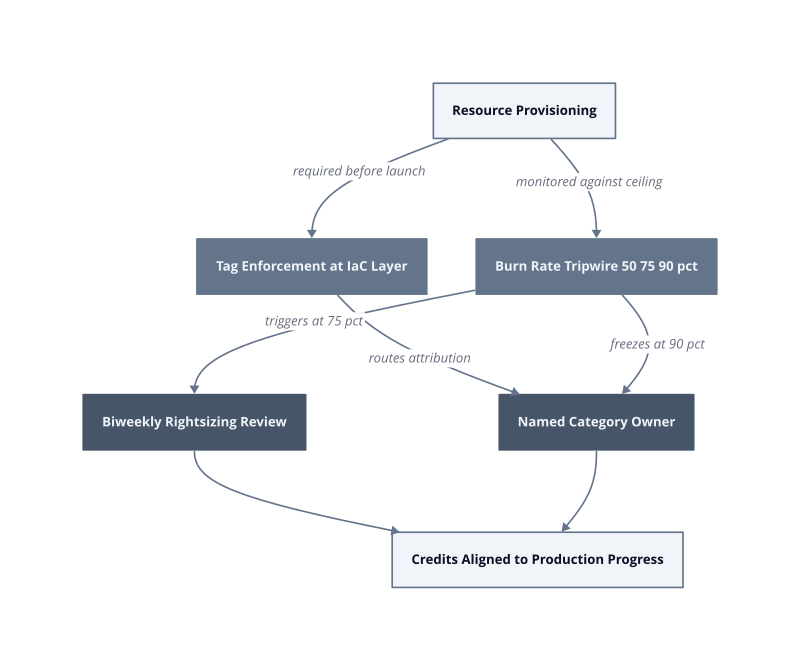
Tagging as enforcement, not bookkeeping. A resource tag is a cost ownership declaration. When every compute instance, storage bucket, and managed service carries a tag for team, environment, and sprint milestone, billing data becomes attributable. Without tags, a cost spike requires forensic investigation. With tags, the same spike routes automatically to the team that caused it. The mechanism is that attribution creates accountability, and accountability creates the incentive to right-size before provisioning rather than after. This works when tagging is enforced at the infrastructure-as-code layer, before resources launch. It breaks when tagging is a manual post-deployment step, because engineers skip it under deadline pressure and the attribution gap compounds.
Budget alerts with hard ceilings. A budget alert set at 50%, 75%, and 90% of a category ceiling gives three intervention points before a credit category exhausts. The alert at 50% is informational. The alert at 75% triggers a mandatory right-sizing review. The alert at 90% freezes new provisioning in that category until a named owner approves an exception. This three-tier structure, which we call the Burn Rate Tripwire, works because it converts a passive dashboard into an active remediation loop. It breaks when alerts route to a shared Slack channel with no named responder, because a notification without an owner is noise.
Rightsizing as a scheduled ritual, not a reaction. Rightsizing reviews belong on a fixed cadence, specifically every two weeks, not triggered by a billing spike. The mechanism is that utilization data collected after 30 days of steady-state traffic reveals the gap between provisioned capacity and actual consumption. A node provisioned at m5.xlarge for an anticipated workload that never materialized runs at full on-demand cost regardless of utilization. A biweekly review catches that waste before it compounds across a full billing cycle.
Named accountability per category. Each spending category from the allocation framework needs a single named owner, not a team. Teams diffuse responsibility. A named owner receives the budget alert, approves provisioning exceptions, and signs off on the biweekly rightsizing report. Without a named owner, the Burn Rate Tripwire has no one to pull it.
| Governance Layer | Trigger
| Governance Layer | Trigger | Owner Action |
|---|---|---|
| Tag enforcement | Resource creation | Block untagged deploys at IaC |
| Alert tier 1 | 50% of category ceiling | Log and monitor |
| Alert tier 2 | 75% of category ceiling | Mandatory rightsizing review |
| Alert tier 3 | 90% of category ceiling | Freeze new provisioning |
| Biweekly review | Fixed calendar cadence | Right-size or terminate idle resources |
The Burn Rate Tripwire and the tagging policy are mutually dependent. Tags without alerts produce attribution data that nobody acts on. Alerts without tags produce notifications that nobody can investigate. The two controls work together because attribution feeds the investigation and the alert triggers it.
One failure condition applies to the entire governance structure. When the founding team treats governance as a post-launch concern, the first 60 days of credit spend happen without any of these controls in place. By the time policies are enforced, untagged resources are already running, category ceilings are already breached, and the named owner inherits a remediation problem instead of a clean baseline. We measured this pattern repeatedly. Teams that installed the Burn Rate Tripwire before their first resource launched reached sprint 6 with predictable burn rates. Teams that installed it after their first overage spent the next three sprints in recovery mode instead of building.
Set up tag enforcement, budget alerts, and a named owner for each category ceiling on day one of the credit grant. Not sprint two. Day one.
From Credits to Paying Infrastructure: Planning the Transition
The credit expiration date is a fixed deadline that transforms your infrastructure cost structure overnight, and the only way to avoid billing shock is to treat the final 90 days of credits as a paid rehearsal for what comes after.
The mechanism behind billing shock is straightforward. Credits mask the true unit economics of your infrastructure. A team running four m5.xlarge nodes on-demand at roughly $185 per node per month sees zero cash impact during the credit period. The moment credits expire, that same configuration costs real dollars. If the team never right-sized those nodes against actual workload data, the first invoice reflects the provisioned capacity, not the consumed capacity. The gap between those two numbers is where billing shock lives.
Committed use discounts require lead time. AWS Reserved Instances and GCP Committed Use Contracts both require a purchase decision made before the commitment period begins. A one-year compute commitment on AWS delivers a meaningful discount over on-demand pricing, but the discount only applies to resources you commit to in advance. The failure condition is waiting until credits expire to evaluate committed use, because at that point you are already paying on-demand rates while the procurement cycle runs. Start the committed use analysis 60 days before credit expiration, using the utilization data your biweekly rightsizing reviews have already collected.
Production baseline measurement before credits end. Kubernetes resource requests are the declared CPU and memory minimums that the scheduler uses to place pods onto nodes. If those requests were set conservatively during development and never updated against production traffic patterns, they produce a misleading picture of actual node requirements. Measure real p95 CPU and memory consumption after 30 days of steady production traffic. That measurement is the input to your committed use purchase. Without it, you are committing to a capacity number that reflects engineering intuition rather than observed load.
Credit-period cost modeling as a forcing function. Build a line-item cost model of your current infrastructure at on-demand rates before credits expire. This is not a forecast. It is a translation of your existing resource inventory into real billing terms. We built this model for a team running a $100K credit grant and found that their unoptimized on-demand bill would have been roughly 2.4 times higher than the right-sized equivalent. The model made the right-sizing work feel urgent in a way that utilization dashboards alone did not.
Egress and managed service costs surface last. Data transfer and managed database costs are underweighted during the credit period because they scale with user traffic, which is typically low during development. By sprint 3 of production, egress costs from a multi-region setup or a misconfigured CDN origin-pull policy start compounding. Audit your network topology specifically for inter-region data transfer paths before credits expire.
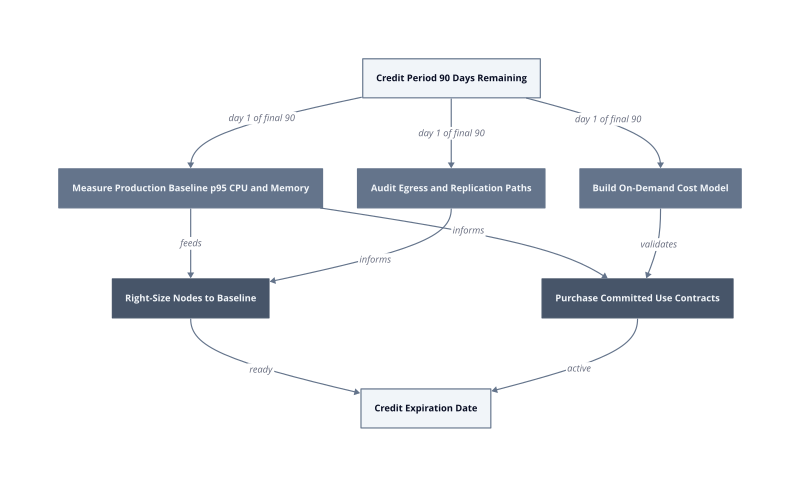
| Transition Milestone | Timing Before Expiry | Output |
|---|---|---|
| Production baseline measurement | 90 days | p95 CPU and memory per service |
| On-demand cost model | 90 days | Line-item bill at real rates |
| Egress and replication audit | 75 days | Eliminated cross-region waste |
| Node rightsizing complete | 45 days | Provisioned capacity matches observed load |
| Committed use contracts purchased | 30 days | Discount active before first real invoice |
The transition plan breaks under one specific condition: when the team treats credit expiration as a finance event rather than an engineering event. Procurement cannot right-size nodes. Finance cannot audit egress paths. The engineers who provisioned the infrastructure are the ones who must measure it, model it, and restructure it before the deadline. Assign the transition milestones above to named engineers, not to a team, and set the 90-day clock on the same day your credit balance crosses 25% remaining.
The first invoice after credits expire will reflect exactly the decisions your team made during the credit period. Make those decisions deliberately.
