
OpenShift Belongs in the Same Kubernetes Inventory as EKS and AKS
ROSA is invisible to the AWS APIs that discover EKS, so it drops out of inventory and every policy inventory feeds. One cluster list fixes that.
zopdev writing tagged gcp. Engineering and FinOps notes, post-mortems, and benchmarks.
ROSA is invisible to the AWS APIs that discover EKS, so it drops out of inventory and every policy inventory feeds. One cluster list fixes that.

Cloud pricing pages are built to sell compute and storage. Every other charge is buried.
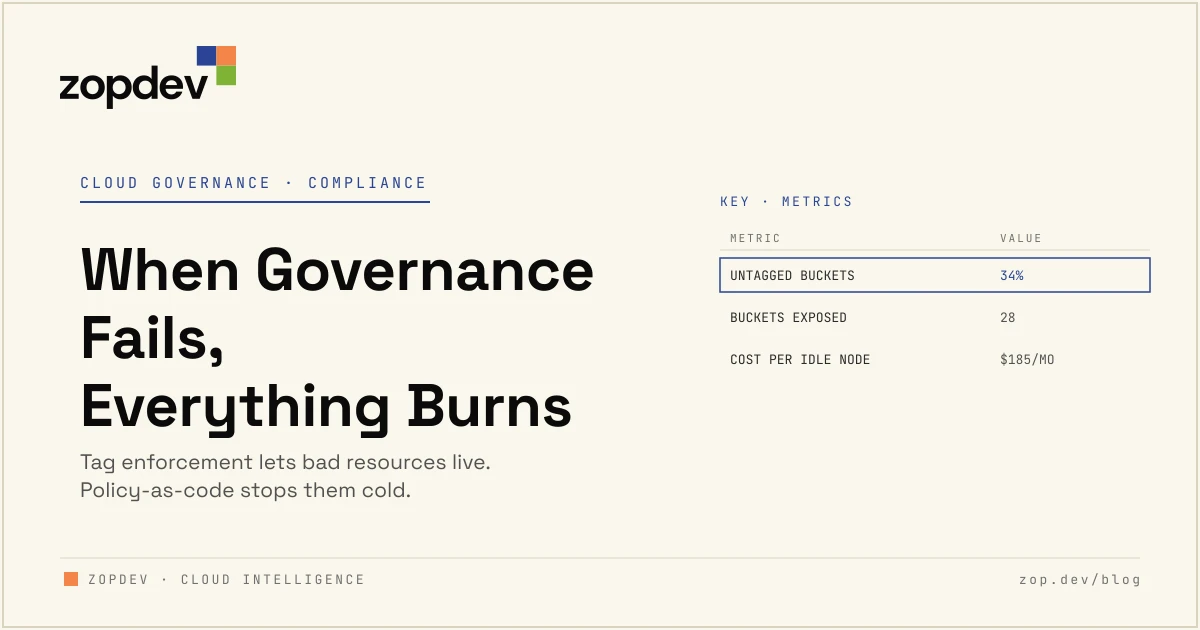
Governance failures in cloud environments do not fail quietly. They propagate. A single misconfigured IAM role, an untagged production bucket, or an overly permissive network policy does not stay…

Cloud credits mask structural waste, and the bill that arrives after they expire reflects months of decisions made without cost accountability. This is the credit cliff: the moment a startup's…

Free cloud credits do not reduce your infrastructure costs. They defer them, invisibly, until expiration forces a full-price reckoning on a codebase that was never designed with billing in mind.

Cloud credits expire. That is the mechanism that turns a $100K grant into a liability. Cloud providers structure these programs with hard expiration dates because free compute that converts to paid…

Cloud inventory has a blind spot nobody notices, because you cannot see what it never recorded.

Ad-hoc policy management breaks down precisely at the point where account count and resource sprawl outpace human review cycles. Below 50 resources across two or three accounts, a shared spreadsheet…

Egress charges are structurally invisible in most cloud billing workflows, and that invisibility is expensive. The clearest proof: $28,000 per month in egress costs were approved without explicit…

The free-credit expiration is not a billing event. It is a systems failure that was designed into the architecture from day one.

Cloud cost optimization fails because teams treat it as a project with a finish line, not a process with a heartbeat. The moment a team declares victory after a reservation purchase or a rightsizing…

Cloud providers price egress and API calls in ways that guarantee the invoice will not match the estimate. This is not an accident. The mechanism is structural: compute and storage costs appear…

Cloud pricing pages are a selection effect, not a disclosure. Providers surface compute and storage rates because those numbers are competitive and comparable. Egress fees, support tiers, and…

The pricing page is a cost floor, not a cost forecast. AWS, Azure, and GCP publish per-unit rates for compute, storage, and managed services. Those rates are accurate. The problem is that they…
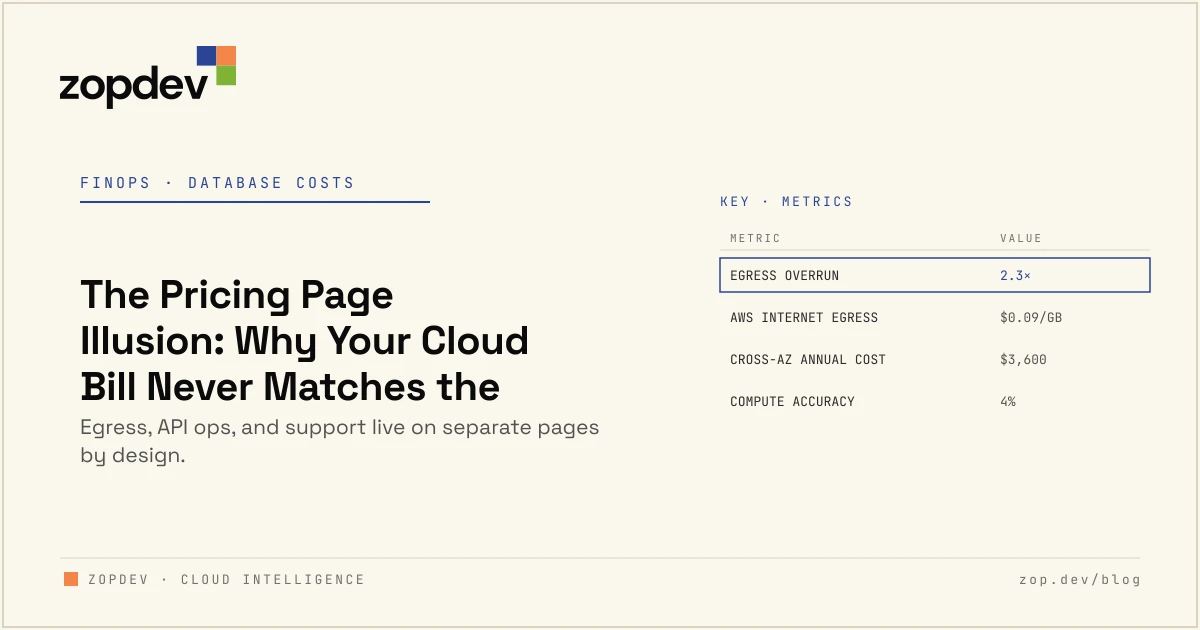
Cloud provider pricing pages are built to sell compute and storage, not to reveal what your workload actually costs in production. The headline numbers, virtual machine rates, object storage per GB,…

Databricks is one of the largest and most opaque line items on a data team's cloud bill. It is also one of the few that genuinely spans clouds: the same platform runs on AWS, Azure, and GCP, often…

Vertex AI cost sprawls across endpoints, notebooks, feature stores, and jobs. The worst offenders have no off switch. FinOps starts with finding them all.

A cross-cloud IAM

AI assistants now connect to cloud cost infrastructure in 5 minutes, transforming how engineering teams query spending data. Claude Fable wires to cloud cost data via ZopNight in 5 minutes (ZopDev…

A team provisions a Cloud SQL Postgres instance in one GCP VPC and wants to connect it to a GKE cluster in a different VPC. The team's instinct, learned from AWS habits, is to set up VPC peering…
One post a week. Sundays. No "10 ways to think about cloud" listicles, just the engineering and FinOps notes we'd want to read.
See. Find. Fix. Automatic.
Connect your first cloud account in under 5 minutes. See your first remediation in under 7. No credit card required.