
The Policy-as-Code Decision That Doesn't Bite You Until Later
The policy-as-code choice between OPA and Cedar feels low-stakes at ten accounts. It stops feeling that way at 500.
zopdev writing tagged cloudgovernance. Engineering and FinOps notes, post-mortems, and benchmarks.
The policy-as-code choice between OPA and Cedar feels low-stakes at ten accounts. It stops feeling that way at 500.

A pasted access token is identical in every assistant that holds it. OAuth consent gives each one its own revocable grant, scoped to the orgs you pick.

Fourteen new MCP tools let an agent create, dry-run and manage IaC pull-request policies. The two withheld tools are the ones that bypass the gate.

ZopNight's MCP catalogue grew from 122 tools to 275, with 83 new writes. Every write clears four gates that can each refuse alone, across three tiers.

ROSA is invisible to the AWS APIs that discover EKS, so it drops out of inventory and every policy inventory feeds. One cluster list fixes that.

ZopNight removed the frontend gate blocking capabilities your role lacks. Enforcement was always at the gateway, so the decision moved to call time.

ZopNight re-reads the resource a finding fired on before closing it. All 264 rules that can raise a recommendation now carry a verification path.

Tag apply on AWS went from 21 resource types to 36. The work was refusing to build an ARN the platform could not prove pointed at the right resource.

Cost history must outlive the resource that created it. That principle sounds obvious until you watch a deleted API key take three months of spend attribution with it into the void.

An AI assistant connected to your infrastructure through MCP reads far more than it writes. It checks a resource's state, looks up a cost figure, or lists a team's permissions many times over for…

Policy as Code works cleanly until it meets ten teams, and then it breaks in ways the pilot never predicted. The first three months feel like a governance win. Policies deploy, violations get caught,…

Cloud bills do not lie, but they do surprise. The $28,000 per month in shadow compute charges that accumulated without a single approval signature is not an anomaly. It is the predictable output of a…

The credit cliff kills runway not because cloud bills grow, but because the pricing environment changes completely the moment credits expire.

Cloud pricing pages are built to sell compute and storage. Every other charge is buried.
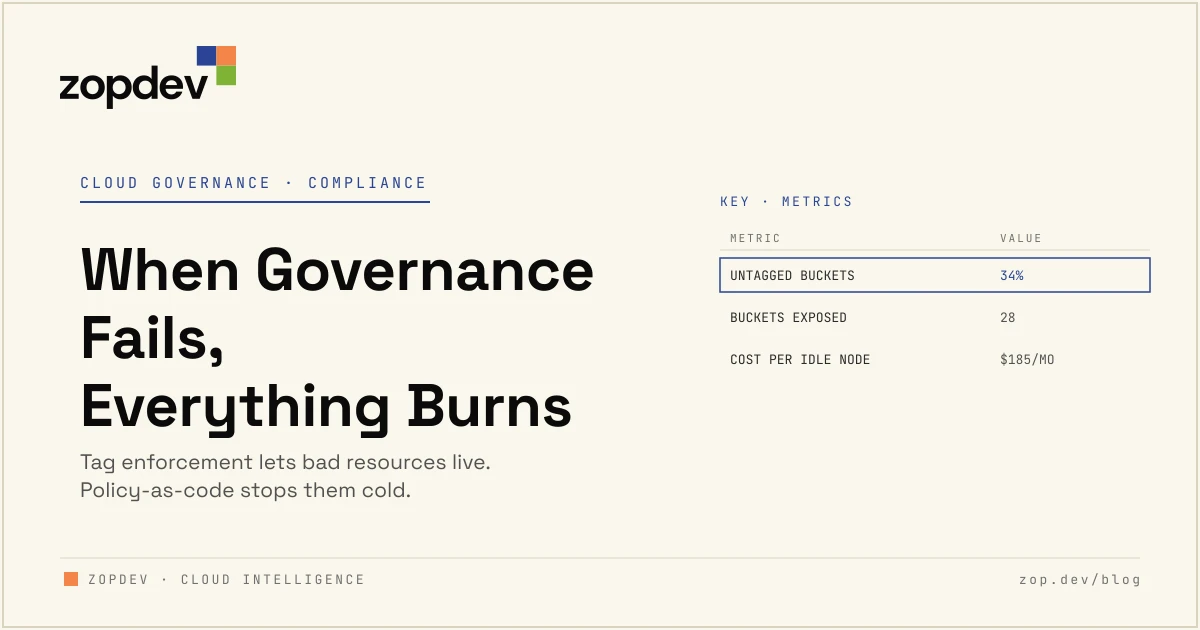
Governance failures in cloud environments do not fail quietly. They propagate. A single misconfigured IAM role, an untagged production bucket, or an overly permissive network policy does not stay…

HashiCorp's August 2023 switch from the Mozilla Public License to the Business Source License forced every infrastructure team running Terraform to make a governance decision they had not budgeted…

At 500 managed resources, infrastructure drift stops being a maintenance nuisance and becomes a misdiagnosis engine that corrupts incident response at the root.

Every time a team ships before governance is ready, they do not pay once. They pay every quarter the gap stays open.

Cloud credits mask structural waste, and the bill that arrives after they expire reflects months of decisions made without cost accountability. This is the credit cliff: the moment a startup's…

Tags are the join key of cloud governance.

At 500 Terraform resources, the bottleneck is never Terraform. It is the organization running it.

Autonomous remediation systems promise to eliminate toil, but the mechanism that removes human latency also removes human judgment, and that trade produces a specific failure class: the…

HashiCorp's August 2023 relicensing of Terraform from MPL-2.0 to the Business Source License 1.1 was not a routine legal update. It was a governance event that forced every infrastructure team to…

Manual policy enforcement breaks at infrastructure scale because the number of enforcement decisions grows faster than the number of resources. A team managing 50 resources reviews policy by…

Cloud inventory has a blind spot nobody notices, because you cannot see what it never recorded.

Visibility without a remediation path saves exactly $0, and we measured this directly: after 6 months of dashboard investment, cloud spend was unchanged (ZopDev, "The Visibility Trap: $0 Saved After…

Cloud cost optimization fails because teams treat it as a project with a finish line, not a process with a heartbeat. The moment a team declares victory after a reservation purchase or a rightsizing…

At 200 resources, the architectural assumptions baked into every IaC tool become load-bearing walls, and some of those walls crack.

Prompt engineering entered DevOps not as an experiment but as a pressure valve: teams shipping faster than their tooling could support needed a way to extract precise, repeatable outputs from AI…

The pipeline itself is not the risk. The risk is the gap between what the pipeline assumes is true and what is actually true in the environment it deploys into.

HashiCorp's August 2023 switch from the Mozilla Public License 2.0 to the Business Source License 1.1 drew a hard line between commercial and community use of Terraform, and that line fractured a…

Every cloud-native team building observability at scale hits the same three-way constraint: you cannot simultaneously maximize platform capability, minimize cost, and keep operational complexity low.…

HashiCorp's August 2023 relicense of Terraform from MPL-2.0 to the Business Source License forced every infrastructure team to make a governance decision, not a technical one.

Cloud cost optimizations degrade predictably after implementation, and the degradation is structural, not accidental. Every manual FinOps cycle produces a point-in-time snapshot of savings. The…

Most FinOps teams track one number when they need two, and that single blind spot turns cost governance into a cleanup exercise instead of a control system.

Platform engineering teams are paying $180,000 per year in duplicate tooling costs without a line item that names it (ZopDev, "The IDP Tax"). That cost has a name: the IDP tax. It accumulates because…

Most IDPs ship as friction-reducers and land as a new category of sprint tax. The promise is a self-service portal that abstracts infrastructure complexity. The reality, in production, is a platform…

HashiCorp's August 2023 license change from MPL-2.0 to the Business Source License forced every team running Terraform in production to make a governance decision they had not budgeted for. The BSL…

Cloud cost optimizations expire. Not because engineers lose discipline, but because the infrastructure beneath every savings decision keeps moving. New services launch, teams grow, deployment…

Every FinOps initiative follows the same arc: a burst of recoverable savings in the first weeks, then a structural decay that accelerates past month 3 (ZopDev, "Why FinOps Savings Decay Faster After…

Commitment-based cloud savings decay by 18% within four months of purchase, and that decay is not a surprise outcome. It is the predictable result of treating a purchasing decision as a finished task…

IaC tools built for single-team deployments fail structurally at 200 accounts because the failure modes are architectural, not configurational.

Every runbook your team executes manually is an open automation ticket that nobody filed. That is the central problem. The runbook library is not documentation. It is a backlog in disguise, and most…

Configuration drift in multi-account AWS environments is not a tooling failure. It is a structural consequence of per-account manual governance, and the only durable fix is centralized Policy-as-Code.

Cloud infrastructure pricing forces a binary choice: lock in capacity at a fixed discount or chase maximum savings with no guarantees. Commitment discounts deliver predictable costs by reserving…

Ticket-based infrastructure workflows inject a minimum three-day delay into every deployment cycle because each request moves through a queue where a centralized team must interpret, validate, and…

Building an Internal Developer Platform for 12 teams costs $400,000 (Platform Engineering for 12 Teams: The $400k IDP Bill), and understanding where that money goes determines whether you build or…

Traditional cloud alerting creates more work than it prevents because engineers spend 60-90 minutes per day triaging notifications that describe problems without fixing them. The mechanism is…
One post a week. Sundays. No "10 ways to think about cloud" listicles, just the engineering and FinOps notes we'd want to read.
See. Find. Fix. Automatic.
Connect your first cloud account in under 5 minutes. See your first remediation in under 7. No credit card required.