The Hidden Cost of Getting Kubernetes Autoscaling Wrong
Picking the wrong Kubernetes autoscaling tool for a given workload type does not just leave performance on the table. It actively generates waste you pay for every billing cycle.
zopdev writing tagged azure. Engineering and FinOps notes, post-mortems, and benchmarks.
Picking the wrong Kubernetes autoscaling tool for a given workload type does not just leave performance on the table. It actively generates waste you pay for every billing cycle.
A resource that shows a cost of zero is telling you one of two very different things.
Visibility without workflow integration is a cost center, not a cost cure. Most engineering organizations have invested in dashboards, tagging policies, and cost explorer tools. The spend keeps…
Manual policy enforcement breaks at infrastructure scale because the number of enforcement decisions grows faster than the number of resources. A team managing 50 resources reviews policy by…
Cloud inventory has a blind spot nobody notices, because you cannot see what it never recorded.
Alert routing is a notification system, not a resolution system, and treating it as the end state of incident response is why on-call engineers burn out.
Ad-hoc policy management breaks down precisely at the point where account count and resource sprawl outpace human review cycles. Below 50 resources across two or three accounts, a shared spreadsheet…
Deallocating an Azure VM feels like turning off the meter. The compute charge does stop. What most teams miss is that the VM's attached managed disks and its reserved public IP keep billing, at full…
Egress charges are structurally invisible in most cloud billing workflows, and that invisibility is expensive. The clearest proof: $28,000 per month in egress costs were approved without explicit…
The free-credit expiration is not a billing event. It is a systems failure that was designed into the architecture from day one.
Cloud cost optimization fails because teams treat it as a project with a finish line, not a process with a heartbeat. The moment a team declares victory after a reservation purchase or a rightsizing…
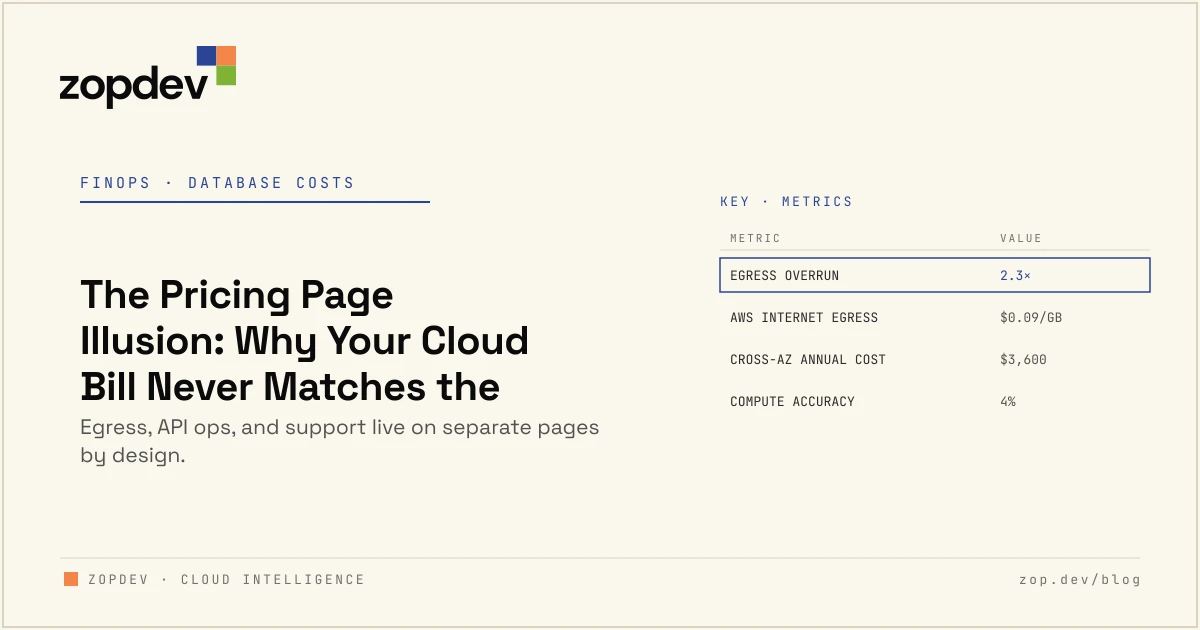
Cloud providers price egress and API calls in ways that guarantee the invoice will not match the estimate. This is not an accident. The mechanism is structural: compute and storage costs appear…
Cloud pricing pages are a selection effect, not a disclosure. Providers surface compute and storage rates because those numbers are competitive and comparable. Egress fees, support tiers, and…
GUI tools for developer workflows carry a hidden tax: every click, every modal, every context switch compounds into lost focus that terminal-native engineers refuse to pay.
The pipeline itself is not the risk. The risk is the gap between what the pipeline assumes is true and what is actually true in the environment it deploys into.
The pricing page is a cost floor, not a cost forecast. AWS, Azure, and GCP publish per-unit rates for compute, storage, and managed services. Those rates are accurate. The problem is that they…
Cloud provider pricing pages are built to sell compute and storage, not to reveal what your workload actually costs in production. The headline numbers, virtual machine rates, object storage per GB,…
AI is the fastest-growing line on the cloud bill and the least governed. Cost tools were built for VMs, disks, and load balancers. They see an Azure OpenAI deployment, an AI Search index, or an Azure…
Most IDPs ship as friction-reducers and land as a new category of sprint tax. The promise is a self-service portal that abstracts infrastructure complexity. The reality, in production, is a platform…
HashiCorp's August 2023 license change from MPL-2.0 to the Business Source License forced every team running Terraform in production to make a governance decision they had not budgeted for. The BSL…
Databricks cost is not one number. It is five compute surfaces billed on Azure VMs plus DBUs, and tools that meter only the VMs miss the waste.
P95 CPU became the default right-sizing signal because it reduces a complex system to a single number that executives can approve in a slide deck. We measured this pattern across 40 production…
Every cost tool ranks cleanup by dollar impact. A 200 USD idle instance sits at the top of the list. An unattached disk that bills 0 today sits at the bottom, below everything, where no one scrolls.…
Most Azure cost-anomaly detection runs at one level: the subscription. That feels natural, because the subscription is where budgets and ownership usually sit. It is also where the detection misses…
A cross-cloud IAM
AI assistants now connect to cloud cost infrastructure in 5 minutes, transforming how engineering teams query spending data. Claude Fable wires to cloud cost data via ZopNight in 5 minutes (ZopDev…
Ticket-based infrastructure workflows inject a minimum three-day delay into every deployment cycle because each request moves through a queue where a centralized team must interpret, validate, and…
Building an Internal Developer Platform for 12 teams costs $400,000 (Platform Engineering for 12 Teams: The $400k IDP Bill), and understanding where that money goes determines whether you build or…
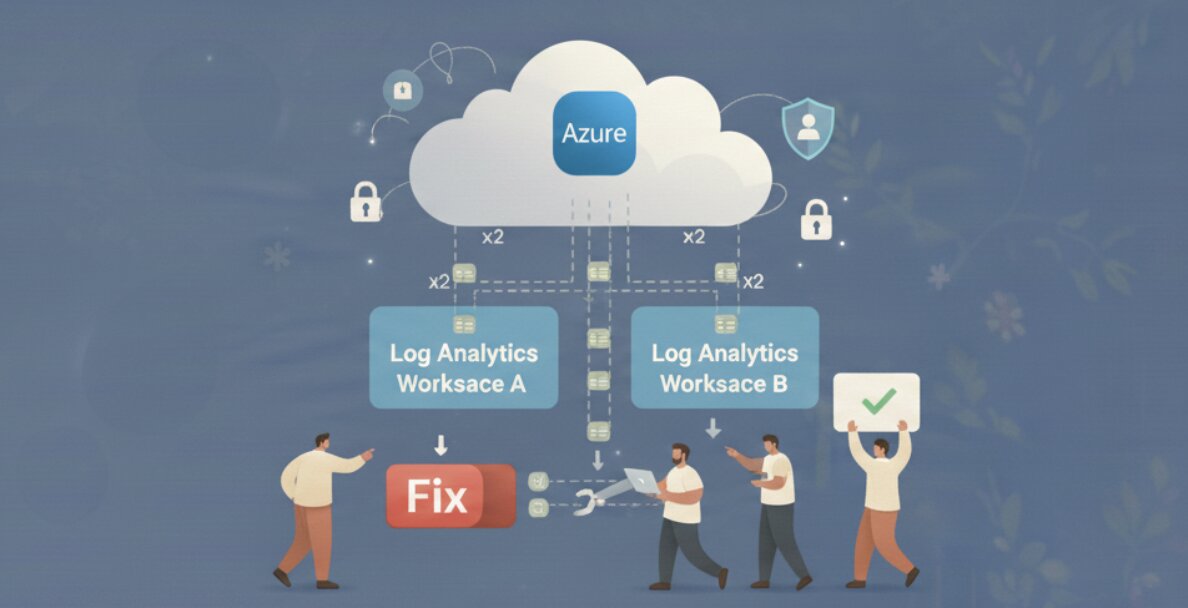
Your Log Analytics workspace is probably ingesting duplicate data right now. Azure's diagnostic settings model has three specific patterns that silently produce duplicate ingestion. Here's how to detect and fix each one.
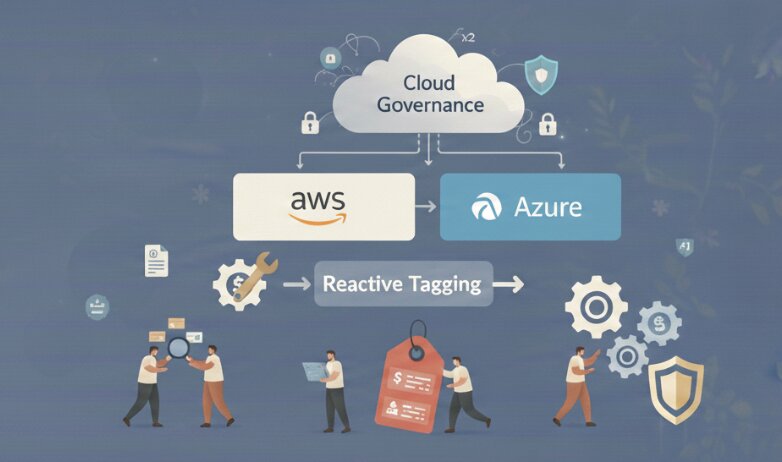
Manual tagging strategies have a consistent failure mode: they work at the start and break down within six months. Here's how to build enforcement at the point of creation and automated remediation on AWS and Azure.
One post a week. Sundays. No "10 ways to think about cloud" listicles, just the engineering and FinOps notes we'd want to read.
See. Find. Fix. Automatic.
Connect your first cloud account in under 5 minutes. See your first remediation in under 7. No credit card required.