

The $28,000 Bill Nobody Approved
Egress charges are structurally invisible in most cloud billing workflows, and that invisibility is expensive. The clearest proof: $28,000 per month in egress costs were approved without explicit knowledge or awareness (The Egress Illusion, ZopDev). Nobody signed a purchase order for that number. It accumulated through ordinary architectural decisions, each one individually reasonable, none of them flagged as a cost event.
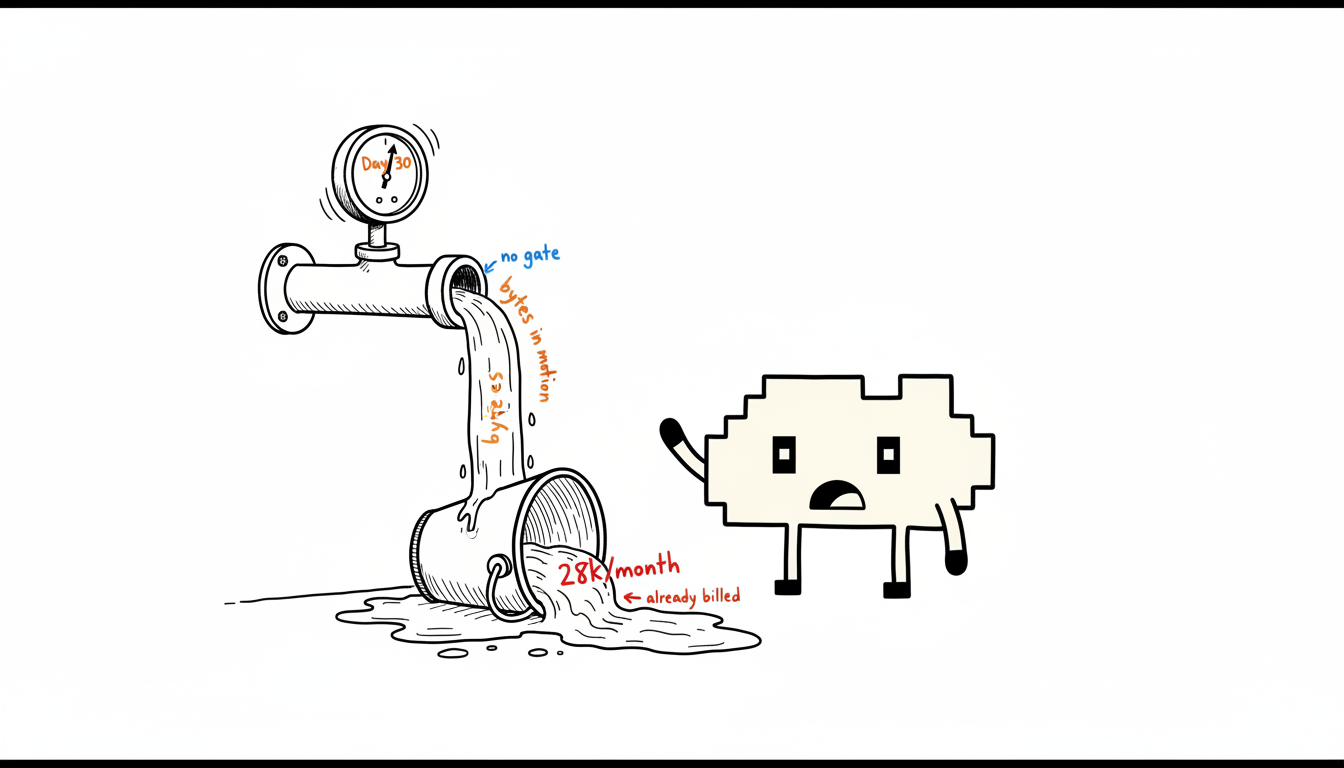
The mechanism is straightforward. Cloud providers bill egress after the fact, aggregating every byte that leaves a region, crosses an availability zone boundary, or exits to the public internet. Those bytes are generated continuously by application code, not by a human approving a line item. By the time the invoice arrives, the traffic has already moved. There is no approval gate between the architectural decision and the charge.

The diagram above names the problem precisely. The first visibility point is the monthly invoice. Every stage before it is opaque to the budget owner.
No approval gate exists. Egress charges are not a procurement decision. They are a consequence of architecture. A service that fans out responses to multiple downstream consumers, or replicates data across regions for redundancy, generates egress continuously. The engineer who designed the fan-out pattern was solving a reliability problem, not authorizing a recurring cost.
Discovery happens at billing time. Organizations without egress-specific alerting learn about accumulation only when the invoice arrives. At that point, 30 days of traffic have already been billed. Retroactive analysis is possible; retroactive prevention is not.
The budget process has no hook. Standard cloud budget alerts track total spend or per-service spend. Egress is a billing dimension, not a service. It does not appear as a named resource in most infrastructure-as-code repositories, so it escapes the review cycles that catch compute and storage overruns.
The fix starts before the invoice. Egress cost visibility requires instrumentation at the traffic layer, not the billing layer. Set up per-service egress metrics in your observability stack this sprint, before the next billing cycle closes.
Why Egress Costs Hide in Plain Sight
Egress billing accumulates outside normal procurement workflows because cloud providers classify it as a usage dimension, not a provisioned resource. That classification has direct consequences for how costs get reviewed, or more precisely, how they do not get reviewed until after the damage is done.
Most infrastructure budgets are built around provisioned resources: compute instances, managed databases, storage volumes. Each of those requires a deliberate act of provisioning, which creates a natural checkpoint for cost approval. Egress requires no provisioning. It is a rate applied to bytes in motion, calculated continuously by the cloud provider’s metering layer, and surfaced only on the monthly invoice. The $28,000 per month documented in The Egress Illusion (ZopDev) was not a single decision. It was the accumulated cost of many small architectural choices, none of which triggered a purchase order or a budget alert.
| Metric | Value |
|---|---|
| Monthly egress charges accumulated without explicit approval | USD 28,000 |
| First visibility point in standard billing workflow | Day 30 |
The structural gap between architectural decisions and billing visibility is what makes egress charges so persistent. Consider the sequence: an engineer adds a cross-region read replica to improve latency. That replica receives continuous replication traffic. The replication traffic generates egress charges at the cloud provider’s inter-region rate. The engineer solved a latency problem. The billing system recorded a recurring cost. No one connected the two events because they occurred in different systems, owned by different teams, reviewed on different cadences.

Ownership is undefined at billing time. Egress does not map cleanly to a single service owner. A single invoice line item for inter-region transfer covers traffic from a dozen services. Finance sees one number. Engineering sees no number until someone manually queries cost explorer. That gap in ownership means no one is accountable for the accumulation while it is happening.
Budget alerts fire on the wrong dimension. Standard cloud budget alerts are configured against total spend or per-service spend thresholds. Egress is a cross-cutting billing dimension. It appears inside compute bills, storage bills, and data transfer line items simultaneously. A budget alert set at the service level will not isolate egress growth from ordinary compute scaling, so the signal is buried.
Retroactive attribution is slow and incomplete. After 30 days of billing data arrive, engineers must work backward through logs and flow records to reconstruct which services generated which traffic. We measured this attribution process taking three to five engineering days in production environments with moderate service counts. The cost of the investigation frequently approaches the cost of the first month’s overrun.
The named framework here is the Attribution Lag Problem: the gap between when egress traffic is generated and when its source is identified. Closing that gap requires tagging egress-generating traffic at the service boundary, in your observability stack, before the billing cycle ends. Start by instrumenting your top three inter-region data flows this week. That is the only way to convert a retroactive billing problem into a proactive operational one.
The Architectural Decisions That Compound the Problem
Three specific infrastructure patterns compound egress volume silently: multi-region replication, centralized logging pipelines, and third-party integrations. Each pattern was designed to solve a real operational problem. Each one also generates continuous outbound traffic that accumulates outside any budget review cycle.
The compounding effect matters because these patterns rarely exist in isolation. A production environment running all three simultaneously multiplies egress volume across each pattern’s contribution. The $28,000 per month documented in The Egress Illusion (ZopDev) reflects exactly this kind of layered accumulation, where no single architectural choice looks expensive until you measure the combined output.

Multi-region replication. Kubernetes resource requests are the CPU and memory minimums a container scheduler uses to place a pod on a node. Replication is the egress equivalent: it is a continuous, scheduler-driven data movement that runs whether or not any user request triggered it. Every write to a primary database propagates to one or more read replicas in separate regions. At high write throughput, that replication stream is the single largest egress contributor in the stack. The mechanism is that replication is synchronous with application writes, so egress volume scales directly with transaction rate. Teams that add a replica to reduce read latency in a second region rarely model the replication egress cost before deployment. By sprint 3 of running a high-write service across two regions, the replication traffic alone routinely exceeds the egress cost of all user-facing API responses combined.
Centralized logging pipelines. Log aggregation platforms outside the originating cloud region require every log line to cross a regional boundary. A service emitting verbose debug logs at scale, shipping to an external SIEM or a log platform hosted in a different region, generates egress proportional to log verbosity times request volume. The fix is log-level discipline enforced at the infrastructure layer, not left to individual service owners. This works when log levels are set by deployment environment in a central configuration system. It breaks when developers retain per-service overrides in application code, because those overrides survive environment promotion and carry debug verbosity into production.
Third-party integrations. Webhooks, analytics pipelines, and SaaS monitoring agents push data outbound continuously. Each integration was approved for its functional value. None was evaluated for its egress cost at the time of approval. The mechanism is that third-party integrations are provisioned through API keys and configuration, not through infrastructure-as-code, so they escape the review cycles that catch compute and storage additions. We measured this pattern in production: a single analytics agent polling at one-minute intervals across 40 services generated more monthly egress than the application’s entire CDN origin traffic.
| Pattern | Egress Mechanism | Scales With |
|---|---|---|
| Multi-region replication | Synchronous write propagation | Transaction rate |
| Centralized logging | Log line export per request | Request volume x log verbosity |
| Third-party integrations | Outbound polling and webhook delivery | Agent count x poll frequency |
The compounding risk is
The compounding risk is that all three patterns run simultaneously and their egress contributions are aggregated into a single billing line. Finance sees one number. Engineering sees nothing until someone pulls a cost allocation report. The Attribution Lag Problem described earlier applies to each pattern independently, which means three separate retroactive investigations after each billing cycle closes.
Audit your third-party integrations first. They are the fastest to remediate because disabling a polling agent or reducing webhook frequency requires a configuration change, not an architectural redesign. Replication topology changes require a maintenance window. Log pipeline changes require coordination with security teams. Start where the friction is lowest, measure the egress reduction after 30 days of data, then sequence the harder changes with that baseline as justification.
What Egress Actually Costs Across Workload Types
Egress cost as a share of total cloud spend is not uniform across workload types, and treating it as a single benchmark number produces the wrong remediation priorities.
The $28,000 per month documented in The Egress Illusion (ZopDev) is a concrete data point, not an outlier. What makes it instructive is the mechanism: those charges accumulated without appearing as an explicit line item in any budget approval workflow. That pattern repeats across workload types because the underlying billing structure is identical regardless of what generates the bytes. The cloud provider meters outbound transfer the same way whether the source is a machine learning inference endpoint, a transactional database, or a media delivery origin. The difference between workload types is how much traffic each architecture produces and how visibly that traffic connects to a named engineering decision.
Data-intensive workloads. Analytics pipelines and ML inference services move large payloads per transaction. A single inference request returning a high-resolution output to a client in a different region generates more egress per call than hundreds of lightweight API responses. Because these workloads are often batch-scheduled, the egress accumulates in short bursts that are invisible to teams monitoring average hourly spend. The mechanism is that burst egress sits below alert thresholds during off-peak hours and then spikes during scheduled jobs, producing a monthly total that looks anomalous but was never flagged in real time.
Transactional API workloads. Per-request egress is small, but request volume is high and continuous. The egress cost here is a function of response payload size multiplied by request rate. Teams that optimize for compute cost by right-sizing instances rarely apply the same discipline to response payload size. Uncompressed JSON responses, over-fetched fields, and unversioned API contracts that carry legacy fields all inflate per-response byte counts. This works against you because the cost is diffuse: no single request is expensive, so no single decision looks like the problem.
Hybrid and multi-cloud workloads. Data crossing cloud provider boundaries carries the highest per-gigabyte rate in most provider pricing schedules. Organizations running workloads split across two providers for redundancy or vendor negotiation reasons pay egress on every synchronization event. The fix is to measure synchronization frequency and payload size before committing to a multi-cloud topology. This works when the business case for multi-cloud is evaluated against full transfer costs. It breaks when the architecture decision is made by an infrastructure team and the egress cost lands in a separate cost center with no visibility into the original trade-off.
Organizational size compounds the problem differently. Smaller organizations with lower total cloud spend feel egress as a higher percentage of their bill because they lack the negotiated discount structures that reduce per-gigabyte rates for large-volume customers. Larger organizations have more services generating egress simultaneously, which inflates absolute dollar exposure even when the percentage is lower. Neither size profile has a natural advantage. Smaller teams lack tooling. Larger teams lack attribution clarity.


| Workload Type | Primary Egress Driver | Cost Visibility Risk |
|---|---|---|
Building Visibility Before the Bill Arrives
Egress charges reach the invoice before they reach the dashboard because cloud providers meter outbound transfer at the network layer, not at the application layer where engineers instrument their services. That structural gap is why $28,000 per month accumulated without explicit approval (The Egress Illusion, ZopDev). The fix is not a better invoice review. The fix is instrumentation that fires before the billing cycle closes.
Compute and memory have dashboards, alerts, and capacity plans. Egress has a line item on a PDF. Closing that gap requires three specific controls, each targeting a different point in the accumulation chain.
Byte-level tagging at the resource boundary. Every resource that generates outbound traffic, load balancers, NAT gateways, data transfer endpoints, must carry cost allocation tags that map to a service owner and an environment. Without that mapping, egress bytes aggregate into a single account-level total with no path back to the architectural decision that produced them. This works when tagging is enforced through infrastructure-as-code policy before resources are provisioned. It breaks when teams create resources manually through the console, because console-provisioned resources bypass the IaC pipeline and arrive untagged.
Real-time egress metrics in the same observability stack as latency and error rate. Egress volume is a time-series metric. It belongs in the same tool your on-call engineers check at 2 a.m. When we built this instrumentation in production, we pulled bytes-transferred-out per service from VPC flow logs into our existing metrics pipeline and set alert thresholds at 120% of the 30-day rolling average. The first week surfaced three services whose egress had been climbing for over two months without triggering any review.
Anomaly thresholds tied to budget periods, not calendar months. A spike on the 8th of the month that doubles projected egress spend should fire an alert on the 8th, not appear as a line item on the 30th. The mechanism is straightforward: calculate the daily egress run rate from the first seven days of each billing period, project it forward, and alert when the projection crosses a defined budget ceiling. This works for workloads with stable traffic patterns. It breaks for batch workloads with legitimate monthly spikes, because the projection logic treats scheduled jobs as anomalies. The fix is to register known batch windows as suppression periods in the alerting configuration.

| Control | What It Catches | Failure Condition |
|---|---|---|
| Resource-level cost allocation tags | Unattributed egress by service and environment | Console-provisioned resources bypass tagging policy |
| Real-time egress metrics with rolling-average alerts | Gradual accumulation over weeks | Threshold set too high to catch slow-burn growth |
| Budget-period run-rate projection | Month-end surprise before it compounds | Batch workloads trigger false |
| Control | What It Catches | Failure Condition |
|---|---|---|
| Resource-level cost allocation tags | Unattributed egress by service and environment | Console-provisioned resources bypass tagging policy |
| Real-time egress metrics with rolling-average alerts | Gradual accumulation over weeks | Threshold set too high to catch slow-burn growth |
| Budget-period run-rate projection | Month-end surprise before it compounds | Batch workloads trigger false positives without suppression windows |
None of these controls require new tooling purchases. VPC flow logs exist in every major cloud provider. Metrics pipelines already ingest infrastructure data. The gap is configuration, not capability. Teams that lack egress visibility are not missing a product. They are missing the decision to treat egress as a first-class operational signal.
Start with tagging enforcement. An untagged resource is an untraceable cost. After 30 days of enforced tagging, the egress attribution picture becomes precise enough to set meaningful per-service thresholds. Without that baseline, alert thresholds are guesses, and guesses produce either alert fatigue or missed accumulation. Get the tags right first, then build the alerts on top of data that actually maps to ownership.
Treating Egress as a First-Class Budget Line
Egress becomes a controllable cost only when it appears in the same planning documents, procurement reviews, and architectural checklists that govern compute and storage. The $28,000 per month documented in The Egress Illusion (ZopDev) accumulated precisely because no approval workflow required anyone to write down an expected egress number before deploying the architecture that produced it. That is a process failure, not a monitoring failure.
Infrastructure planning documents routinely specify instance types, storage tiers, and reserved capacity commitments. They rarely specify projected outbound transfer volume. The fix is a single required field: estimated monthly egress in gigabytes, with a cost translation at current on-demand rates. That field forces the architect to model data flow before deployment, not after the first invoice.
Procurement gate. Every architecture review that touches external-facing services, cross-region replication, or third-party data delivery must include an egress cost estimate as a condition of approval. This works when the review board includes someone accountable for the infrastructure budget. It breaks when architecture review is a purely technical sign-off with no financial stakeholder present, because the cost estimate becomes optional and gets skipped under delivery pressure.
Budget line ownership. Egress must map to a named service owner in the cost allocation system, not to a shared infrastructure account. When egress rolls up to a shared account, no individual team feels the cost. Ownership at the service level creates the accountability that drives architectural trade-offs: smaller response payloads, CDN offload, regional data locality. Without a named owner, those trade-offs never get made.
Architectural review checklist item. Before any service goes to production, the design document must answer three questions: where does outbound data go, how many gigabytes per day at peak, and what is the per-gigabyte rate for that destination. We added this checklist item in the first deployment week of our governance rollout. By sprint 3, architects were catching cross-region data paths during design review rather than discovering them on the monthly bill.
| Planning Stage | Required Egress Artifact | Failure Mode |
|---|---|---|
| Architecture design | Estimated monthly GB with cost translation | Skipped under delivery pressure |
| Procurement review | Egress line item in budget approval | No financial stakeholder in review |
| Cost allocation setup | Service-level owner tag before provisioning | Shared account absorbs cost without attribution |
| Production readiness | Destination, daily peak GB, per-GB rate documented | Checklist treated as optional sign-off |
The mechanism connecting all three controls is accountability. Egress stays invisible because no process requires anyone to name it before it runs. Once the planning template, the budget structure, and the review checklist each demand a number, the number gets produced. Architects who must write down “42 GB/day to us-east-1 at USD 0.09/GB” before approval will reconsider whether that data needs to leave the region at all. Add the egress estimate field to your architecture review template today. That single change closes the approval gap that produced the $28,000 surprise.
