
The Policy-as-Code Decision That Doesn't Bite You Until Later
The policy-as-code choice between OPA and Cedar feels low-stakes at ten accounts. It stops feeling that way at 500.
zopdev writing tagged sre. Engineering and FinOps notes, post-mortems, and benchmarks.
The policy-as-code choice between OPA and Cedar feels low-stakes at ten accounts. It stops feeling that way at 500.

Policy as Code works cleanly until it meets ten teams, and then it breaks in ways the pilot never predicted. The first three months feel like a governance win. Policies deploy, violations get caught,…

Point-in-time benchmarks produce misleading Kubernetes cost comparisons because cluster behavior, workload patterns, and pricing all shift across a 12-month horizon in ways a single snapshot cannot…

Off-hours incidents expose a structural flaw in how engineering teams are staffed: human cognition degrades sharply after midnight, and every minute of that degradation has a direct dollar cost…

The credit cliff kills runway not because cloud bills grow, but because the pricing environment changes completely the moment credits expire.

Static runbooks fail at 3 AM not because engineers write them poorly, but because incidents refuse to follow the sequences those runbooks assume.

On-call engineers are routinely woken at 3am to execute the same five-step runbook they ran the night before, and the tooling to stop this pattern has existed in production environments for years.…

ZopNight's newest release notes open with a new feature: you can now migrate a database from one GCP Cloud SQL instance to another without leaving ZopDay, the Kubernetes platform ZopNight ships…
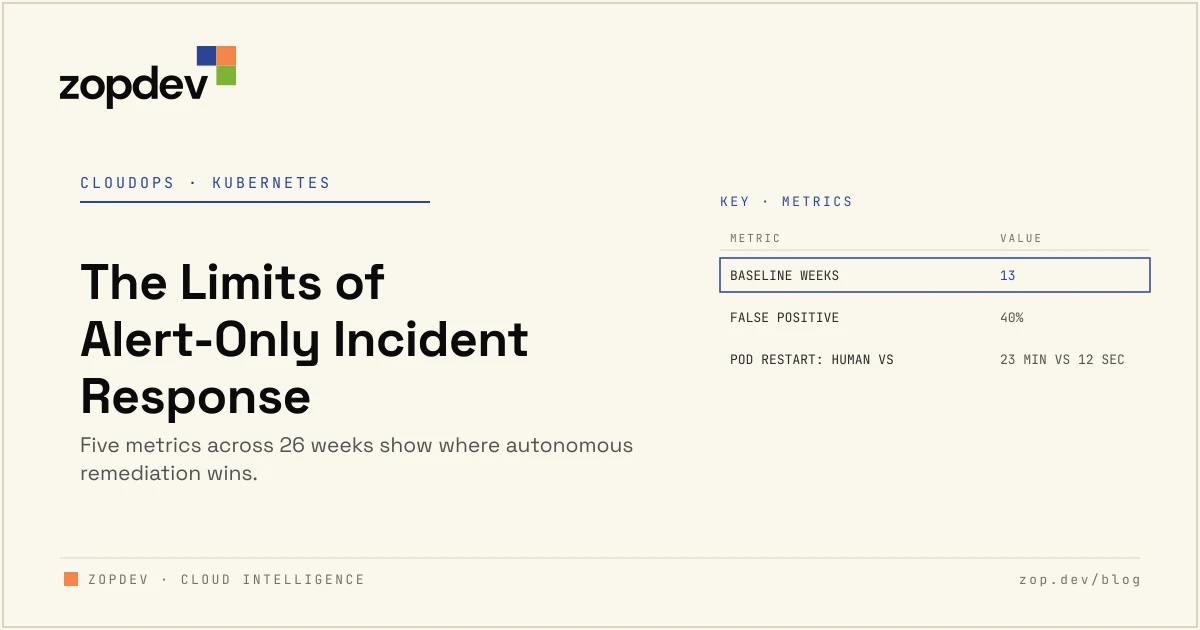
Alert-only incident response transfers the cost of every failure from the system to the engineer, and that transfer compounds at scale.

At 500 managed resources, infrastructure drift stops being a maintenance nuisance and becomes a misdiagnosis engine that corrupts incident response at the root.

Every time a team ships before governance is ready, they do not pay once. They pay every quarter the gap stays open.

Most AIOps implementations treat the "Act" phase as the finish line, and that architectural choice turns automated remediation into a liability rather than a guarantee.

A green dashboard is not evidence of a healthy system. It is evidence that your automation closed the tickets. These are different facts, and conflating them is how teams accumulate silent technical…

Cloud credits mask structural waste, and the bill that arrives after they expire reflects months of decisions made without cost accountability. This is the credit cliff: the moment a startup's…

A single production incident costs more than most engineering teams budget for the entire on-call program that prevents it. The $50,000 figure (ZopDev) is not a worst-case projection. It is a floor,…

Tags are the join key of cloud governance.

At 500 Terraform resources, the bottleneck is never Terraform. It is the organization running it.

A green dashboard is not proof of a healthy system. It is proof that your automation closed a ticket. Those two outcomes are not the same thing, and conflating them is how engineering teams…

Autonomous remediation systems promise to eliminate toil, but the mechanism that removes human latency also removes human judgment, and that trade produces a specific failure class: the…

Manual policy enforcement breaks at infrastructure scale because the number of enforcement decisions grows faster than the number of resources. A team managing 50 resources reviews policy by…

When an on-call engineer is your primary failure mitigation strategy, you have not built reliability. You have built a human circuit breaker that trips at 2 a.m.

Alert routing is a notification system, not a resolution system, and treating it as the end state of incident response is why on-call engineers burn out.

Alert-only monitoring does not reduce operational cost. It defers labor and compounds it.

AI Ops agents create a dangerous illusion: they close tickets fast, but they routinely fix the wrong thing first (ZopDev, "Why Your AI Ops Agent Fixes the Wrong Thing First").

A single bad deployment cost $180,000 not because the deployment was uniquely catastrophic, but because nothing in the system was configured to stop it from spreading (ZopDev, "Blast Radius by…

Static runbooks fail modern infrastructure because the gap between when a failure begins and when a human reads an alert is measured in minutes your SLO does not have.

Every Internal Developer Platform carries two price tags: the one on the sales deck, and the one buried in your engineers' calendars.

Alerting is not remediation. That gap between "alert fired" and "system restored" is where reliability erodes and costs accumulate.

Prompt engineering entered DevOps not as an experiment but as a pressure valve: teams shipping faster than their tooling could support needed a way to extract precise, repeatable outputs from AI…

GUI tools for developer workflows carry a hidden tax: every click, every modal, every context switch compounds into lost focus that terminal-native engineers refuse to pay.

The pipeline itself is not the risk. The risk is the gap between what the pipeline assumes is true and what is actually true in the environment it deploys into.

Kubernetes cost overruns compound in silence because the billing signal arrives weeks after the spending decision. A developer sets a memory request too high on a Tuesday. The scheduler honors that…

Every cloud-native team building observability at scale hits the same three-way constraint: you cannot simultaneously maximize platform capability, minimize cost, and keep operational complexity low.…

Transient P99 latency spikes self-resolve before alerting systems surface them, and that gap is where the most dangerous incidents hide.

Manual incident response at 2 AM is an organizational failure mode, not a staffing problem. When a bad deployment reaches production and an engineer's phone wakes them, the damage clock started…

The on-call model fails at the architectural level, not the execution level. Paging a human, waiting for acknowledgment, and then diagnosing a live incident introduces latency that compounds into…

Platform engineering teams are paying $180,000 per year in duplicate tooling costs without a line item that names it (ZopDev, "The IDP Tax"). That cost has a name: the IDP tax. It accumulates because…

Reactive alerting pipelines fail not because the tools are broken, but because the model is wrong. PagerDuty does exactly what it was designed to do: notify a human when a threshold is crossed. The…

Cost-cutting deployments fail SLOs not because engineers are careless, but because infrastructure assumptions are invisible until load exposes them.

Most engineering organizations budget precisely for building an Internal Developer Platform and budget nothing for operating one. The build cost is visible: headcount, tooling licenses, sprint…

Reliability engineering gets defunded because it produces no visible artifact. Finance sees a team that prevents things from happening, and prevention is invisible by definition. The budget…

Every Internal Developer Platform we have seen hits the same wall: feature shipping slows down at the three-month mark, not because the platform was built wrong, but because the forces that made…

IaC tools built for single-team deployments fail structurally at 200 accounts because the failure modes are architectural, not configurational.

Every runbook your team executes manually is an open automation ticket that nobody filed. That is the central problem. The runbook library is not documentation. It is a backlog in disguise, and most…

OOMKill is a reporting artifact, not a root cause. By the time the kernel logs the kill event and your alerting pipeline fires, the service already degraded for every user who hit it in the preceding…

Kubernetes restarts failed pods faster than most alerting systems can fire, creating a class of incidents that resolve themselves before operations teams know they happened. This self-healing…

Traditional cloud alerting creates more work than it prevents because engineers spend 60-90 minutes per day triaging notifications that describe problems without fixing them. The mechanism is…

Kubernetes MTTR: From 43 Minutes to 9 With Structured Runbooks The median Kubernetes incident takes 43 minutes to resolve. Eight minutes of that is the actual fix. The other 35 minutes is engineers…

A 500-pod cluster has one pod that restarted three times in the last 10 minutes. The operator on call does not know which pod. returns 500 lines of and a handful of interleaved through them. Finding…

The 3am page is rarely about something that needs a human. The on-call gets paged at 03:14 because a pod has crashlooped four times in five minutes. They open Slack, look at the logs, see "OOMKilled"…

The average remediation event takes 47 minutes in runbook-driven ops. The fix takes 4. Closed-loop remediation eliminates the overhead — here's the full technical architecture and how to start with your first policy.
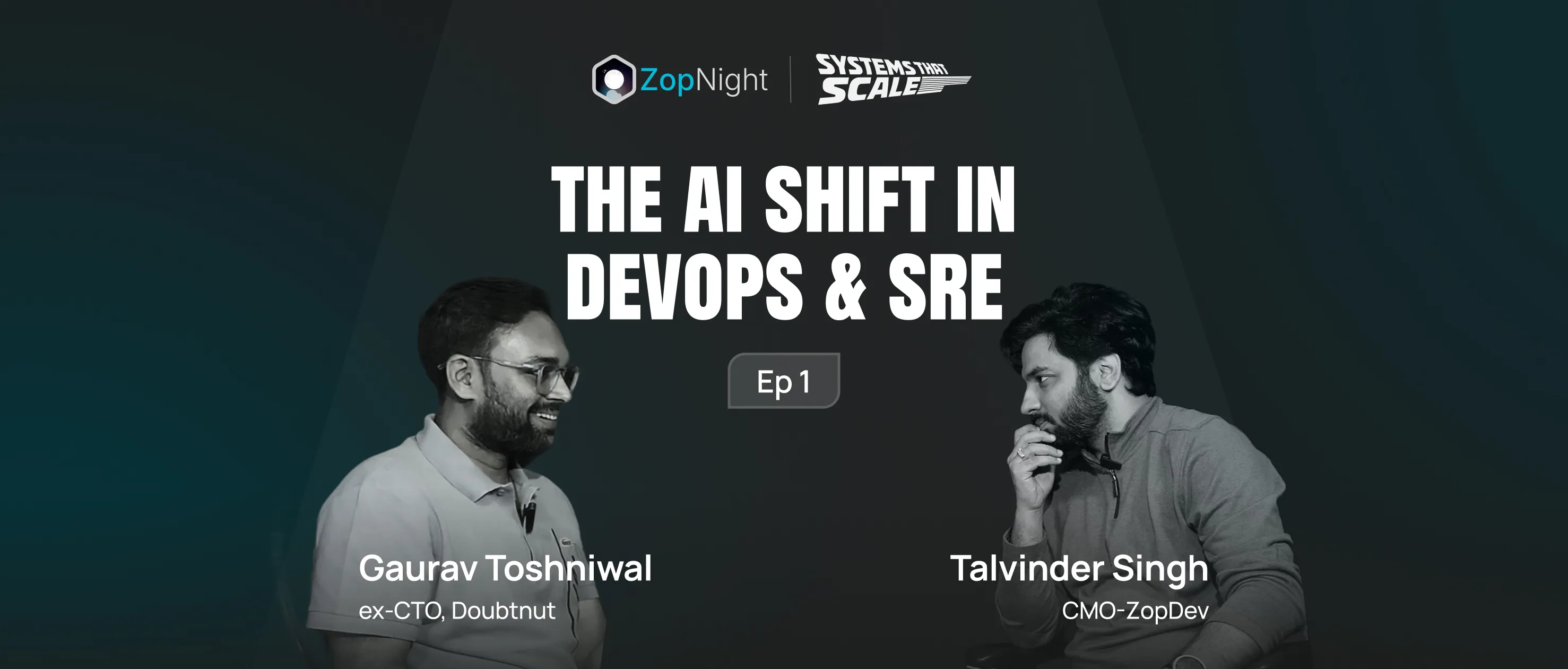
Real lessons from DevOps at scale. Episode 1 of Systems That Scale covers SRE breakdowns, operational complexity, and the rise of AI driven reliability.
One post a week. Sundays. No "10 ways to think about cloud" listicles, just the engineering and FinOps notes we'd want to read.
See. Find. Fix. Automatic.
Connect your first cloud account in under 5 minutes. See your first remediation in under 7. No credit card required.