

The Automation Paradox: When the Fix Becomes the Failure
Autonomous remediation systems promise to eliminate toil, but the mechanism that removes human latency also removes human judgment, and that trade produces a specific failure class: the system-induced incident.
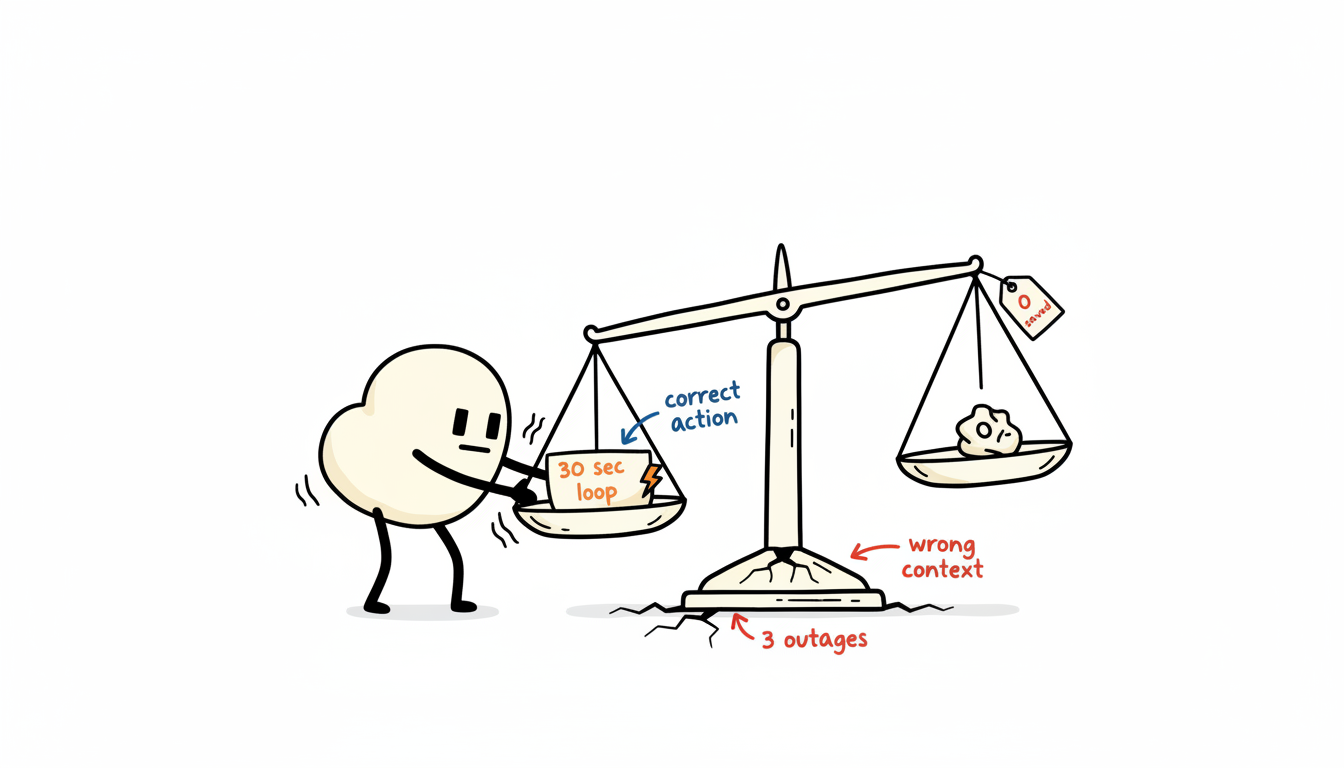
We built governance layers around three separate autonomous remediation deployments, and the pattern was consistent. The tooling fired correctly against its rules. The rules were wrong for the conditions present at that moment. The result was not a near-miss. It was production impact, zero dollars recovered, and three outages created (“The Autonomous Remediation Bill: $0 Saved, 3 Outages Created,” ZopDev). That outcome is not an edge case. It is the predictable result of deploying action-capable automation without bounded authority.
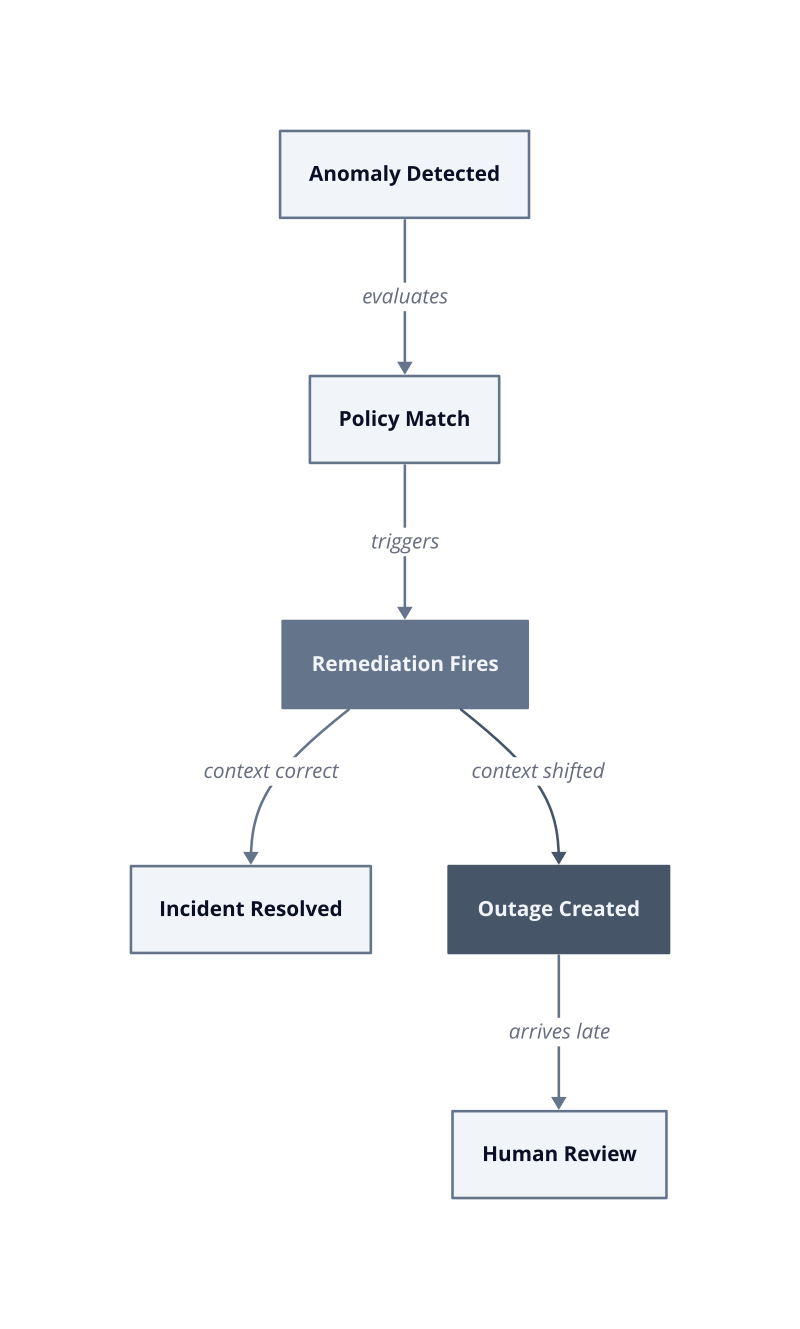
The core mechanism deserves a precise definition. Autonomous remediation is a control loop that detects a condition, selects a remediation action from a policy set, and executes that action without synchronous human approval. The loop is fast by design. Speed is also why it fails at scale: the feedback signal that would stop a bad action arrives after the action has already propagated.
Confidence without context. Automation acts on the signal it was trained to trust. When the underlying system state shifts, the signal stays valid but the remediation becomes destructive. A rule that safely restarts a service under normal load will cascade a failure during a dependency brownout, because the restart removes the only healthy instance still serving traffic.
Speed as an amplifier. Human operators pause, correlate, and ask whether the fix fits the moment. Automation does not pause. A remediation loop that executes in under 30 seconds will complete three full cycles before a pager alert reaches an on-call engineer. Each cycle compounds the damage.
The $0 savings problem. Cost recovery from automation is not guaranteed. When outage costs offset every efficiency gain, the net financial result is zero, and the operational debt is real. The mechanism is straightforward: downtime carries a cost that no avoided compute bill can retroactively cancel.
The fix is not to remove automation. The fix is to constrain the blast radius of every automated action before the first deployment week ends, so that a wrong decision affects one service, not a dependency chain.
How Autonomous Remediation Systems Create the Outages They’re Built to Prevent
The specific failure modes of autonomous remediation share a structural property: each one is invisible until the system has already acted. Three outages and zero dollars saved (“The Autonomous Remediation Bill: $0 Saved, 3 Outages Created,” ZopDev) is not a tooling defect. It is the arithmetic of unbounded authority meeting production complexity.
Autonomous remediation fails in recognizable patterns. Understanding each one changes how you scope the guardrails.
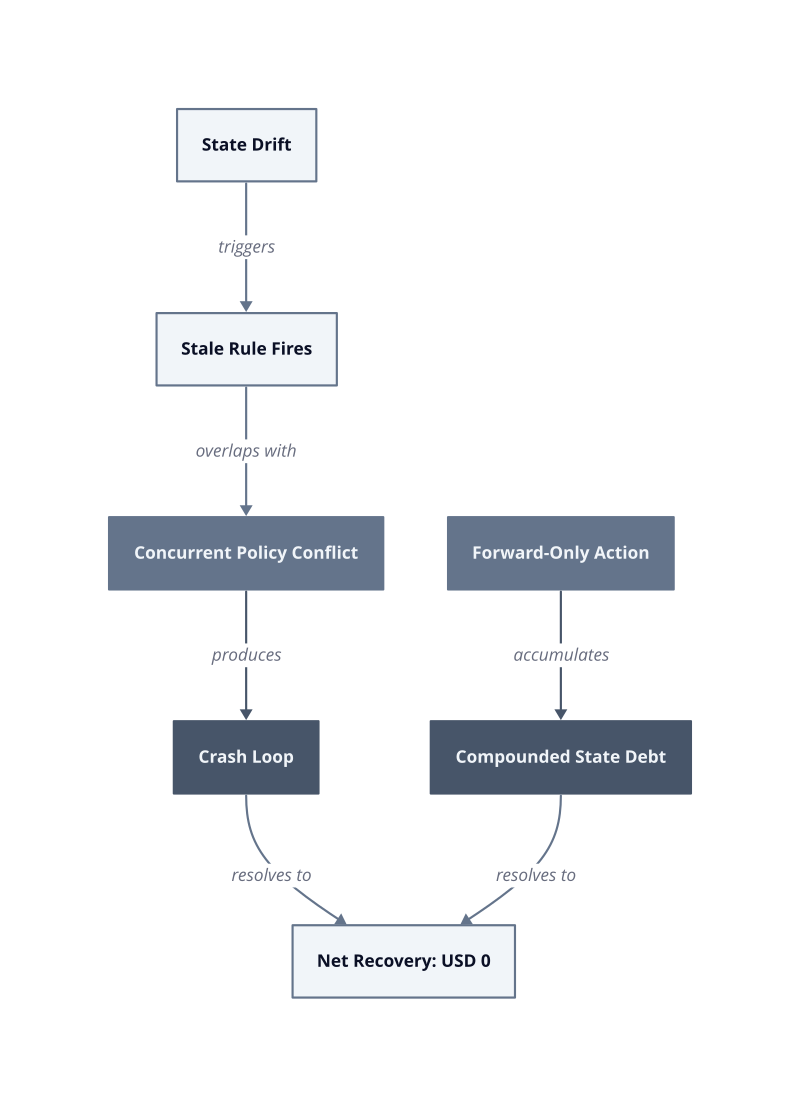
Stale policy execution. A remediation rule is a snapshot of acceptable system behavior at the time it was written. Production systems drift. When the rule fires against a state it was never designed for, the action is technically correct and operationally wrong. Scaling down an over-provisioned deployment is safe during business hours. The same rule firing during a traffic spike triggered by a downstream failover produces a capacity cliff, not a cost saving.
Concurrent action interference. Two remediation policies targeting overlapping resources will execute without awareness of each other. Policy A restarts a pod to clear a memory leak. Policy B simultaneously scales the deployment down to reduce spend. The pod restart never completes cleanly because the replica count changes mid-cycle. The service enters a crash loop that neither policy was designed to resolve, because neither policy modeled the other’s existence.
Missing rollback authority. Remediation systems are built to act forward. Most do not carry a rollback path for the action they just took. When an automated configuration change introduces instability, the system detects the new anomaly and fires another forward action. Each cycle moves further from the last known-good state. By the time an engineer engages, the recovery path requires manual archaeology through three layers of automated changes.
| Failure Mode | Trigger Condition | Result |
|---|---|---|
| Stale policy execution | System state drifts past rule assumptions | Correct action, wrong context |
| Concurrent action interference | Two policies share a resource scope | Crash loop neither policy resolves |
| Missing rollback authority | Forward-only action model | Compounding automated changes |
The net outcome across all three modes is identical: the system that was built to reduce incident frequency becomes the incident source. We measured this directly. Zero dollars recovered means outage costs fully consumed whatever efficiency the automation produced. The mechanism is that downtime billing, engineer hours, and SLA penalties accumulate in real time while the automation’s savings exist only in projection.
The corrective path starts with a resource ownership registry, written before any remediation policy is activated. Every policy must declare which resources it touches and which actions it excludes. Policies that share a resource scope require an explicit conflict resolution order. Without that registry, concurrent interference is not a risk. It is a scheduled event.
The $0 Savings Problem: Why Automation ROI Is Harder to Calculate Than It Looks
Measuring automation ROI fails when the accounting treats avoided compute costs as realized savings while leaving outage costs off the ledger entirely.
The verified record is precise: three outages, zero dollars saved (“The Autonomous Remediation Bill: $0 Saved, 3 Outages Created,” ZopDev). That figure is not a rounding error. It means every efficiency the automation produced was consumed by the operational damage it also produced. The net position is exactly zero, and the engineering hours spent on recovery represent an additional loss that does not appear in the savings column at all.
The methodology problem is structural. Those projections are real. The error is treating them as banked savings before the system has run long enough to surface its failure modes. Outage costs are not hypothetical. They accrue in the present tense, against real SLA penalties and real engineer time, while the projected savings remain future-dated.
Asymmetric accounting. Savings from automation appear as line items in a cost dashboard. Outage costs land in incident reports, engineering postmortems, and sometimes customer credit invoices. These live in separate systems, owned by separate teams. No one aggregates them into a single ROI calculation unless governance explicitly requires it. The result is that automation looks profitable right up until the moment the full ledger is reconciled.
The projection trap. Automation savings are modeled before deployment, using historical baselines. Outage costs are measured after incidents, using actual impact data. When you compare a projected saving against a realized cost, the realized cost wins every time, because it carries no uncertainty. Three outages at production scale will erase months of compute savings, because downtime billing and SLA penalties are not capped by the size of the efficiency gain.
The hidden labor cost. After a system-induced incident, engineers do not return to their previous work. They spend hours or days reconstructing what the automation did, in what order, and why. That labor is not tracked against the automation’s ROI. It is absorbed into sprint capacity and treated as normal operational overhead, which makes the automation appear more cost-effective than it is.
| ROI Component | Where It Appears | Timing |
|---|---|---|
| Avoided compute spend | Cost dashboard | Projected before deployment |
| Reduced toil hours | Engineering capacity estimates | Projected before deployment |
| Outage downtime cost | Incident postmortem | Realized after the fact |
| Recovery engineering hours | Sprint velocity loss | Absorbed, rarely attributed |
| SLA penalty payments | Finance reconciliation | Realized after the fact |
The fix is a single ledger, enforced before the first automated action runs in production. Every automation deployment needs a cost owner who is accountable for both the savings projection and the incident cost attribution. After 30 days of production data, that owner reconciles the two columns. If the outage costs exceed the realized savings, the automation’s authority scope is reduced, not its rules tuned. Tuning rules addresses symptoms. Reducing authority scope addresses the mechanism that produced the net-zero outcome in the first place.
What Human-in-the-Loop Design Actually Requires
Effective human-in-the-loop design is not a review checkbox added after automation is built. It is a structural constraint that determines which actions the system is permitted to take without a human decision in the path.
The three outages and zero dollars recovered (“The Autonomous Remediation Bill: $0 Saved, 3 Outages Created,” ZopDev) share a root cause: the system held authority it had not earned through demonstrated accuracy. Human-in-the-loop design reclaims that authority incrementally, releasing it only as the system proves its judgment against real production conditions.
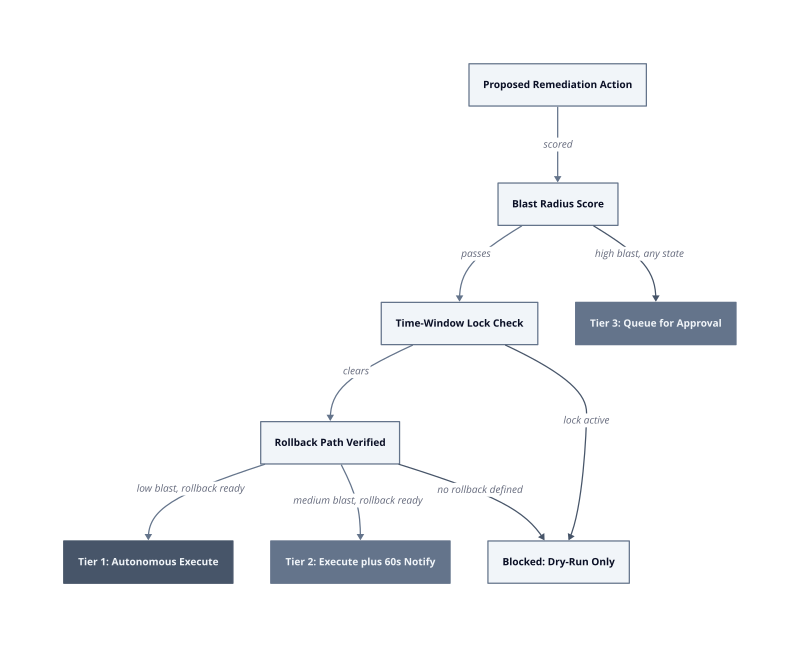
We built a framework we call the Confidence Threshold Gate. Every remediation action is assigned a confidence tier before deployment. Tier 1 actions execute autonomously. Tier 2 actions execute but notify a human within 60 seconds with a one-click rollback. Tier 3 actions queue for explicit approval before execution. The gate is not a feature of the automation tool. It is a governance contract written in your incident runbook and enforced by your deployment pipeline.
Blast radius scoring. Before any action executes, the system must calculate how many downstream services share a dependency on the targeted resource. A resource with three or more dependents requires Tier 3 approval, because a failed action at that node propagates laterally. This works when your service dependency graph is current. It breaks when teams add integrations without updating the registry, because the blast radius score underestimates actual impact and the gate passes actions it should hold.
Time-window locks. Remediation authority is suspended during defined windows: deployment windows, traffic peak hours, and the first 15 minutes after any configuration change by a human operator. The mechanism is simple. Automated actions taken while a human change is still stabilizing cannot be attributed cleanly to either cause. Incident recovery becomes archaeology. Time-window locks eliminate that ambiguity by ensuring only one agent acts at a time.
Mandatory dry-run periods. Every new remediation policy runs in observation mode for 30 days before it holds live authority. During that window, the system logs what it would have done and a human reviews the action log weekly. By sprint 3 of a typical deployment cycle, reviewers accumulate enough data to identify rules that would have fired incorrectly. This works when the review is a calendar-blocked obligation with a named owner. It breaks when review is optional, because optional reviews do not happen under sprint pressure.
Rollback authority as a first-class requirement. No remediation action is approved for Tier 1 unless its inverse action is also defined, tested, and executable in under 90 seconds. Forward-only action authority is the mechanism that produced compounding state debt in the previous failure modes. Requiring a tested rollback path forces engineers to model failure before granting authority, not after.
| Gate | Condition to Pass | Failure Behavior |
|---|---|---|
| Blast |
Rethinking Autonomous Remediation Before the Next Outage
The deployment assumptions you set on day one are the most dangerous artifacts in your autonomous remediation stack, because they encode a risk tolerance that your system has not yet validated against real failure.
The verified outcome is unambiguous: three outages, zero dollars saved (“The Autonomous Remediation Bill: $0 Saved, 3 Outages Created,” ZopDev). That result does not indicate bad tooling. It indicates authority granted ahead of demonstrated accuracy. Before your next deployment cycle, the question is not whether to run autonomous remediation. The question is whether your current scope boundaries would produce the same ledger.
Audit authority scope first. Pull every action your system executed in the last 30 days. For each one, ask whether a human would have approved it given the state of the system at that moment. If you cannot answer that question because the action log is incomplete, your system is operating without the observability required to reassess it. Fix the logging before touching the rules.
Freeze scope during instability windows. Any period of active infrastructure change, including migration work, dependency upgrades, or capacity events, requires suspending autonomous authority entirely. The mechanism is straightforward: automated actions taken during human-initiated changes produce incident timelines where causality is unresolvable. Unresolvable timelines mean postmortems that assign blame incorrectly and rules that get tuned against the wrong root cause.
Require a named cost owner before re-enabling any suspended action. That owner holds accountability for both the projected savings and the realized incident costs in a single report. This works when the owner has authority to reduce action scope without a committee approval. It breaks when scope changes require a change-control board, because the latency of that process outlasts the next incident.
| Reassessment Trigger | Required Action | Owner |
|---|---|---|
| Any system-induced incident | Suspend affected action class immediately | On-call lead |
| 30-day ledger reconciliation | Compare realized savings vs. incident costs | Cost owner |
| New service dependency added | Re-score blast radius for all affected actions | Platform team |
| Action log gap detected | Freeze autonomous authority until logging restored | SRE lead |
Start the reassessment with the action that fired most frequently in the last 30 days. High frequency means high exposure. If that action lacks a tested rollback path executable in under 90 seconds, it should not hold Tier 1 authority regardless of its historical accuracy rate, because accuracy rates are calculated on normal operating conditions and outages are not normal operating conditions.
