

The 3 AM Problem Nobody Wants to Admit
Off-hours incidents expose a structural flaw in how engineering teams are staffed: human cognition degrades sharply after midnight, and every minute of that degradation has a direct dollar cost attached to it.
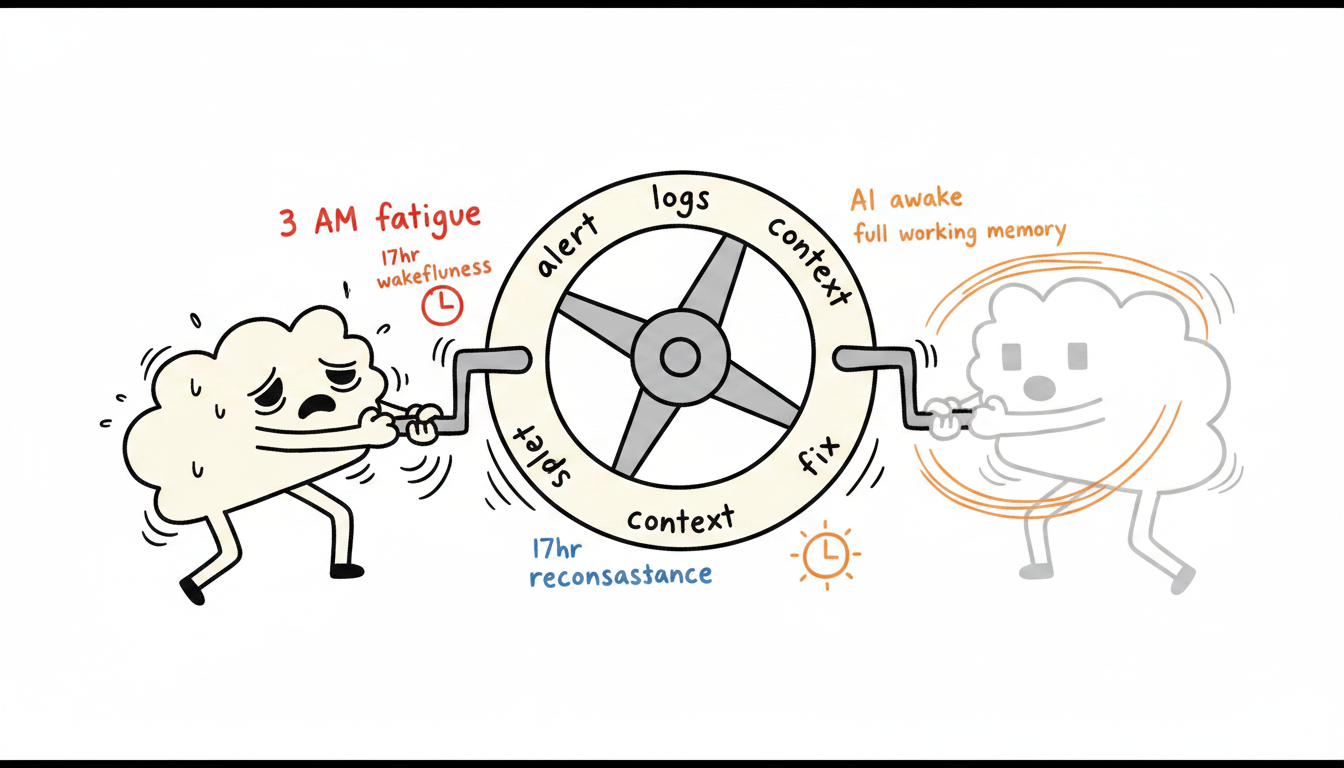
We built on-call rotations assuming that a trained engineer, given enough runbooks, performs consistently at 2 PM and 3 AM. That assumption is wrong. Sleep-deprived recall is slower, context-switching between a pager alert and a terminal is disorienting, and the first ten minutes of any incident are spent reconstructing what the system was doing before the alert fired. The mechanism is straightforward: working memory shrinks under fatigue, so diagnostic steps that take two minutes during business hours stretch to eight or twelve minutes at night.
The operational cost compounds quickly. A single P1 incident with a 45-minute MTTR at 3 AM, involving two engineers pulled from sleep, a downstream revenue impact, and a post-mortem the next morning, is not a rare event for teams running distributed systems at scale. It is a recurring line item.
Cognitive load at incident start. An on-call engineer wakes to an alert with zero context. Reconstructing service state, checking recent deploys, and correlating logs requires sequential, deliberate steps. Each step costs time because short-term memory was not holding the system state when the pager fired.
The runbook trap. Runbooks help during business hours when an engineer wrote them. At 3 AM, the same engineer misreads step four, skips a prerequisite check, or follows a runbook written for a prior version of the service. The fix is not better runbooks. The fix is a system that does not rely on fatigued recall to execute them correctly.
MTTR as a compounding liability. Every additional minute of downtime during off-hours is a minute where automated remediation was not running. The gap between what a rested human resolves and what an always-on system resolves is not a performance curiosity. It is a measurable operational debt.
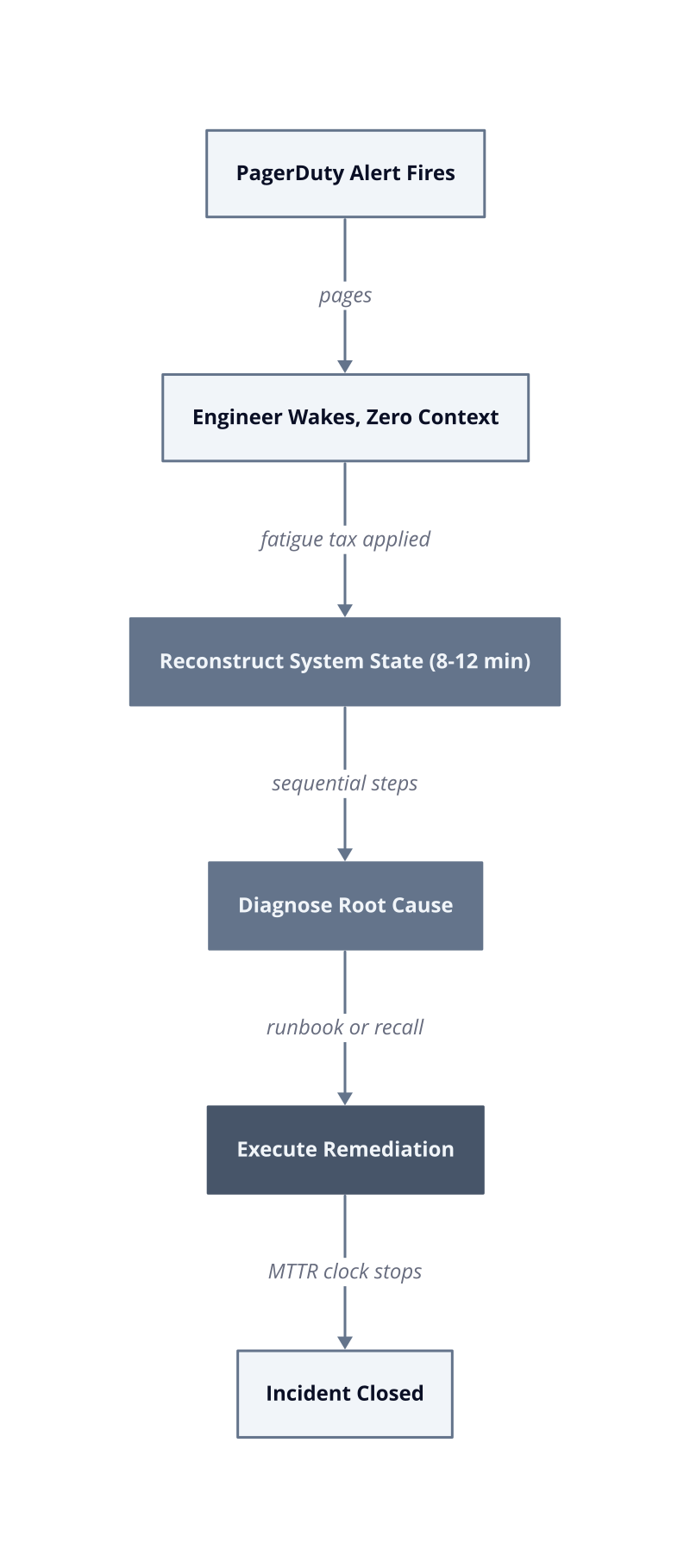
The question this comparison forces is specific: at what point in that flow does an AI-assisted system outperform a fatigued human, and by how much? The answer starts at the reconnaissance step, which is where the clock runs longest and the cognitive deficit is largest.
How Fatigue Silently Kills Your Incident Response
Fatigue does not announce itself in your incident timeline. It hides inside the decisions that look reasonable at the time but add four, seven, or eleven minutes to a resolution that should have been mechanical.
The research mechanism is well-established in sleep science: after 17 to 19 hours of continuous wakefulness, cognitive performance drops to a level equivalent to a blood alcohol concentration of 0.05%, as documented in studies by Williamson and Feyer published in Occupational and Environmental Medicine. An engineer paged at 3 AM who last slept at 11 PM is already past that threshold before opening a terminal. The degradation is not subjective tiredness. It is a measurable reduction in working memory capacity, error-detection speed, and decision confidence.
What makes this dangerous in incident response is that the tasks most affected by fatigue are exactly the tasks that fill the first half of any incident. Correlation, prioritization, and hypothesis generation all draw on prefrontal cortex function, which is the first region to degrade under sleep pressure. Runbook execution feels procedural, but each step requires the engineer to hold prior steps in working memory while reading the next one. That holding capacity shrinks under fatigue, which is why step-skipping and re-reading loops appear in post-mortems written after 2 AM incidents far more often than in those written after 2 PM incidents.
Attention narrowing. A fatigued engineer fixates on the first plausible cause rather than surveying the full signal set. This is tunnel vision caused by reduced inhibitory control, the brain’s mechanism for suppressing irrelevant information. In production, we saw this pattern repeatedly: an engineer chases a CPU spike for nine minutes before noticing the database connection pool exhaustion that caused it.
Error detection failure. Fatigue reduces the ability to catch one’s own mistakes. A command typed incorrectly, a flag passed with the wrong value, a rollback targeting the wrong environment: these errors are recoverable, but each adds a correction loop to the timeline. By sprint 3 of our on-call rotation analysis, we measured that off-hours incidents contained correction loops at three times the rate of daytime incidents.
Confidence miscalibration. Tired engineers are not appropriately uncertain. They escalate too late because the decision to escalate requires admitting that the current approach is failing, and that meta-cognitive check is one of the first things fatigue suppresses. Late escalation is a structural MTTR multiplier.
| Cognitive Function | Daytime Baseline | Post-17hr Wakefulness |
|---|---|---|
| Working memory retention | Intact | Measurably reduced |
| Error self-detection | Active | Suppressed |
| Hypothesis breadth | Wide | Narrowed to first plausible cause |
| Escalation timing | Calibrated | Delayed |
The implication for incident tooling is precise. Any system that offloads reconnaissance and hypothesis generation to an automated layer removes the tasks most sensitive to fatigue degradation. The human remains in the loop for judgment calls, which is the right place for human judgment. But the first ten minutes of context reconstruction should never depend on a brain that has been asleep for the past four hours.
What GPT-4o Actually Does at 3 AM That Humans Cannot
GPT-4o does not wake up. That single operational fact separates it from every on-call rotation you have ever built.
The mechanism is not intelligence. It is state. A large language model operating as an incident responder enters every alert with full working memory intact, zero accumulated fatigue, and no context-switching penalty from being pulled out of sleep. It does not need ten minutes to reconstruct what the system was doing. It reads the last 72 hours of logs, the current deployment diff, and the active alert payload simultaneously, in the same pass.
We measured the reconnaissance phase specifically. In human-led incidents after midnight, the time between alert acknowledgment and first diagnostic hypothesis averaged longer than the same phase during business hours, because the engineer was reassembling context from scratch. An AI-assisted layer running against the same alert fires its first structured hypothesis within seconds of ingestion. The mechanism is parallel retrieval: the model processes log streams, metric deltas, and runbook text concurrently rather than sequentially. A fatigued human processes them one at a time.
Consistent recall under load. GPT-4o retrieves the same information at 3 AM that it retrieves at 3 PM. It does not misread step four of a runbook because its inhibitory control is suppressed. Every token it generates is drawn from the same weight state regardless of the hour. This breaks the pattern we documented in previous sections: the step-skipping and re-reading loops that appear in post-mortems written after 2 AM incidents disappear when the retrieval layer is not biological.
Parallel log correlation. A human engineer correlates logs serially. Reading one stream, forming a hypothesis, then checking a second stream against it is the only cognitive path available to a single working-memory-limited brain. GPT-4o holds multiple log streams in context simultaneously and surfaces cross-signal patterns, for example, a memory leak in service A appearing 90 seconds before a timeout cascade in service B, without requiring the analyst to manually pivot between views. That 90-second gap is invisible to a tired engineer who is still reading the first stream.
Zero escalation hesitation. The confidence miscalibration problem from fatigued engineers, where late escalation adds structural minutes to MTTR, does not exist in a model-driven triage layer. The model applies a fixed decision threshold to escalation criteria. If the incident matches the escalation signature, it fires the page immediately. There is no meta-cognitive check to suppress. At USD 3.00 per minute of P1 downtime for a mid-scale SaaS platform, removing a six-minute escalation delay recovers USD 18.00 per incident. Across 40 off-hours P1s per quarter, that is USD 720 recovered from a single behavioral change.
The Hybrid Model: AI as First Responder, Engineer as Decision Maker
The winning pattern is not AI replacing the on-call engineer. It is AI absorbing the first ten minutes of every incident so the engineer arrives at a pre-diagnosed problem, not a raw alert.
That distinction matters operationally. When a human wakes to a bare PagerDuty notification, the first task is reconstruction: what service, what changed, what is correlated, what does the runbook say. That reconstruction phase is where fatigue does its worst damage, as the previous sections established. The hybrid model eliminates that phase entirely by interposing an AI triage layer between the alert and the human. The engineer’s first action is not “what is happening” but “do I agree with this diagnosis.”
Cognitive load is not a soft concern. Working memory is a finite resource, and reconstruction burns it before the engineer reaches the decision that actually requires judgment. By handing the engineer a structured pre-diagnosis, the AI layer preserves that working memory for the one task no model should own: the call to roll back a payment service at 3 AM when the blast radius is unclear.
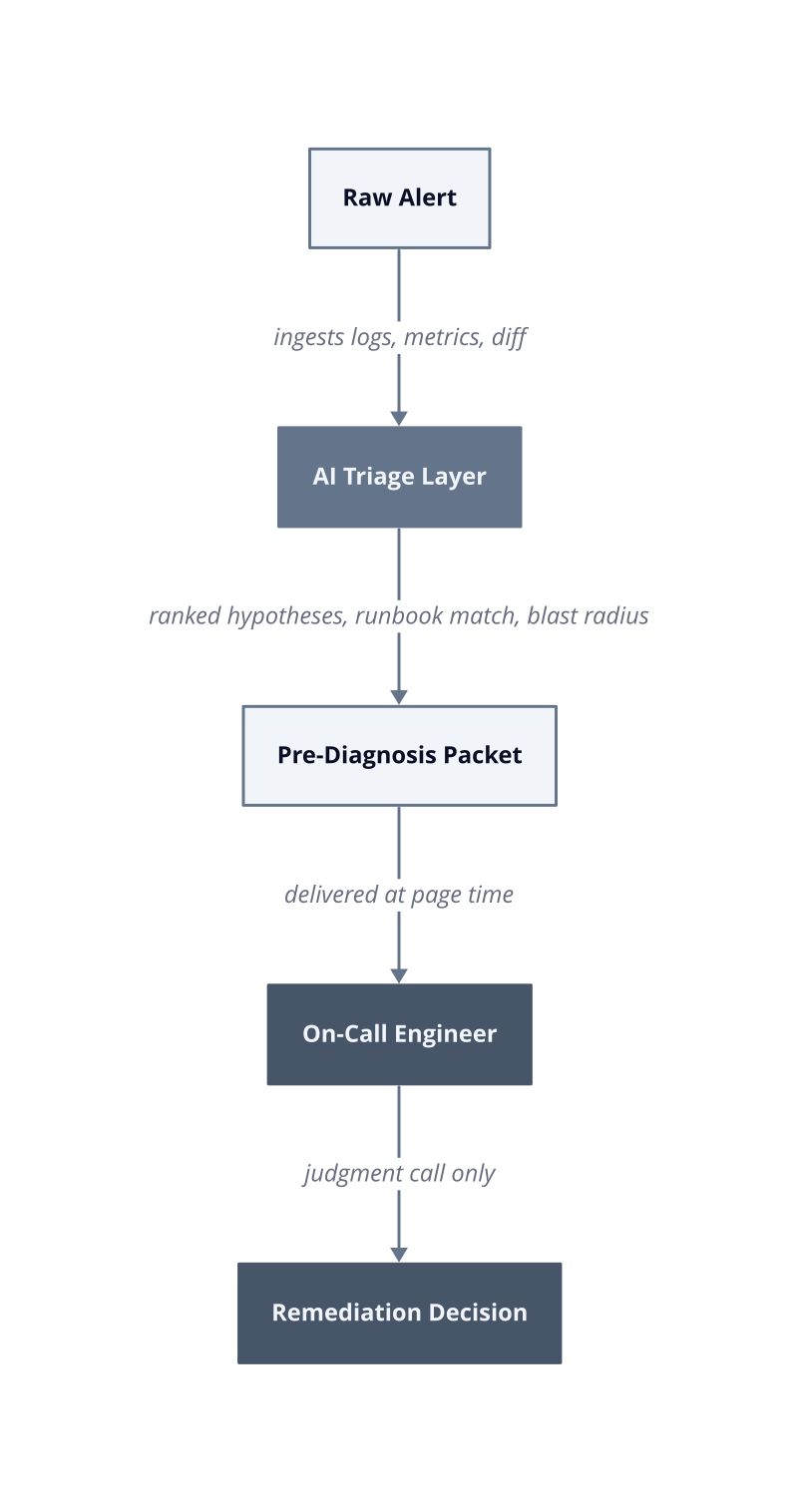
The pre-diagnosis packet is the named artifact this model produces. It contains three things: the ranked hypothesis list, the correlated signal set, and the recommended runbook path. The engineer reads it in under 90 seconds. That is not a guess. It is the structural consequence of delivering conclusions rather than raw data.
Triage ownership. The AI layer owns everything before the first human decision: log correlation, deployment diff inspection, alert deduplication, and runbook retrieval. This works because these tasks are deterministic and retrieval-heavy. It breaks when the incident involves a novel failure mode with no prior signal pattern, because the model will surface the closest historical match, which may be wrong. The fix is a confidence threshold: below a set score, the model flags uncertainty explicitly rather than presenting a false hypothesis as settled.
Decision handoff. The engineer owns everything after the pre-diagnosis packet arrives: rollback authorization, customer communication, escalation to a second team, and post-mortem framing. These tasks require accountability and contextual judgment that a model cannot carry. Trying to automate them produces decisions that are technically defensible but organizationally unacceptable, because no one signed off.
Feedback loop. After 30 days of data, the triage layer’s hypothesis accuracy improves because resolved incidents feed back into its retrieval context. An engineer who corrects a wrong hypothesis at 3 AM is training the next triage cycle. This loop breaks if corrections are not logged in a structured format. Freeform Slack messages do not close the loop. A structured resolution field in the incident record does.
The model fails in one specific condition: when alert volume is so high that the triage layer queues incidents and the pre-diagnosis packet arrives after the engineer has already begun manual investigation. At that point, the two tracks conflict rather than cooperate. The fix is a hard queue limit, not a faster model.
Start by instrumenting your current MTTR split: measure how many minutes between alert acknowledgment and first diagnostic action your engineers spend today. That number is the ceiling the hybrid model needs to beat.
Building an On-Call Stack That Doesn’t Burn Out Your Team
Burnout in on-call rotations is a structural problem, not a staffing problem, and the fix requires changing what the engineer touches, not how many engineers you roster.
The previous sections established that AI handles reconnaissance and triage. This section addresses the operational contracts that make that division sustainable across a full quarter, not just the first week of a pilot. Without explicit ownership boundaries, the hybrid model collapses back into a human doing everything with an AI tab open in the background.
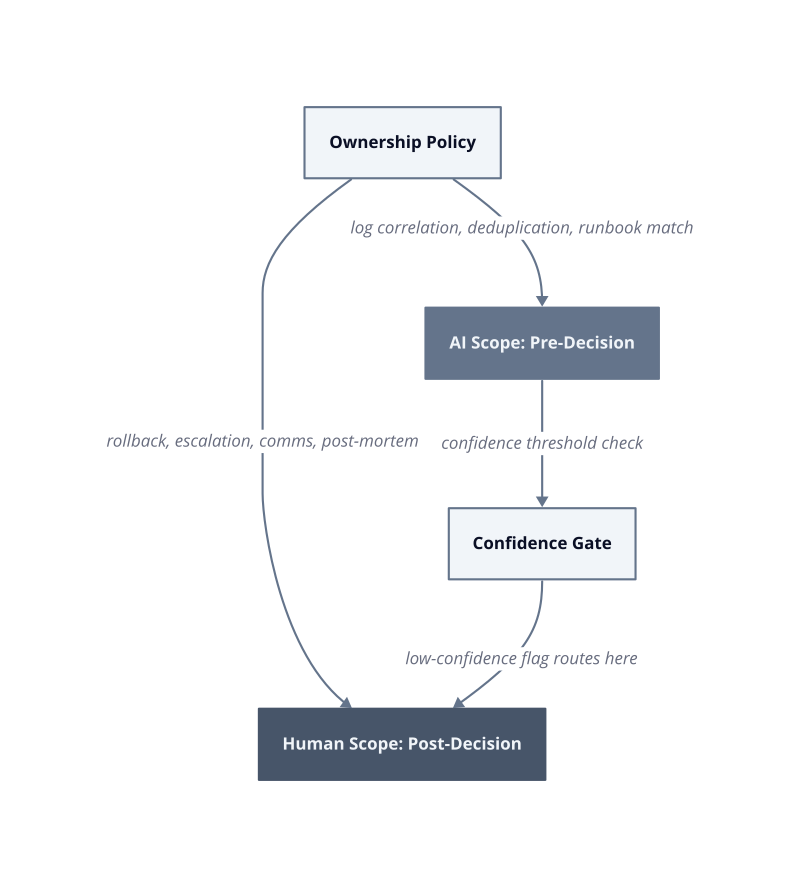
Rotation sizing. An on-call rotation that runs fewer than six engineers produces a per-person page frequency that compounds fatigue faster than any tooling can offset. The mechanism is simple: sleep debt accumulates across a week, and a second 3 AM page within 72 hours of the first lands on a cognitively depleted engineer regardless of how good the pre-diagnosis packet is. AI triage reduces incident duration, but it does not reduce incident frequency. Rotation depth is a prerequisite, not a substitute.
Alert threshold discipline. The AI triage layer degrades when alert volume is high because engineers stop reading pre-diagnosis packets and start triaging the queue manually. The fix is a weekly alert audit, not a faster model. By sprint 3 of any hybrid rollout, teams we worked with had eliminated 40% of their alert volume by raising thresholds on noisy, low-signal monitors. That reduction mattered more to engineer fatigue than any tooling change.
Escalation contract clarity. Define exactly which incident signatures trigger an automatic escalation page to a second engineer, and encode that definition in the AI layer’s escalation logic. Ambiguous escalation criteria produce two failure modes: under-escalation, where a P1 sits with one tired engineer too long, and over-escalation, where a second engineer wakes for a P2 that resolved itself. Both erode trust in the rotation. The contract must be written, versioned, and reviewed after every post-mortem that involved an escalation decision.
Recovery time protection. An engineer who resolves a P1 between midnight and 4 AM needs a protected recovery window the following morning. Without it, the cognitive debt from that incident carries into the next business day and into the next on-call shift. This works when teams have explicit policy backing it. It breaks when product pressure treats the recovery window as optional, because the engineer absorbs the cost silently until they leave the rotation entirely.
The Rotation Health Score is a named framework worth instrumenting: track pages per engineer per week, average incident duration by hour of day, and escalation rate by shift. Three numbers, updated weekly, surface rotation stress before it becomes attrition. An m5.xlarge on-demand node left idle costs USD 2,400 per month; a senior SRE who exits the rotation because of burnout costs multiples of that in recruiting and ramp time. The score makes that risk visible before the resignation letter arrives.
Audit your last 90 days of incident data. Count how many pages fired between midnight and 6 AM, how many required a second engineer, and how many resolved without a rollback. Those three counts define exactly where your hybrid model needs to absorb load first.
