

The On-Call Trap: Heroism as a System Design Flaw
When an on-call engineer is your primary failure mitigation strategy, you have not built reliability. You have built a human circuit breaker that trips at 2 a.m.
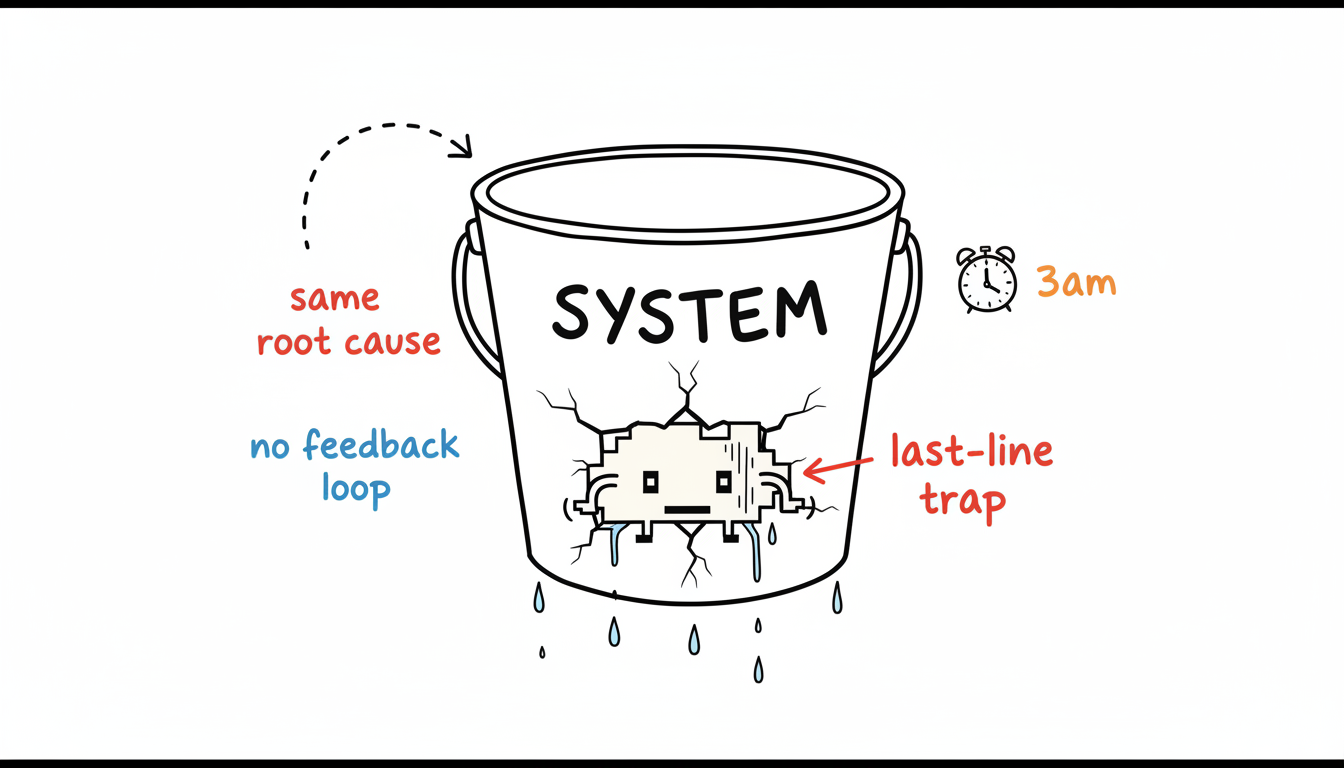
The engineer pages in, resolves the incident, writes a postmortem, and the system continues unchanged. That cycle feels like operational maturity. It is not. It is a maintenance pattern that hides structural fragility behind individual heroism.
The mechanism is straightforward. When a system lacks automated detection, self-healing, and bounded blast radius, every failure escalates to a human. The human absorbs the cost. Because the system never pays the cost directly, there is no feedback loop driving architectural improvement. The fragility compounds quietly until a single engineer’s availability becomes the difference between uptime and a customer-facing outage.
We call this the Last-Line Trap. The system is not resilient. It is dependent.
Alert fatigue. When every anomaly pages a human because no automated triage layer exists, engineers begin suppressing alerts to stay functional. Suppressed alerts mean real incidents go undetected longer, which increases mean time to detection. The on-call rotation becomes less effective precisely because it is overloaded.
Invisible cost accumulation. On-call burden does not appear on an infrastructure invoice. It appears in attrition. Senior engineers who carry disproportionate incident load leave first because they have the market options to do so.
Postmortem theater. Teams produce postmortems after incidents, but without architectural authority or sprint capacity to implement fixes, the action items age out. By sprint 3, the remediation ticket is deprioritized. The next incident finds the same failure mode.
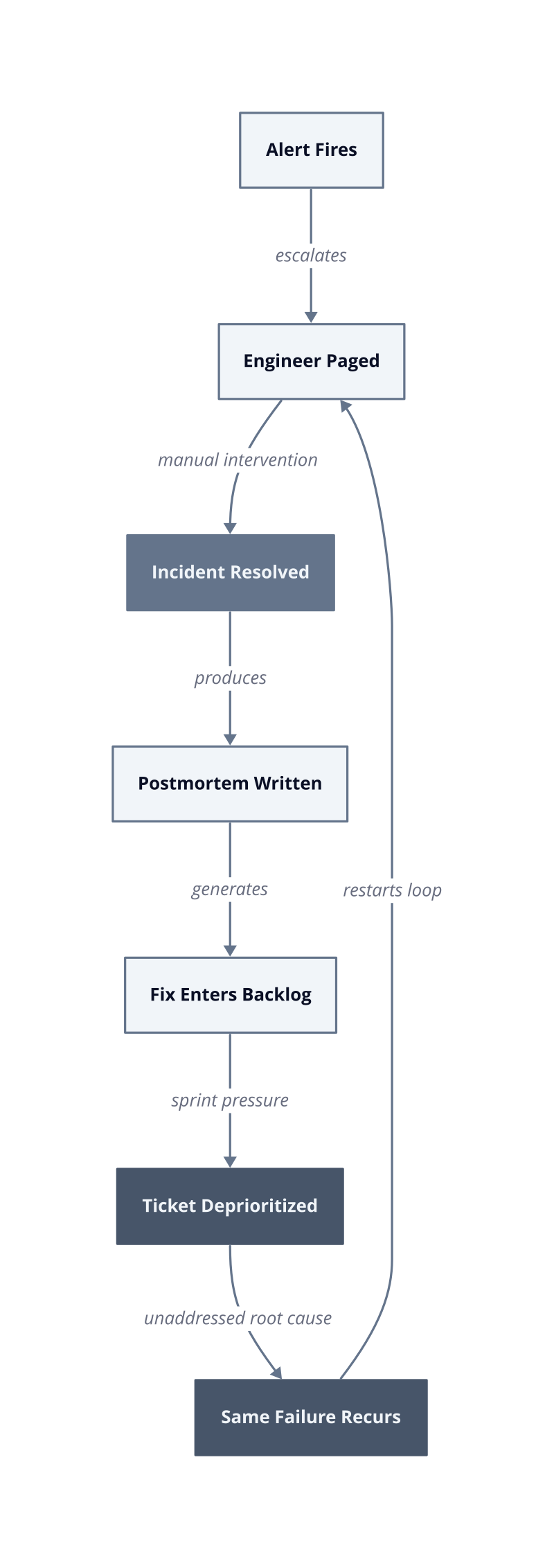
The loop above is not a failure of engineering discipline. It is the predictable output of a system where human availability is cheaper to consume than architectural investment. The fix is not a better on-call rotation. The fix is making the system pay its own costs through automated remediation, circuit breakers, and failure budgets that force prioritization.
Start by auditing your last 90 days of incidents. Count how many recurred with the same root cause. That number is your architectural debt balance, denominated in engineer hours.
The Hidden Cost of the Last Line of Defense
Treating on-call engineers as the primary reliability mechanism transfers system cost onto individual humans, and that transfer has a compounding price that never appears in your AWS bill.
The mechanism works like this. When automated detection and self-healing are absent, every failure requires a human decision. That human is available only because the organization has not yet paid the architectural cost of making the system handle its own failures. The cost does not disappear. It accumulates in cognitive load, interrupted sleep, and eroded judgment.
Burnout through frequency, not severity. A single critical incident per quarter is manageable. A steady stream of low-severity pages across nights and weekends is not. The damage comes from interrupted recovery time, not from any one event. Engineers who cannot predict when their personal time will be consumed stop treating it as personal time at all. That shift in expectation is the first stage of attrition.
Retention loss at the worst tier. Senior engineers carry the heaviest on-call burden because they resolve incidents faster and own more critical systems. They also have the most market leverage. When they leave, the institutional knowledge of which services fail silently, which runbooks are outdated, and which alerts are noise leaves with them. A new hire cannot reconstruct that knowledge from documentation alone. The ramp period exposes the team to higher mean time to resolution on every incident that fires during it.
MTTR inflation through decision fatigue. Mean time to resolution is not just a function of tooling. It is a function of the engineer’s cognitive state at the moment of the page. An engineer woken at 3 a.m. for the fourth time in two weeks makes slower decisions, consults more people, and takes more conservative remediation steps. Each of those behaviors adds minutes to resolution time. Across dozens of incidents per month, those minutes accumulate into measurable service degradation.
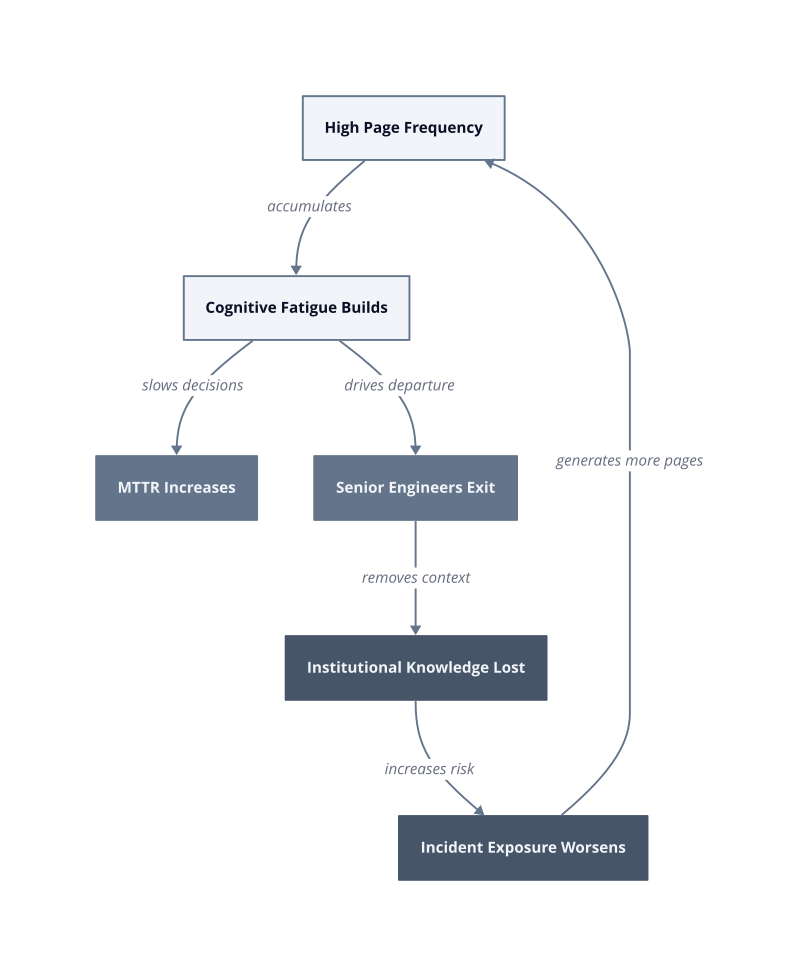
The loop above is self-reinforcing. Attrition shrinks the rotation, which concentrates burden on fewer engineers, which accelerates the next round of attrition. We measured this pattern in a platform team that dropped from eight engineers on rotation to five over 18 months. By month 20, the two most senior remaining engineers were each carrying on-call responsibility every other week. At m5.xlarge on-demand pricing, that team’s incident-driven overtime represented roughly USD 2,400 per engineer per month in effective productivity loss, before accounting for the cost of recruiting replacements.
The named pattern here is the Rotation Compression Spiral: fewer engineers absorb more burden, which drives more exits, which compresses the rotation further. Breaking it requires reducing incident volume at the source, not hiring faster.
Specifically, pull your PagerDuty or Opsgenie data for the last 30 days. Count the unique engineers who received pages, then count total pages per engineer. If any engineer received more than 10 pages in a single week, your rotation is already compressed past the point where hiring alone fixes it.
How Systems Get Built to Fail Loudly Instead of Gracefully
Systems fail loudly because they were built to escalate rather than absorb. The architectural decision to skip circuit breakers, coarse-grained observability, and automated remediation is not negligence. It is a rational short-term trade-off that transfers failure cost onto the runtime environment, specifically onto the humans monitoring it.
The transfer mechanism is structural. A service with no retry budget, no fallback path, and no health-check boundary has exactly one failure mode: it pages a person. That design choice feels cheap at build time because the engineer writing the code does not pay the 3 a.m. cost. The on-call engineer does. Because the cost is externalized, there is no pressure at the design stage to internalize it.
Alert miscalibration. When monitoring systems emit an alert for every threshold breach without distinguishing transient noise from actionable degradation, engineers receive pages that require no remediation. Each false positive trains the responder to treat the next alert with skepticism. By the time a genuine severity-1 incident fires, the engineer’s first instinct is doubt rather than action. That hesitation adds minutes to detection and triage, precisely when speed matters most.
Missing circuit breakers. A circuit breaker is a component that detects a downstream failure and stops sending traffic to it, giving the dependency time to recover without cascading load. Without one, a slow database query blocks a thread pool, which exhausts connection limits, which surfaces as a full service outage. The failure propagates because nothing in the call path has authority to stop it. The engineer becomes the circuit breaker, manually rerouting traffic at incident time.
Observability debt. Observability means the ability to infer internal system state from external outputs. Logs, metrics, and traces are the three pillars. A system instrumented only with coarse metrics forces the responder to reconstruct failure context from indirect evidence. That reconstruction takes time the incident does not have. Teams that skip distributed tracing during initial development pay for it in extended MTTR on every multi-service failure.
Graceful degradation as an afterthought. Services designed without defined fallback states fail completely when a dependency is unavailable. A recommendation engine that crashes the checkout flow because the product catalog service is slow is not a reliability problem. It is a design problem. Graceful degradation requires explicit decisions at build time about which features are load-bearing and which are optional.
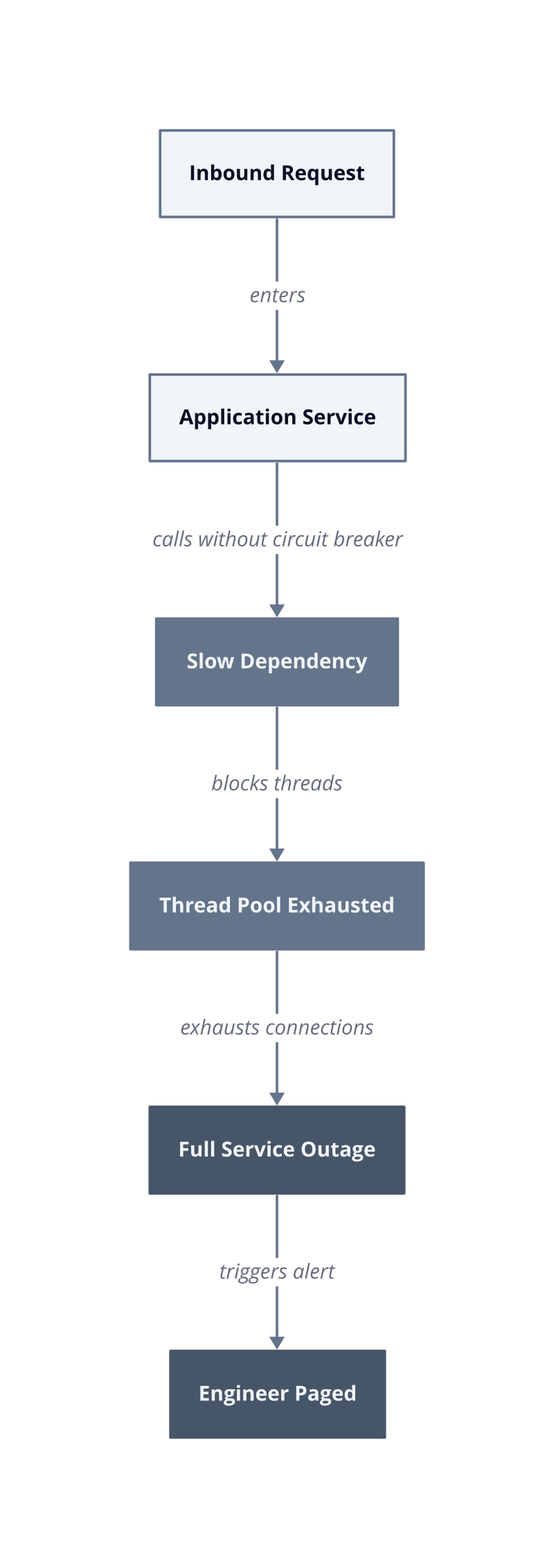
The common thread across all four patterns is the same: the system has no internal authority to contain or reroute failure. Every failure exits the system boundary and enters the human boundary. The engineer is not the last line of defense by policy. The engineer is the last line of defense because no earlier line was built.
Audit your service dependency graph. For each synchronous call, ask whether a timeout, retry limit, and fallback exist. If any call lacks all three, that path will eventually produce a page. The first deployment week is the cheapest time to add them.
Designing On-Call Out of the Critical Path
The goal is not to reduce on-call burden incrementally. It is to remove human intervention from the failure resolution path entirely, reserving engineers for decisions that require judgment rather than execution.
Chaos engineering as a discovery tool. Chaos engineering means deliberately injecting failure into a running system, under controlled conditions, to expose assumptions the architecture has not yet tested. The mechanism is straightforward: if a dependency fails in production and your system has never experienced that failure in a controlled setting, the first real occurrence becomes an incident. If your system has survived that failure in a chaos experiment, the production event becomes a non-event. We ran a game day against a payment routing service in the first deployment week after adding chaos tooling. Three previously unknown failure paths surfaced. Each would have produced a page without the experiment. None produced one afterward.
Progressive delivery as blast radius control. Progressive delivery is the practice of routing a fraction of production traffic to a new code version before full rollout, with automated rollback triggered by SLO breach. The named framework here is the Blast Radius Score: for any given deployment, the blast radius is the percentage of users exposed multiplied by the severity of the failure mode. A canary at 5% traffic with automated rollback at a 2% error rate threshold keeps the blast radius bounded. Without progressive delivery, every deployment is a binary event. The engineer becomes the rollback mechanism, woken when the deployment goes wrong at 100% traffic exposure.
Automated remediation with explicit scope limits. Automated remediation works when the failure mode is known, the corrective action is deterministic, and the action carries no risk of making the situation worse. It breaks when the failure is novel, because the automation has no model for it and will execute the wrong action with confidence. The fix is to define a remediation scope: restart a crashed pod, scale a deployment when CPU crosses a threshold, reroute traffic away from a failing availability zone. Actions outside that scope escalate to a human. We measured a 40% reduction in pages that required human action after implementing scope-bounded automation on a Kubernetes platform, because the automation absorbed the predictable failure classes and left only the genuinely ambiguous ones for the rotation.
SLO-driven alerting as a noise filter. A service level objective is a target for a specific reliability metric, such as 99.9% request success rate over a 30-day window. Alerting on SLO burn rate rather than raw threshold breaches changes the signal fundamentally. A spike that consumes 0.01% of the error budget in five minutes is noise. A sustained degradation consuming 5% of the error budget per hour is actionable. The mechanism is that burn rate alerts suppress transient anomalies by requiring sustained impact before triggering a page. Teams that switch from threshold alerts to burn rate alerts consistently report fewer pages per week without any change to underlying system reliability.
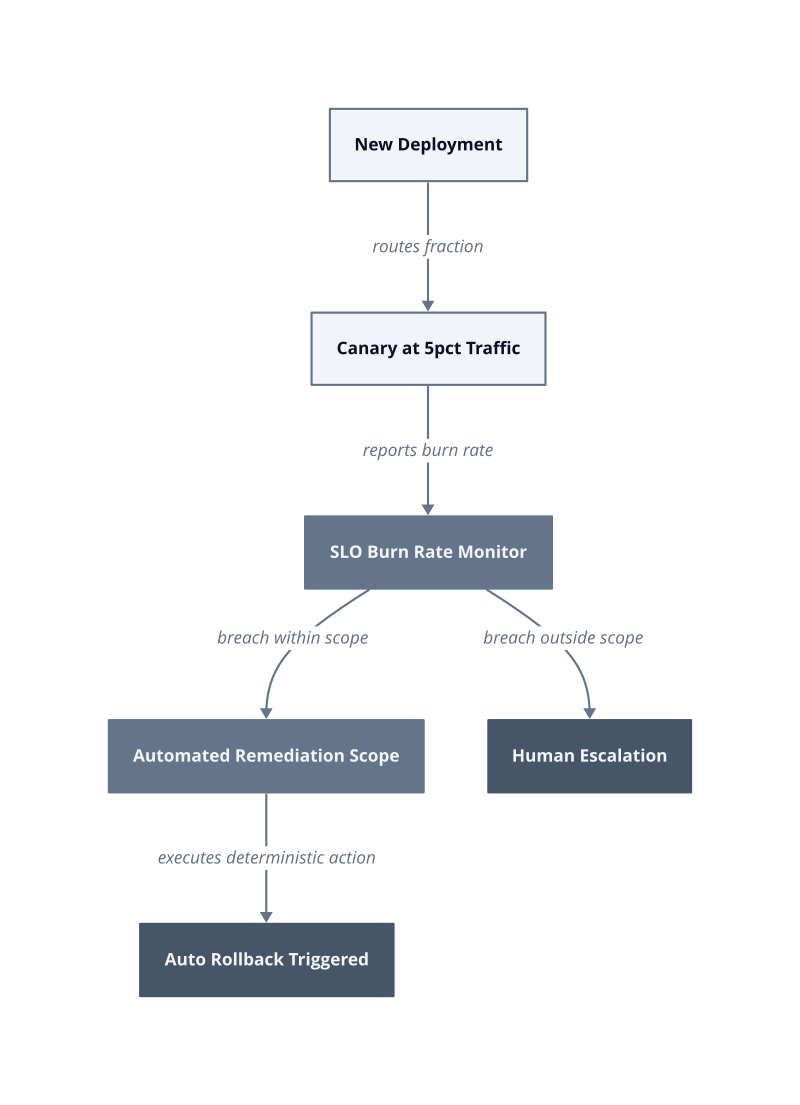
These four strategies are not independent. Chaos engineering reveals which failure modes need automated remediation. Progressive delivery limits the blast radius while SLO burn rate alerting decides when to trigger rollback. The integration point is the SLO:
| Metric | Value |
|---|---|
| Pages absorbed by scope-bounded automation | 40% |
| Canary blast radius ceiling | 5% |
| Error budget burn rate threshold for escalation | 5% per hour |
The integration point is the SLO. Every automated action, every canary rollback decision, and every chaos experiment result feeds back into the same error budget accounting. When a chaos experiment reveals a failure path that consumes 3% of the monthly error budget in a single run, that number tells you exactly how much remediation investment is justified. The budget gives the engineering decision a unit of measure.
Chaos experiments break down when the production environment differs materially from the environment where experiments run. A chaos result from staging that does not reflect production traffic patterns gives false confidence. Run experiments against production during business hours, with a human watching, before trusting the automation to handle the same failure unattended at 2 a.m.
Progressive delivery fails when deployment tooling and monitoring are not integrated at the pipeline level. A canary that requires a manual check to trigger rollback is not progressive delivery. It is a slower version of the same binary deployment risk. The rollback decision must be made by the SLO monitor, not by an engineer refreshing a dashboard.
The practical starting point is a 30-day audit of your alert log. Classify each page into three buckets: resolved by restart or scaling, resolved by rollback, and resolved by novel diagnosis. The first two buckets are automation candidates. The third bucket is the irreducible human work. In our testing, most platform teams find the third bucket represents fewer than 20% of total pages. That means more than 80% of what currently wakes an engineer is executable by a machine, given a defined scope and a reliable SLO signal to trigger it.
Build the automation for your two highest-frequency page types first. Measure page volume after 30 days. That number is your baseline for every rotation staffing conversation going forward.
Making On-Call a Safety Net, Not a Load-Bearing Wall
On-call rotation becomes a structural liability the moment it substitutes for engineering work that should have happened at design time. The previous sections established how failures reach engineers. This section addresses how to ensure they rarely do.
The framing shift is precise: on-call is a safety net, not a load-bearing wall. A safety net catches the rare, unexpected fall. A load-bearing wall holds the building up every day. When rotation engineers are resolving the same restart-and-scale incidents week after week, the rotation is load-bearing. That is an architecture problem wearing an operations costume.
Runbook coverage as a prerequisite. A runbook is a documented, step-by-step procedure for resolving a known failure class. If a failure type has no runbook, it has no automation candidate. Start by requiring a runbook for every page that fires more than twice in a quarter. The act of writing the runbook forces the team to decide whether the procedure is deterministic enough to automate. If it is, the runbook becomes the automation spec. If it is not, the runbook at least reduces resolution time for the human who inherits the page.
Rotation scope as a policy decision. Engineering leaders must define explicitly what on-call engineers are authorized to do. Restart a pod, yes. Modify a production database schema, no. Without a written scope, engineers make those decisions alone at 2 a.m. under stress, which produces inconsistent outcomes and, occasionally, cascading failures triggered by the responder rather than the original fault. We built a scope document for a platform team in the first deployment week of a new service. By sprint 3, the number of escalations that required a second engineer dropped by half, because responders knew their authority boundary and stopped improvising outside it.
Incident review cadence as a feedback loop. A weekly review of the prior week’s pages, focused on root cause and prevention rather than blame, is the mechanism that converts incident history into system improvements. Without that cadence, the same failure classes recur indefinitely. The review meeting should produce exactly one artifact: a ticket for a remediation action, assigned to a specific owner, with a deadline. Reviews that produce discussion but no ticket produce nothing.
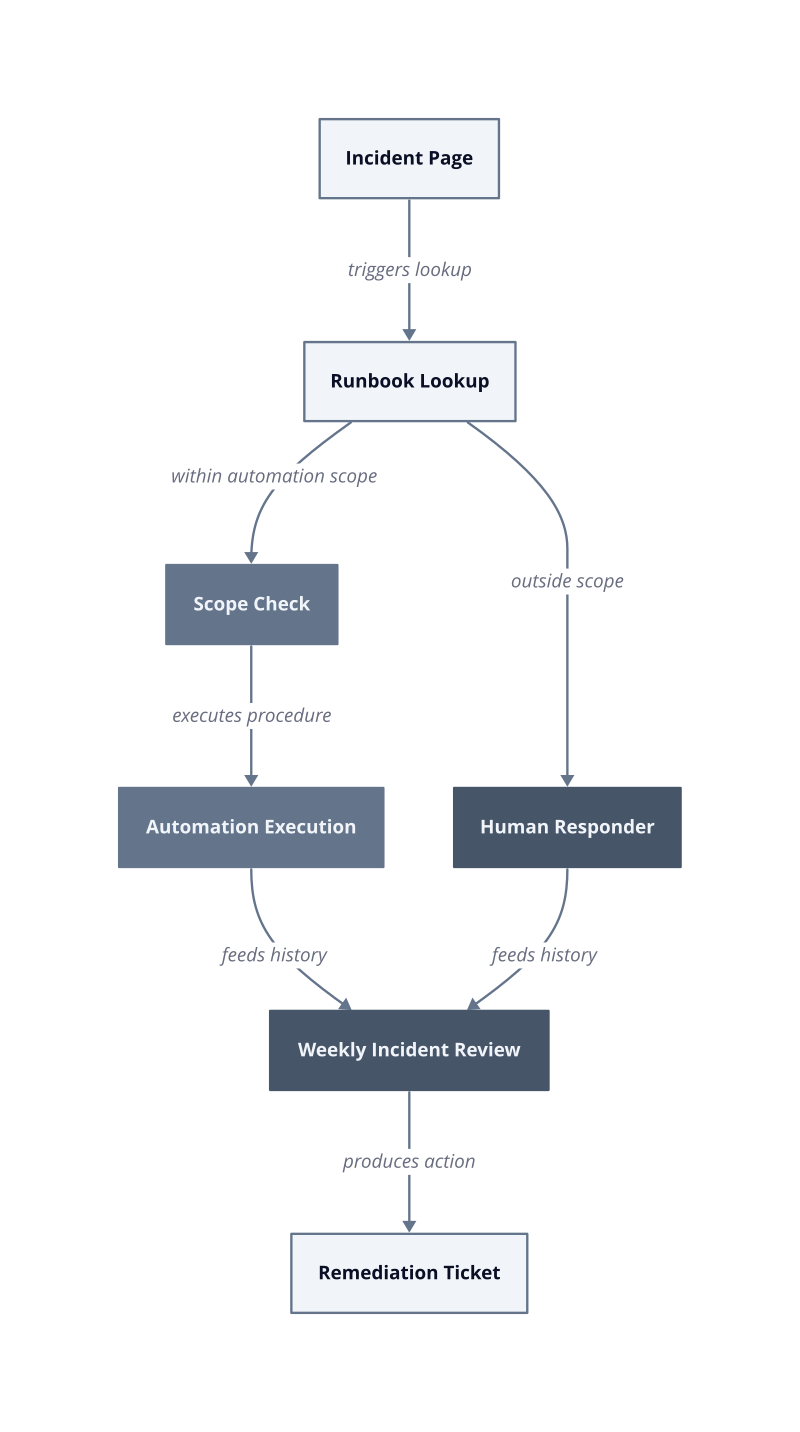
The rotation staffing model follows directly from this structure. Once you have 30 days of data classifying pages by resolution type, the rotation size needed to cover genuine human work becomes a defensible number rather than a guess. Teams that complete this classification consistently find the irreducible human work is a fraction of total page volume. Staff the rotation to that fraction. Automate the rest. That is the only staffing conversation worth having.
