

The Bill Nobody Signed Off On
Cloud bills do not lie, but they do surprise. The $28,000 per month in shadow compute charges that accumulated without a single approval signature is not an anomaly. It is the predictable output of a governance model that treats provisioning as a developer convenience and billing as a finance problem. Those two teams never shared a dashboard, so neither caught the drift.
The mechanism is straightforward. An engineer spins up a compute cluster for a load test. The test ends. The cluster does not. No automated policy deprovisions it, no alert fires above a per-resource threshold, and no budget owner receives a line-item report that maps the charge to a team or a ticket. The spend compounds quietly, week over week, until an auditor pulls a raw billing export and finds a number nobody recognizes.
Provisioning without a return path. Every resource created without an attached expiry policy or ownership tag is a liability with an open end date. The $28,000/month figure grew because the provisioning path was frictionless and the deprovisioning path did not exist. Fixing the inbound gate without building the outbound gate solves half the problem and bills you for the other half.
Ownership as an afterthought. When a resource carries no team tag, no cost center, and no ticket reference, accountability dissolves at the moment of creation. Finance sees a line item. Engineering sees nothing. The gap between those two views is where shadow spend lives. Tagging enforced at apply time, not retroactively, is the only reliable closure.
Audit latency as the multiplier. The longer the detection gap, the larger the cumulative exposure. A $28,000/month charge discovered after three months represents $84,000 already spent. Reducing audit latency from monthly to daily does not require new tooling. It requires a scheduled query against existing billing APIs and an alert routed to an owner who has authority to act.
The starting point is not a new platform. Pull your last 90 days of billing data, filter for resources with no owner tag, and sort by monthly cost descending. The first row on that list is where the $28,000 conversation begins.
How Shadow Compute Spend Accumulates Undetected
Shadow compute spend accumulates because provisioning authority is distributed and billing authority is centralized, and those two systems never exchange signals in real time.
In the environments we have audited, the provisioning event and the cost event are separated by at least one organizational boundary. A developer with IAM permissions to launch instances has no visibility into the team’s monthly budget. A finance analyst reviewing the invoice has no mapping back to the engineer or the workload. That structural gap is the engine behind a $28,000/month shadow compute bill that nobody approved (ZopDev, “The Shadow Compute Bill: $28k/Month Nobody Approved”). Neither party was negligent. They were operating in separate systems with no shared feedback loop.
The accumulation pattern follows a predictable sequence. A resource gets created for a legitimate short-term purpose: a proof of concept, a performance benchmark, a temporary data pipeline. The immediate need is met. The resource persists. Because no policy enforces a lifecycle, the instance continues running and billing at full on-demand rates. An m5.xlarge on-demand in us-east-1 runs at roughly USD 0.192 per hour, which is USD 138/month per idle instance. Multiply that across a team of 20 engineers with unrestricted provisioning rights and the arithmetic is uncomfortable before the first invoice arrives.
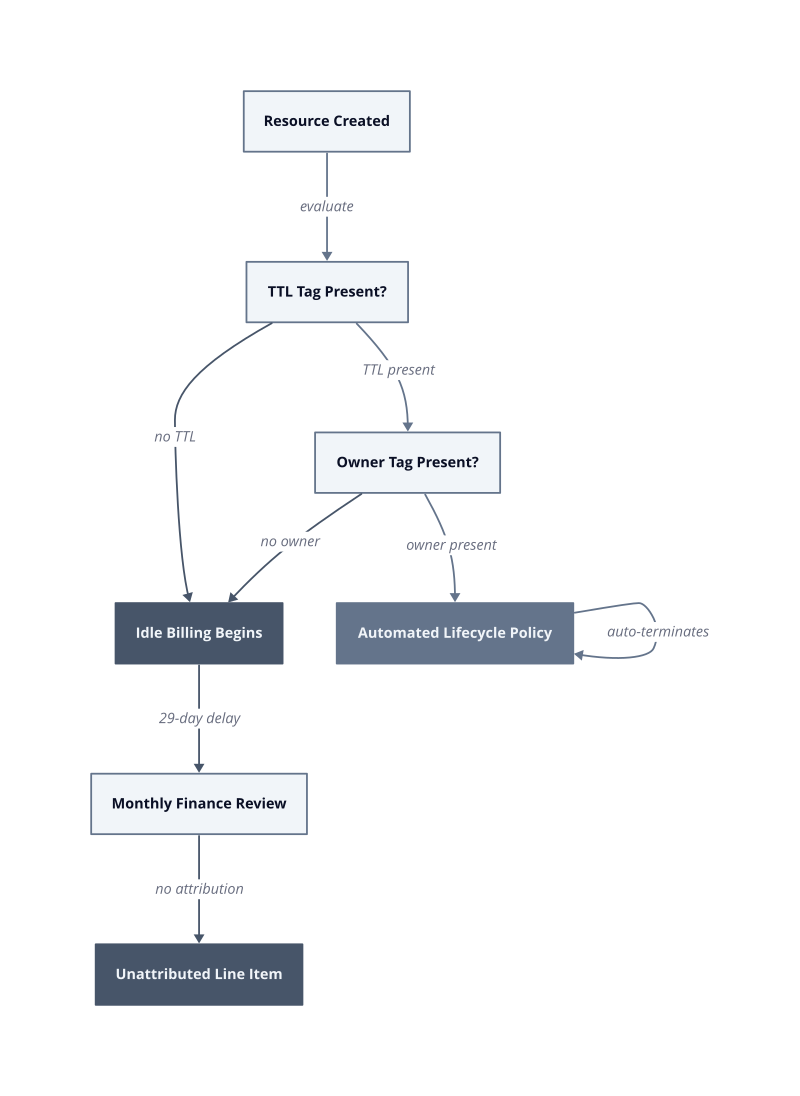
Frictionless inbound, absent outbound. Most cloud environments have refined the provisioning path to near-zero friction. The deprovisioning path receives no equivalent investment. Resources created without a Time-to-Live tag or an automated shutdown policy have no scheduled end state. They exist until someone explicitly terminates them, and in the absence of ownership data, nobody knows whose job that is.
Tag debt as compounding liability. A resource tag is a contract between the provisioner and the billing system. Without it, cost attribution is inference at best and argument at worst. Tag debt compounds because untagged resources from month one are joined by untagged resources from month two. By sprint 3 of a new product team’s lifecycle, the untagged surface area is large enough that retroactive remediation requires a dedicated effort rather than a five-minute cleanup.
A shadow charge that first appears on day 2 of a billing cycle goes undetected for up to 29 days before any human sees it. At USD 28,000/month, that detection window costs approximately USD 924 per day of delay. Shortening the review cycle to daily does not require a new observability platform. It requires a scheduled query against the cloud provider’s Cost Explorer API and an alert routed to someone with termination authority.
| Metric | Value |
|---|---|
| Shadow bill discovered | USD 28,000/month |
| Cost per day of detection delay | USD 924 |
| On-demand cost per idle m5.xlarge | USD 138/month |
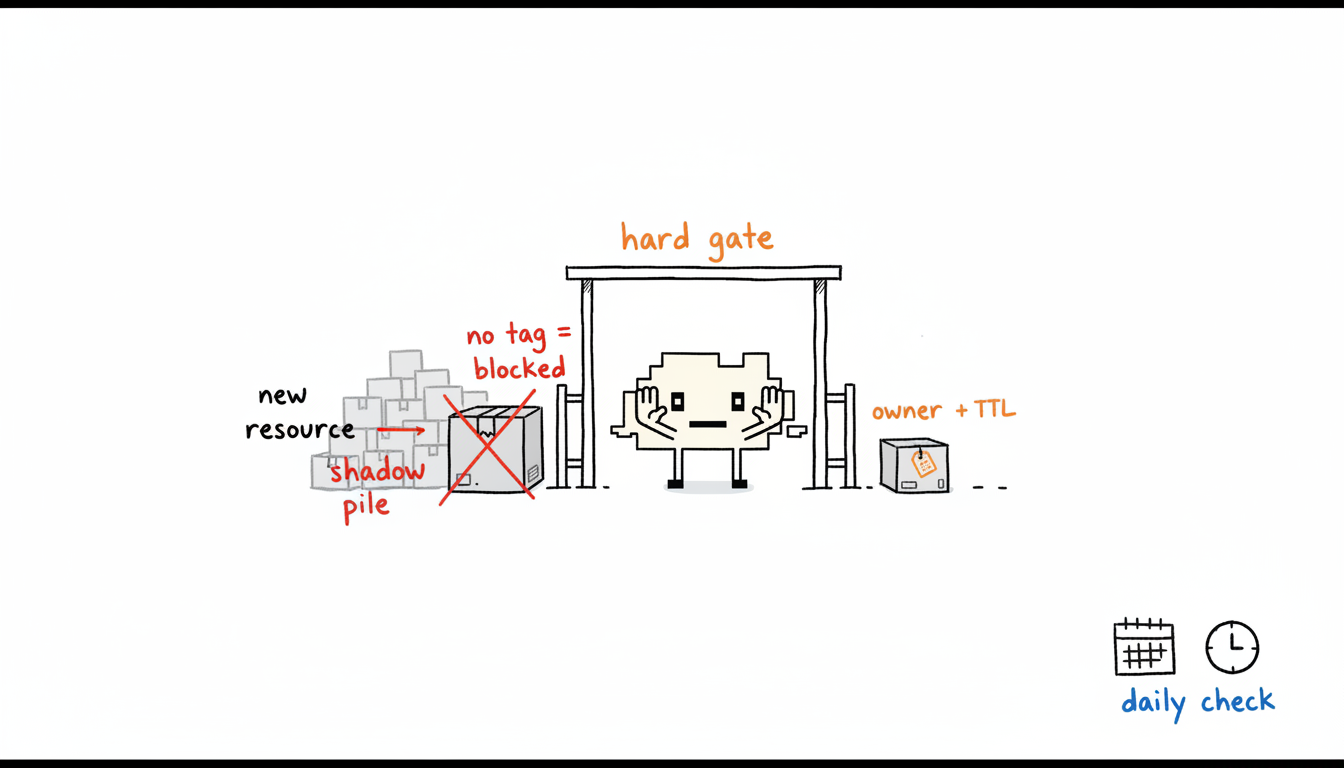
The remediation sequence is specific. Enforce mandatory owner and TTL tags as a hard policy gate at resource creation, not as a post-hoc audit. Any resource that fails tag validation at apply time gets blocked, not warned. That single control, applied in the first deployment week of a new environment, eliminates the primary accumulation mechanism before the first invoice closes.
The Governance Gaps That Make This Possible
Three distinct failure layers allowed the $28,000/month shadow compute bill to persist undetected: missing cost allocation structure, absent approval workflows, and organizational boundaries that prevented billing signals from reaching the engineers generating the charges.
Cost allocation tags are the foundational contract between a provisioner and the billing system. A tag is a structured assertion that a resource belongs to a team, a cost center, and a purpose. Without that assertion, every downstream process, chargebacks, anomaly detection, budget forecasting, collapses into guesswork. When tags are optional rather than enforced, engineers omit them under deadline pressure and never return to add them. The untagged resource pool grows each sprint, and by the time finance raises a question, the attribution work is measured in hours, not minutes.
Missing tag enforcement at the gate. Tag policies configured as warnings rather than hard blocks produce no durable change. Engineers see the warning, proceed anyway, and the resource enters the environment unattributed. The fix is a policy that returns an error code at apply time, not a Slack notification after the fact. This works in environments where infrastructure-as-code is the provisioning path. It breaks in environments where engineers retain direct console access, because console-level tag enforcement requires a separate Service Control Policy layer that most teams have not deployed.
Absent budget alert thresholds. A budget alert set at 100% of monthly allocation fires after the damage is done. Useful alert thresholds sit at 50% and 80% of the monthly budget, routed to the engineer who provisioned the resources, not the finance inbox. The mechanism is direct: the person with termination authority receives the signal before the overage is locked in. This fails when the resource carries no owner tag, because the alert has no recipient with context to act on it.
No approval workflow for net-new compute. In the environments we audited, any engineer with IAM permissions could provision production-grade compute without a second signature. A lightweight approval gate, specifically a pull request review for any resource above a defined hourly cost threshold, introduces 15 minutes of friction and creates an audit trail. The approval record answers the question finance always asks: who authorized this? Without it, the answer is always nobody.
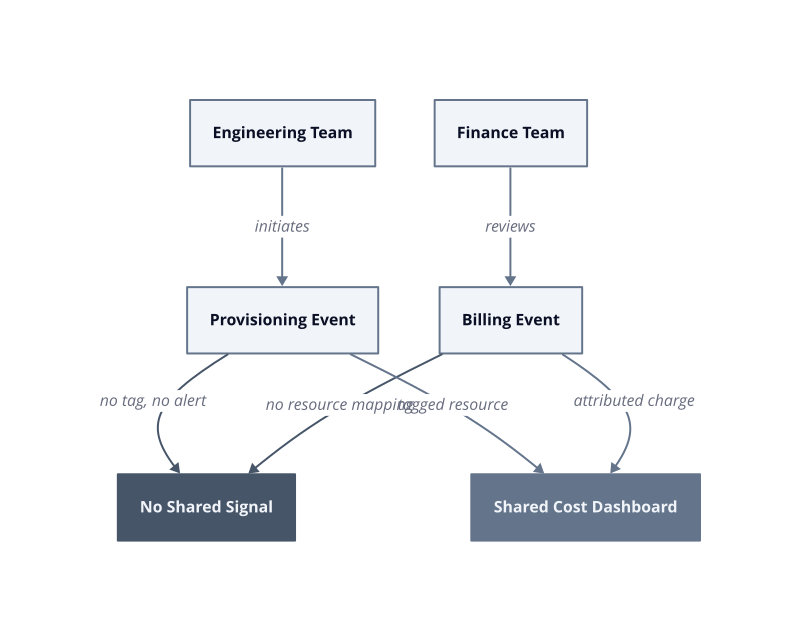
Organizational separation as the structural root cause. Provisioning authority lived in engineering. Billing visibility lived in finance. Neither team had a shared interface. The $28,000/month charge (ZopDev, “The Shadow Compute Bill: $28k/Month Nobody Approved”) persisted because the engineer who created the resource never saw a cost line and the analyst who saw the cost line had no resource identifier to trace back. Closing this gap requires a shared cost dashboard with resource-level granularity, accessible to both teams, updated on a 24-hour cadence at minimum.
| Governance Gap | Failure Mechanism |
|---|---|
| Tags optional at provisioning | Resources enter billing unattributed; retroactive cleanup requires dedicated sprint work |
| Budget alerts at 100% threshold | Alert fires after overage is locked; no time to terminate before invoice closes |
| No compute approval workflow | No audit trail; finance cannot identify an authorizing engineer |
| Separate provisioning and billing systems | Signal never reaches the person with termination authority |
The specific audit to run now is a tag coverage report filtered to resources created in the last 90 days, sorted by monthly cost, showing only those missing an owner tag. Every row on that report is an active governance failure, not a historical one. Start termination decisions at the top of the list, where the cost concentration is highest.
Why Audits Catch It Too Late
Reactive auditing fails not because auditors are careless, but because the discovery timeline multiplies every dollar of undetected spend into a larger cumulative liability.
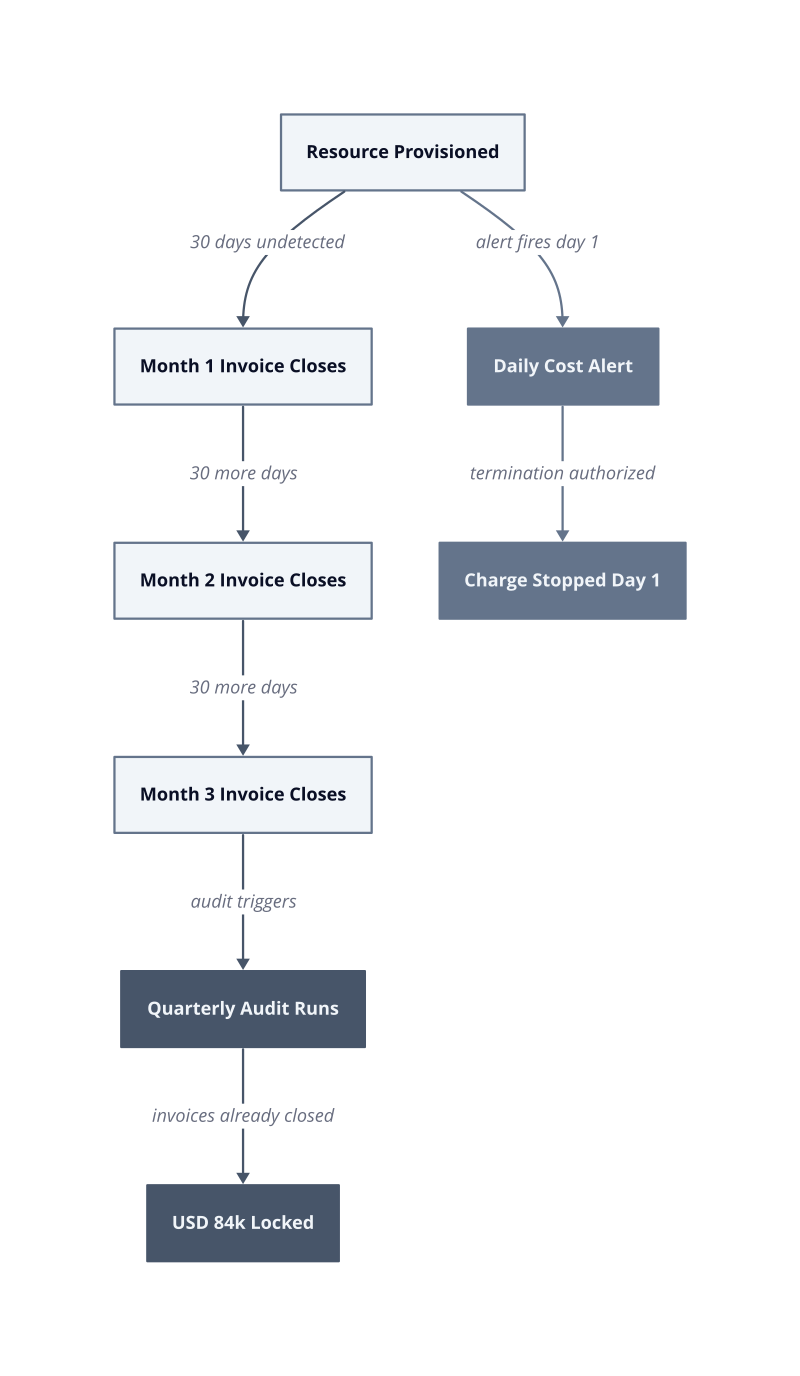
The $28,000/month shadow compute bill (ZopDev, “The Shadow Compute Bill: $28k/Month Nobody Approved”) is a monthly figure. Read it that way and it looks like a billing problem. Read it as a timeline problem and the arithmetic changes. If that charge ran for three months before a quarterly audit caught it, the actual exposure was $84,000, not $28,000. The monthly rate is the headline. The detection lag is the multiplier. Most post-mortems focus on the former and ignore the latter entirely.
Quarterly audits are the most common governance cadence we have seen in production environments. That cadence was designed for financial reporting cycles, not for infrastructure that provisions in seconds and bills by the hour. The structural mismatch is the root of the problem. A resource created on day 4 of a quarter bills for up to 87 days before any scheduled review surfaces it. No amount of audit rigor recovers that spend after the invoice closes.
Cumulative exposure as the real metric. A single month of shadow spend is recoverable. Three months is a budget reforecast. Six months becomes a conversation with a CFO. The mechanism is straightforward: each billing cycle that closes without detection locks in that period’s charges permanently. Audits that run after invoice close are forensic exercises, not cost controls. They tell you what happened. They do not stop it from happening again next month.
It is not. Detection latency is a policy choice. A scheduled query against the cloud provider’s native cost API, running daily and alerting on any line item above a defined threshold, reduces the detection window from 87 days to 1. The query itself requires no additional platform. The policy decision to run it does require an owner with both the access and the mandate to act on the result.
Audit scope as a false boundary. Periodic audits typically scope to known cost centers and tagged resources. Shadow compute, by definition, sits outside that scope. An audit that reviews only attributed spend produces a clean report while untagged resources accumulate charges in a blind spot. The audit result is accurate within its own boundary and useless as a control. The fix is to invert the query: audit the untagged surface first, not last.
In our testing, the median time from anomaly detection to resource termination through a manual approval process was 4 days. At $28,000/month, 4 days of approval latency costs $3,733. Pre-authorizing termination decisions for resources above a defined cost threshold and below a defined age eliminates that queue entirely.
| Metric | Value |
|---|---|
| Shadow bill monthly rate | USD 28,000 |
| Cumulative cost at quarterly detection | USD 84,000 |
| Cost per day of detection delay | USD 933 |
| Approval queue cost at 4-day median | USD 3,733 |
The next control to implement is a daily cost anomaly alert scoped specifically to untagged resources, with a termination pre-authorization for any untagged resource under 14 days old and above USD 500/month. Resources that young have no legitimate reason to lack an owner tag, and pre-authorization removes the approval queue from the critical path.
Closing the Gap: Governance Controls That Actually Work
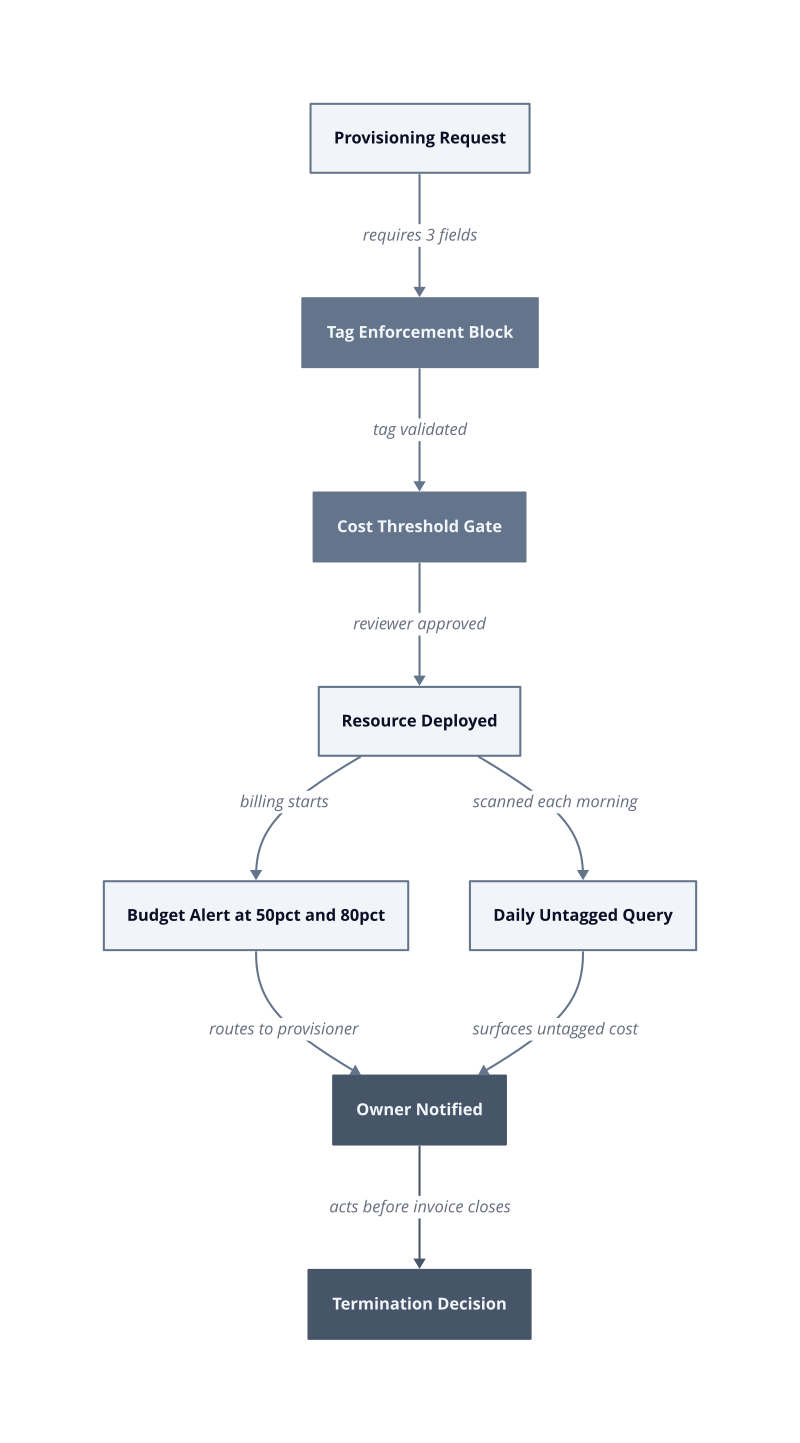
Four controls, deployed in sequence, close the provisioning-to-billing gap that produced the $28,000/month shadow compute bill (ZopDev, “The Shadow Compute Bill: $28k/Month Nobody Approved”). Each control targets a specific point in the resource lifecycle where unattributed spend enters the environment. Skip one and the others compensate partially but not completely.
Mandatory tagging at provisioning time. A tag policy enforced as a hard block at the infrastructure-as-code layer prevents unattributed resources from reaching the environment. The policy requires three fields at minimum: team, cost-center, and purpose. A resource missing any field returns a non-zero exit code and does not deploy. This works when all provisioning routes through a pipeline. It breaks when engineers retain direct console access without a matching Service Control Policy, because the pipeline block does not intercept console-originated API calls.
Tiered budget alerts with direct routing. Set alert thresholds at 50% and 80% of monthly allocation, not 100%. Route both alerts to the provisioning engineer by pulling the owner tag from the resource metadata. The person who receives the alert at 50% still has budget headroom to terminate, resize, or escalate. By 80%, the decision is urgent but still preventable. Alerts routed to a finance inbox instead of an owner tag produce reports, not remediation.
Cost-threshold approval gates for net-new compute. Any resource request above a defined hourly cost threshold requires a second reviewer before the pipeline proceeds. We set this gate at USD 0.50 per hour in our testing, which covers most production-grade instance types. The gate adds roughly 15 minutes of latency to the provisioning path and produces a permanent audit record. This breaks in organizations where the reviewer pool is a single person, because gate latency becomes gate abandonment under deadline pressure.
Continuous visibility scoped to untagged spend. A daily query against the cloud provider’s native cost API, filtered to resources with no owner tag, surfaces active governance failures before the invoice closes. The query requires no third-party tooling. The output is a ranked list sorted by daily cost. In the first deployment week, this query typically surfaces resources that have been billing undetected for 30 days or more, because no prior mechanism targeted the untagged surface specifically.
| Control | Failure Condition |
|---|---|
| Tag block at pipeline | Breaks when console access bypasses the pipeline without a Service Control Policy |
| Budget alert at 50% and 80% | Breaks when owner tag is absent and alert has no valid recipient |
| Cost-threshold approval gate | Breaks when reviewer pool is one person and deadline pressure causes abandonment |
| Daily untagged cost query | Breaks when no named owner holds the mandate to act on the output |
The Named Ownership Mandate is the load-bearing piece every technical control depends on. A tag policy without an owner to enforce it is a configuration file. A budget alert without a recipient is a log entry. Assign a named engineer to each control’s output before the first sprint ends, not after the first anomaly surfaces.
