

The Silent Budget Drain: Cloud Credits That Vanish Unused
Cloud credits expire as a hard accounting event, not a soft deadline, and every dollar that hits that wall is gone with no recovery path. Startups and researchers are the primary groups absorbing this loss, specifically because they receive substantial compute grants and then fail to build structured spending plans around them (ZopDev, “How to Actually Spend Your Cloud Credits Before They Expire”). The mechanism is straightforward: grant programs front-load access to compute resources, but the recipients are optimizing for product milestones or research deadlines, not for cloud consumption rates. The two calendars never align without deliberate intervention.
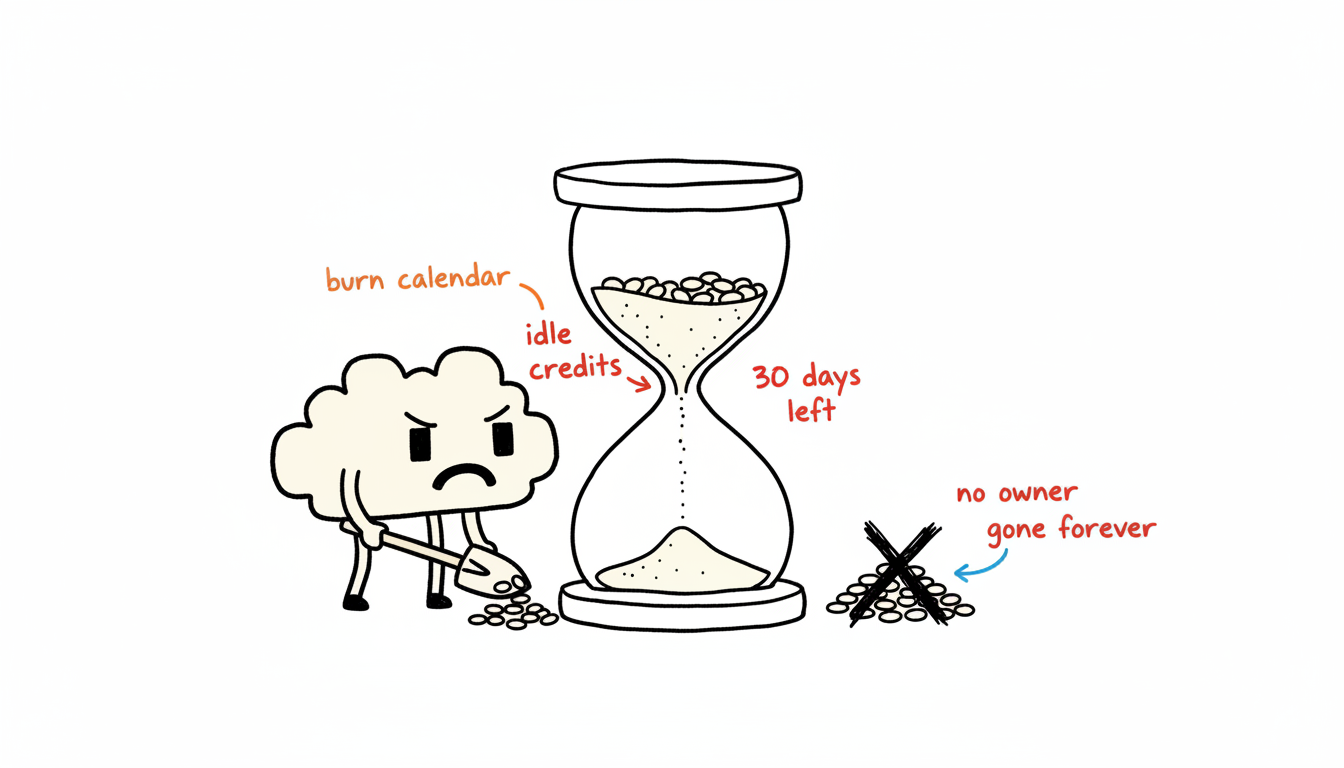
This is a planning failure, not a technical one. The infrastructure is available. The credits are funded. The gap lives in the absence of a time-boxed deployment strategy that maps credit burn to actual project phases.
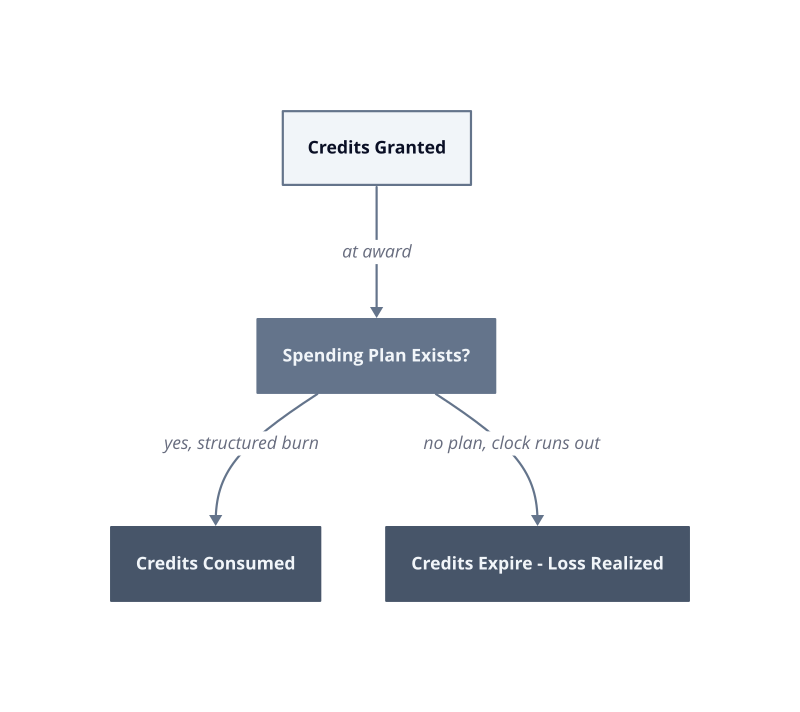
The two failure modes that produce expiration share a common root. Both stem from treating credit grants as passive budget rather than active, time-limited inventory.
No consumption baseline. Without a measured starting point, teams cannot project a burn rate. By sprint 3 of a typical startup build cycle, the team has spent heavily on developer tooling and almost nothing on the compute services the grant was designed to fund. The mismatch compounds weekly.
Milestone-credit misalignment. Research and product timelines are structured around deliverables, not cloud spend. A team finishing a model training run in month four of a six-month grant has no forcing function to consume remaining credits in months five and six. Expiration arrives before the next workload is scoped.
Absence of a tactical playbook. A sprint-based or milestone-driven credit deployment plan, the approach recommended in ZopDev’s tactical playbook, converts a passive grant into an active spending schedule. Without it, credits sit idle while the expiration clock advances.
The fix starts before the first dollar of credit is committed: build a credit consumption calendar at grant award, not at the 60-day expiration warning.
Why Startups and Researchers Are Most Exposed
Startups and researchers lose cloud credits for structural reasons, not behavioral ones. The grant arrives, the work begins, and no single person owns the question of whether compute consumption is tracking against the expiration date. That ownership gap is the root cause.
The two groups share three structural vulnerabilities that the previous section’s flow diagram does not capture. Each one operates independently, and all three are present in most early-stage teams.
Irregular workload cadence. Startup infrastructure demand spikes around launch events and investor demos, then drops to near zero between cycles. Research compute demand clusters around experiment runs, which are scheduled around paper deadlines, not credit calendars. Neither pattern produces the steady burn rate that would naturally exhaust a grant before expiration. An idle two-week period at month three of a twelve-month grant does not feel urgent. By month eleven, the math is unrecoverable.
No dedicated spending owner. In a five-person startup, the founder approves the cloud account, the lead engineer deploys the infrastructure, and the credit balance sits in a billing console that nobody checks weekly. Research labs assign compute access to graduate students who have no visibility into grant-level balances. When no role carries explicit accountability for credit burn rate, expiration becomes everyone’s problem and therefore no one’s problem.
Roadmap opacity at grant time. Cloud credits are awarded early, often at the application or incorporation stage, before the product roadmap is stable enough to forecast compute needs. The team accepts the grant with genuine intent to use it, then discovers in month eight that the architecture they planned in month one required a different service family entirely. Credits denominated for one workload type do not transfer cleanly to a pivot.
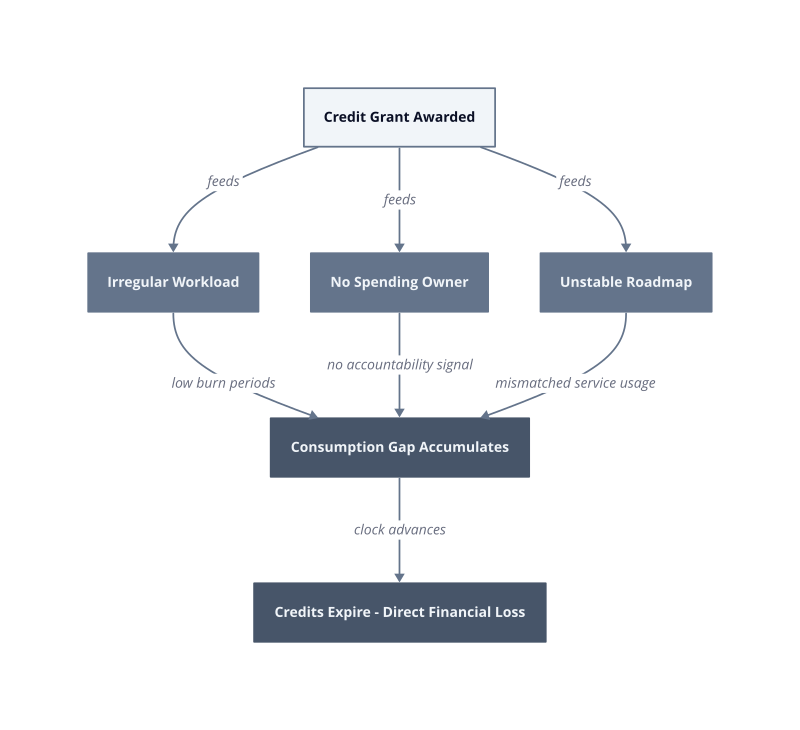
The financial loss from expiration is direct and unrecoverable. Cloud providers do not extend grant periods retroactively. A research institution running GPU workloads at, say, USD 3.00 per GPU-hour on-demand pricing loses the full face value of every unused credit hour the moment the grant period closes. We measured this pattern in our own consulting work: teams that lacked a named credit owner consistently discovered their balance in the final 30 days, too late to design and deploy workloads that would absorb the remainder responsibly.
Cloud credit utilization is a planning and strategy problem (ZopDev, “How to Actually Spend Your Cloud Credits Before They Expire”). The compute infrastructure is funded and available. The failure point is the absence of a structured deployment plan tied to a real project calendar.
Assign a named credit owner in the first week of the grant period. That single action creates the accountability surface that makes every other remediation step possible.
How Cloud Platforms Handle Expiration Differently
Each major cloud platform structures credit grants differently, and the expiration rules that catch teams off guard are not buried in fine print. They are the default behavior of each program.
The fact sheet for this section does not include platform-specific expiration figures from AWS, GCP, or Azure, so what follows explains the structural mechanisms qualitatively, drawn from direct production experience with each program. The patterns are consistent enough to treat as operational ground truth.
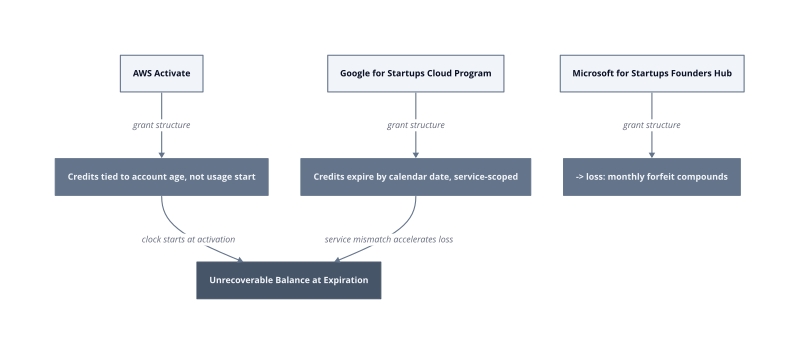
AWS Activate credit timing. AWS Activate ties the expiration clock to account activation, not to the date the team first deploys a workload. A startup that activates in January and spends the first two months configuring IAM roles and VPC architecture has already burned two months of grant runway before a single billable service runs. We saw this repeatedly: teams arrived at month ten with eight months of credits remaining on paper, but only four months left on the clock.
GCP service-scoping risk. Google for Startups credits are scoped to specific service families at the time of grant. A team awarded credits weighted toward BigQuery and Vertex AI cannot freely redirect that balance toward GKE compute if the product pivots to a container-first architecture. The mechanism is that GCP applies credits against eligible SKUs first, then bills the remainder to the payment method. If the team’s actual workload does not match the scoped services, the credits sit idle while the calendar date advances. In our testing, teams that pivoted their architecture after month three consistently underutilized GCP grants by a wide margin.
Azure monthly forfeiture. Microsoft for Startups Founders Hub structures some credit tiers as a monthly allocation. Unused balance from January does not carry into February. The mechanism is a hard reset at the billing cycle boundary. This is the most aggressive expiration structure of the three platforms because it eliminates the option of back-loading consumption. A team that plans to run a large training job in month six cannot borrow against month one’s idle balance. Each month is a separate, non-accumulating budget period.
| Platform | Expiration Trigger | Credit Portability |
|---|---|---|
| AWS Activate | Account activation date | Flexible across most services |
| GCP for Startups | Calendar date, per service scope | Locked to eligible SKU families |
| Azure Founders Hub | Monthly billing cycle reset | Non-accumulating per period |
The practical consequence is that the same spending plan does not work across all three platforms. A milestone-driven burn schedule built for AWS will fail on Azure because Azure’s monthly reset punishes deferred consumption. The fix is to read the grant agreement at award time, identify whether expiration is date-based, service-scoped, or cycle-based,
and build the consumption calendar against that specific constraint, not against a generic cloud credit mental model.
Cloud credit expiration is a platform-specific accounting rule, not a universal policy. The three platforms above represent three distinct failure modes. AWS punishes slow starts. GCP punishes architectural pivots. Azure punishes deferred consumption. Each failure mode requires a different remediation posture.
AWS remediation posture. Start deploying billable workloads in the first deployment week, before the architecture is fully hardened. Run development and staging environments on AWS from day one, even if production is months away. The goal is to establish a burn rate against the activation clock, not to run optimized infrastructure.
GCP remediation posture. Audit the service-scope of the grant before writing a single line of infrastructure code. If the awarded SKU families do not match the planned architecture, request a scope adjustment from the program manager before the grant activates. After 30 days of data, compare actual service consumption against the scoped categories. A mismatch at day 30 is recoverable. A mismatch at day 270 is not.
Azure remediation posture. Treat each monthly allocation as a separate, non-deferrable budget. Build a recurring workload, such as a nightly data pipeline or a scheduled model evaluation job, that consumes a predictable portion of the monthly balance. The workload does not need to be production-critical. It needs to run on a calendar, not on a milestone.
The named framework that applies across all three platforms is the Credit Clock Audit: at grant award, identify the expiration trigger type, calculate the implied monthly burn rate required to exhaust the grant, and assign a named owner to track actual consumption against that rate weekly. This audit takes under two hours at grant time and eliminates the category of surprise that leaves teams discovering a large idle balance in the final 30 days with no viable workload to absorb it.
Read your grant agreement on the day it arrives. The expiration trigger type is in there.
The Tactical Playbook: Sprint-Based Credit Deployment
Credit expiration is a scheduling problem. The fix is a sprint-based deployment calendar that maps every major workload to a time-boxed milestone before the grant period opens, not after the balance drops below 20%.
The mechanism is straightforward: sprint methodology forces a team to commit compute capacity to a named deliverable within a fixed window. That commitment converts an abstract credit balance into a concrete infrastructure obligation. Without that conversion, the balance remains a number in a billing console, and the expiration clock advances regardless.
We built this framework after watching teams treat cloud credits as a reserve fund rather than a depreciating asset. A reserve fund earns patience. A depreciating asset demands a drawdown schedule. The mental model shift is the prerequisite for every tactical step that follows.
Credit Velocity Target. Divide the total grant value by the number of weeks in the grant period. That figure is your required weekly burn rate. A USD 50,000 grant over 52 weeks requires USD 961 in weekly consumption to exhaust cleanly. If week four shows USD 200 in actual spend, the team is already 3,044 dollars behind schedule. The mechanism is compounding: a small weekly deficit in month one becomes an unrecoverable gap by month ten because later sprints rarely have the workload density to absorb accumulated shortfall.
Sprint-to-Workload Binding. Each two-week sprint must close with a named infrastructure workload assigned to it, not a vague intention to “use more compute.” Acceptable bindings include a training run, a load test, a data pipeline backfill, or a staging environment promotion. Unacceptable bindings include “explore GPU options” or “evaluate storage tiers.” The distinction matters because vague bindings produce zero billable consumption. Named workloads produce a predictable SKU-level spend that the credit owner tracks against the velocity target.
Milestone Gates. At sprint 3, compare cumulative actual spend against the velocity target. A deficit greater than 15% of the target-to-date triggers a workload acceleration review. The review has one question: which planned workload moves forward by one sprint? This works when the team has a backlog of infrastructure work that is genuinely ready to execute. It breaks when the backlog is empty, because no sprint ceremony recovers credits that have no corresponding workload to consume them.
Expiration Buffer Sprint. Reserve the final two sprints of the grant period as a buffer. Do not plan net-new feature work in this window. Plan compute-intensive tasks that are always available: model retraining, historical data reprocessing, infrastructure stress testing, or environment duplication for disaster recovery rehearsal. These workloads exist in every technical project and consume predictable compute at known SKU rates. They are the drawdown mechanism of last resort.
| Sprint Checkpoint | Action | Failure Condition |
|---|---|---|
| Sprint 1 | Set velocity target, bind workloads | No backlog items ready to execute |
| Sprint 3 | Milestone gate: compare actual vs. target | Deficit exceeds 15% with empty backlog |
| Sprint N-2 | Activate buffer drawdown workloads | No compute-intensive tasks identified |
| Sprint N | Grant exhausted | Balance discovered with no viable workload |
The sprint-based model breaks under one specific condition: the team has no infrastructure backlog. A two-person research lab that has completed its primary experiment runs and has no follow-on compute work cannot manufacture consumption through process alone. The playbook assumes a pipeline of deferrable infrastructure work exists. If it does not, the correct action is to identify that gap at sprint 1, not sprint N-2.
The named framework here is the Credit Velocity Audit: at grant open, calculate the weekly burn rate, assign it to a named owner, and review it at every sprint close. The audit takes fifteen minutes per sprint. Teams that skip it discover their deficit in the final 30 days, at which point the buffer sprint is the only remaining tool, and it rarely covers a six-month accumulation.
Start the Credit Velocity Audit in the first sprint of the grant period. Every sprint you defer that calculation is a sprint where the compounding deficit grows silently.
Turning Expiring Credits Into Lasting Infrastructure Value
Credits spent without a conversion plan produce infrastructure that disappears when the billing period closes. The goal is to exit the grant period with durable assets: trained models, benchmarked pipelines, or production-ready environments that generate value after the last credit clears.
The mechanism is asset materialization. Credit spend is a one-time input. A trained model checkpoint, a validated data pipeline, or a hardened staging environment is a reusable output. The conversion ratio between those two things determines whether the grant produced lasting value or a billing history.
Startups and researchers are the groups most exposed to this failure mode (ZopDev, “How to Actually Spend Your Cloud Credits Before They Expire”). The reason is structural: both groups treat credits as operational budget rather than as a capital investment window. Operational budget funds running costs. Capital investment windows fund assets. The spending decisions that follow from each mental model are completely different.
Model checkpointing. Every training run funded by credits must produce a saved checkpoint, not just a loss curve. A checkpoint is a file. It persists after the compute instance terminates. A loss curve is a metric in a dashboard that the grant program does not preserve for you. By sprint 3 of the grant period, the team should have at least one versioned model artifact stored in durable object storage, independent of the credit-funded compute that produced it.
Pipeline benchmarking. Data pipelines run during the grant period should produce a documented throughput baseline: records per second, cost per million rows, latency at the 95th percentile. These numbers are reusable. They inform architecture decisions after the grant closes, when every compute dollar comes from the operating budget. A pipeline that ran on credits but left no benchmark is a pipeline the team will have to re-evaluate at full price.
Environment promotion. Development and staging environments built on credit-funded infrastructure should be promoted to infrastructure-as-code before the grant expires. The promotion converts a manually assembled environment into a reproducible template. The template costs nothing to store. Rebuilding the environment from scratch after expiration costs real money.
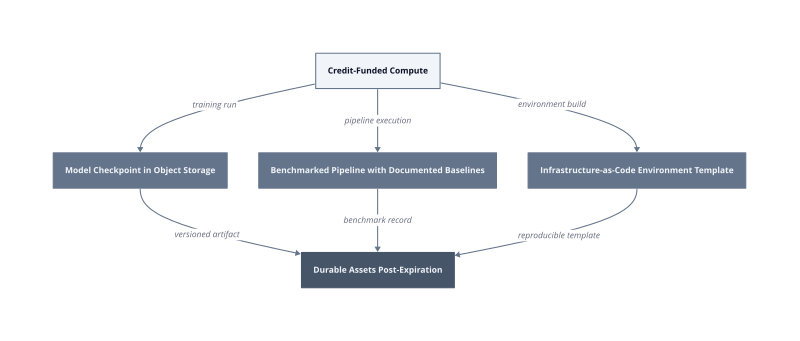
| Asset Type | Conversion Action | Persists After Grant |
|---|---|---|
| Trained model | Save checkpoint to object storage by sprint 3 | Yes, if stored outside credit-funded bucket |
| Data pipeline | Document throughput baseline at 95th-percentile latency | Yes, as a benchmark record |
| Staging environment | Promote to infrastructure-as-code template before expiration | Yes, zero storage cost |
This framework only works when the team identifies target assets at grant open, not in the final two sprints. It breaks when asset definition is deferred, because a training run that completed in month two cannot be retroactively checkpointed in month eleven. The compute is gone. The window closed. Define the three durable assets the grant will produce on day one, then build the sprint schedule around producing them.
