

The Hidden Cost Layer Beneath Free Peering
VPC peering is not free. The connection itself costs nothing, but every byte that crosses an Availability Zone boundary generates a charge, and that charge accumulates silently until the invoice arrives.
The mechanism is specific. Amazon VPC Peering documentation confirms that traffic staying within a single Availability Zone is free, even across accounts. The moment traffic crosses into a second AZ, AWS VPC pricing applies $0.01/GB in both the inbound and outbound direction. That bidirectional billing is the trap. A service sending 10 TB/month across two AZs pays $0.01 per GB twice: once to send, once to receive. The connection looked free in the architecture review. It is not free in production.
The three leading clouds handle this problem differently, and none of them make it easy to reason about upfront.
AWS charges per AZ crossing. Traffic between two peered VPCs in the same region is free only if both endpoints share one AZ. Any multi-AZ deployment, which is the standard high-availability pattern, automatically incurs the $0.01/GB bidirectional rate. Teams that architect for resilience pay for it at the network layer.
Azure charges direction by peering scope. Intra-region VNet peering carries lower transfer rates than global VNet peering. Cross-region peering bills both ingress and egress, unlike the intra-region model. A team that starts with regional peering and later expands to a second region faces a cost structure that differs from what they originally benchmarked.
GCP applies standard egress rates to peered traffic. There is no peering-specific discount on cross-region traffic. GCP treats peered inter-region traffic as normal egress, so the full per-GB rate applies. Teams comparing providers on “peering cost” alone undercount GCP’s true cross-region bill.
The table below maps the core billing dimensions across providers.
| Dimension | AWS | Azure | GCP |
|---|---|---|---|
| Intra-AZ peering fee | Free | Free (intra-region) | Free (same region) |
| Cross-AZ, same region | USD 0.01/GB each direction | Varies by tier | Standard egress rate |
| Cross-region peering | Higher than intra-region | Ingress + egress billed | Full inter-region egress rate |
| Bidirectional billing | Yes | Yes (global peering) | Yes |
The pattern that causes the largest surprise bills is a standard three-AZ deployment where services call each other across zone boundaries on every request. The fix is to map AZ topology before choosing peering as a connectivity primitive, not after the first bill arrives.
AWS: Free Peering, But Availability Zones Are the Trap
AWS charges nothing to establish a VPC peering connection, but the billing clock starts the moment traffic crosses an Availability Zone boundary, and most production architectures cross that boundary on every request.
The rule is binary. Amazon VPC Peering documentation confirms that all traffic staying within a single AZ is free, even between accounts in separate VPCs. Cross that boundary and Amazon VPC pricing applies $0.01/GB in each direction. The connection fee is zero. The topology fee is not.
The bidirectional rate is what breaks budget models. A request leaving service A in us-east-1a and arriving at service B in us-east-1b generates one $0.01/GB charge outbound and one $0.01/GB charge inbound. That is $0.02/GB per round trip, billed as two separate line items. Teams that model only the outbound direction undercount the actual cost by half.
| Metric | Value |
|---|---|
| Intra-AZ peering rate | USD 0.00/GB |
| Cross-AZ rate, each direction | USD 0.01/GB |
| Effective round-trip rate | USD 0.02/GB |
Free peering, constrained topology. The zero-fee peering connection creates an incentive to adopt VPC peering broadly, which is correct. The constraint is that the architecture must co-locate communicating services in the same AZ to realize the free tier. This works when services are stateless and AZ-local replicas are acceptable. It breaks when services depend on shared state in a specific AZ, because the consuming service cannot always co-locate with the data layer.
Standard HA patterns trigger billing automatically. A three-AZ deployment spreads instances across us-east-1a, us-east-1b, and us-east-1c. Without AZ-aware routing, a load balancer sends requests to whichever instance is available. Each cross-zone call incurs the $0.01/GB bidirectional rate. The HA architecture, which every reliability runbook requires, is also the billing trigger.
Local Zone peering carries the same rate. Traffic between a Local Zone and an Availability Zone in the same AWS Region is billed in both directions, identical to inter-AZ traffic within the main region. Teams that extend workloads to Local Zones for latency reasons face the same per-GB charge structure, not a discounted Local Zone rate.

The scale of the problem becomes concrete at modest traffic volumes. A microservice mesh exchanging a large volume of data each month across two AZs pays $0.01/GB in each direction over VPC peering connections that cross Availability Zones, meaning the total bill for both inbound and outbound can grow substantially with scale (Amazon VPC Pricing). Because AWS charges $0.01/GB in both the In and Out direction for data crossing Availability Zones over VPC peering, costs for a single high-traffic service pair accumulate in both directions before any compute, storage, or other line items are added.
The fix is AZ-aware client routing, specifically configuring service clients to prefer endpoints in the same AZ as the caller. This eliminates cross-AZ calls for the majority of traffic. It fails when the target service has only one AZ-local instance and that instance is unhealthy, because the client must then cross a zone boundary to maintain availability. The remediation is to ensure each AZ holds at least one healthy replica of every service in the call graph, so AZ-local routing never forces a cross-zone fallback under normal operating conditions.
Azure: Bidirectional Billing Makes Global Peering Expensive
Azure’s billing model for VNet peering charges both ends of a connection, and when that connection spans regions, both ends pay both directions.
The mechanism is specific. Azure Virtual Network pricing confirms that inbound and outbound traffic is charged at both ends of a peered network. The connection itself carries no compute charge, but every byte traversing the peering link generates a nominal per-GB fee twice: once at the source VNet, once at the destination. This is not an edge case. It is the documented billing behavior for all VNet peering connections.
Azure’s VNet peering overview distinguishes two peering types: virtual network peering within the same region, and global virtual network peering across regions. The intra-region rate is lower. The global rate is higher. A team that benchmarks cost against intra-region peering and then extends their topology to a second region faces a different pricing structure than the one they modeled.
| Metric | Value |
|---|---|
| Peering compute charge | USD 0.00 |
| Billing points per transfer | 2 (source and destination) |
| Peering types | 2 (intra-region, global) |
Double-billing at both ends. Because both the sending VNet and the receiving VNet are charged for each transfer, the effective cost per byte is higher than a single-direction egress model. A team moving 100 TB/month between two peered VNets pays for 100 TB outbound at the source and 100 TB inbound at the destination. The architecture review that counted one data transfer event actually produced two billing events.
Global peering compounds the base rate. When the two peered VNets sit in different Azure regions, the per-GB rate rises above the intra-region equivalent. The mechanism is that cross-region transfers consume backbone capacity between datacenters, so Azure prices global peering at a premium. A workload that runs intra-region in development and global in production will see a cost increase at the first production deployment, not gradually over time.
Compute charges absent, transfer charges present. The absence of compute charges on peering connections creates a false signal. Teams that audit costs by looking for dedicated peering resources on the invoice find nothing, because the charge attaches to data transfer line items, not to the connection object itself. The fix is filtering billing exports by the peering transfer meter, not by resource type.
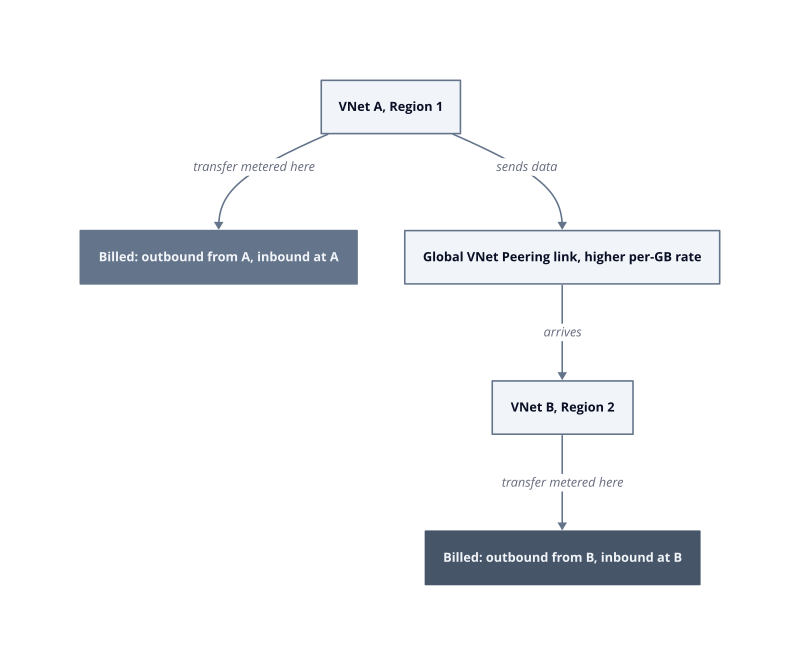
The global peering rate applies immediately on that third VNet, and both ends of every cross-region transfer generate a charge. The remediation is to model global peering costs before provisioning the second-region VNet, using published per-GB rates applied to both source and destination traffic volumes simultaneously, not to one side of the transfer alone.
GCP: Standard Egress Rates Apply With No Peering Discount
GCP applies full inter-region egress rates to peered traffic with no peering-specific discount, making it the most expensive option at scale for cross-region architectures.
The mechanism is straightforward. GCP VPC Network pricing treats traffic flowing across a VPC peering connection as standard inter-region egress. There is no bundled allowance, no peering tier, and no rate reduction for traffic that stays within the Google backbone. A byte of data crossing from us-central1 to us-east1 through a peered connection costs the same as a byte leaving an unpeered VPC to the same destination. The peering topology changes nothing about the billing rate.
This distinguishes GCP from AWS, where intra-region traffic carries a specific $0.01/GB cross-AZ rate, and from Azure, where the charge is split across two billing points. On GCP, the full per-GB inter-region rate applies at the source, in one direction, to every byte that crosses a region boundary. Teams that peer two regional VPCs to share a database or a service mesh pay standard egress for every query and response crossing that boundary.
| Metric | Value |
|---|---|
| Peering-specific discount | None |
| Billing rate for inter-region peered traffic | Standard inter-region egress |
| Cloud Router charge | USD 0.00 |
No discount layer for peered paths. The absence of a peering-specific rate is not an oversight in the documentation. GCP’s pricing page confirms standard rates apply without qualification. This matters because engineers who assume the peering setup itself signals a preferred or discounted path will produce cost models that undercount actual spend from day one of the cross-region deployment.
Cloud Router does not offset transfer costs. GCP VPC Network pricing confirms Cloud Router is provided free of charge, with general networking costs applying only to control plane BGP traffic. The free Cloud Router is accurate and useful for route propagation. It does not reduce the per-GB charge on data plane traffic. Teams that factor out Cloud Router costs correctly still face full inter-region egress rates on every byte of peered data transfer.
Scale amplifies the exposure. At high traffic volumes, the absence of any peering discount compounds quickly. A service pair exchanging 100 TB/month across two GCP regions pays full inter-region egress rates on all 100 TB. There is no threshold after which the rate steps down. The linear cost curve continues regardless of volume, until committed-use contracts enter the picture.
The committed-use question is unresolved. Whether sustained-use discounts or committed-use contracts reduce the effective per-GB rate on VPC peering data transfer is not documented in GCP’s published pricing. The mechanism for compute committed-use contracts is well-established, but its applicability to networking charges on peered traffic is not confirmed. Teams projecting annual spend on cross-region peering cannot assume a committed-use discount will apply without explicit confirmation from a GCP account representative.
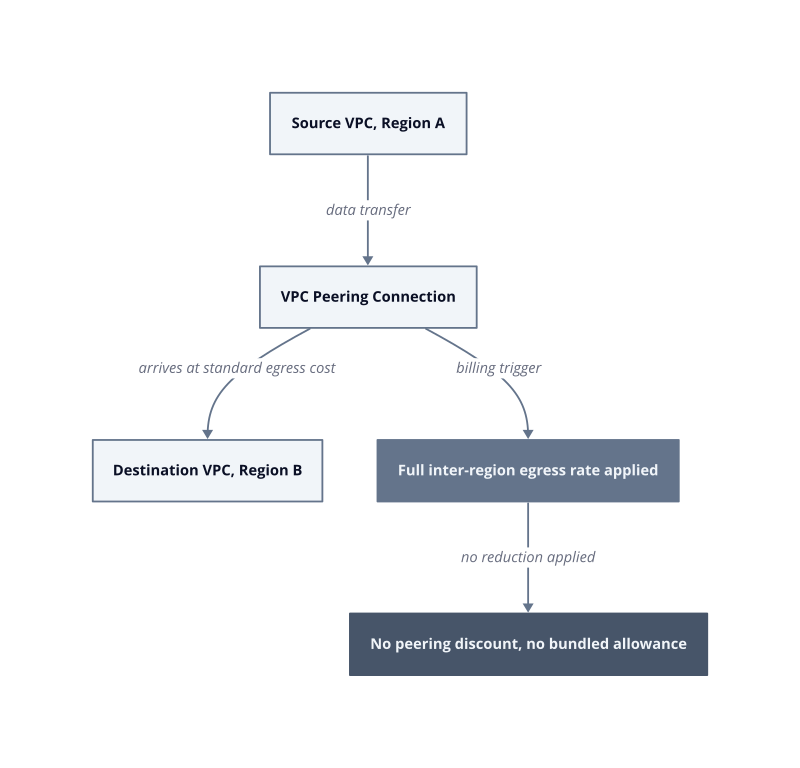
The concrete action before provisioning any cross-region GCP peering topology is to calculate projected inter-region egress in GB/month, apply the published per-GB rate without any discount assumption, and verify with the account team whether committed-use contracts cover networking charges for that specific traffic pattern. Build the cost model on published rates. Adjust only after a written confirmation of applicable discounts is in hand.
When Peering Is the Wrong Tool: Alternatives at High Volume
Peering stops being the right tool when data volumes climb high enough that managed transit services change the total cost equation, and that threshold is not documented clearly enough to skip the analysis.
The core billing behavior is established. Azure Virtual Network pricing confirms that VNet peering charges ingress and egress on every transfer between peered networks. AWS VPC peering documentation shows no peering-specific fee but preserves standard EC2 data transfer rates between availability zones. GCP VPC Network peering documentation confirms full inter-region egress rates apply without a peering discount. All three providers let the per-GB rate accumulate linearly with volume. None publishes a breakeven table comparing peering against their own managed transit products.
The unresolved comparison. How per-GB peering costs stack up against AWS Transit Gateway, Azure Virtual WAN, or GCP Network Connectivity Center at high data volumes is not resolved in published pricing documentation for any of the three providers. Each managed transit product carries its own fee structure, attachment charges, and processing rates. At low volumes, peering’s near-zero overhead wins. At high volumes, the attachment fee of a managed transit hub amortizes across more bytes, and the per-GB rate on that hub may differ from the peering rate. The exact crossover point depends on traffic volume, region pair, and pricing tier.
Why the gap matters operationally. A team that benchmarks peering at a modest monthly volume and projects forward to a much larger volume is extrapolating on a linear model that may not hold once managed transit becomes economically competitive. The mechanism is that managed transit services charge a fixed attachment or connection fee plus a lower or comparable per-GB rate. Below a certain volume, the fixed fee dominates and peering wins. Above it, the fixed fee is negligible and the per-GB comparison determines cost. That volume threshold is workload-specific.
GCP’s committed-use gap compounds the uncertainty. As noted in published GCP documentation, whether committed-use contracts reduce effective per-GB rates on peered traffic is unconfirmed. GCP Network Connectivity Center introduces a separate pricing surface. Teams cannot assume the same committed-use terms that apply to compute will transfer to Network Connectivity Center attachments without written confirmation. The two cost models, peering and managed hub, both carry unresolved discount questions at scale.
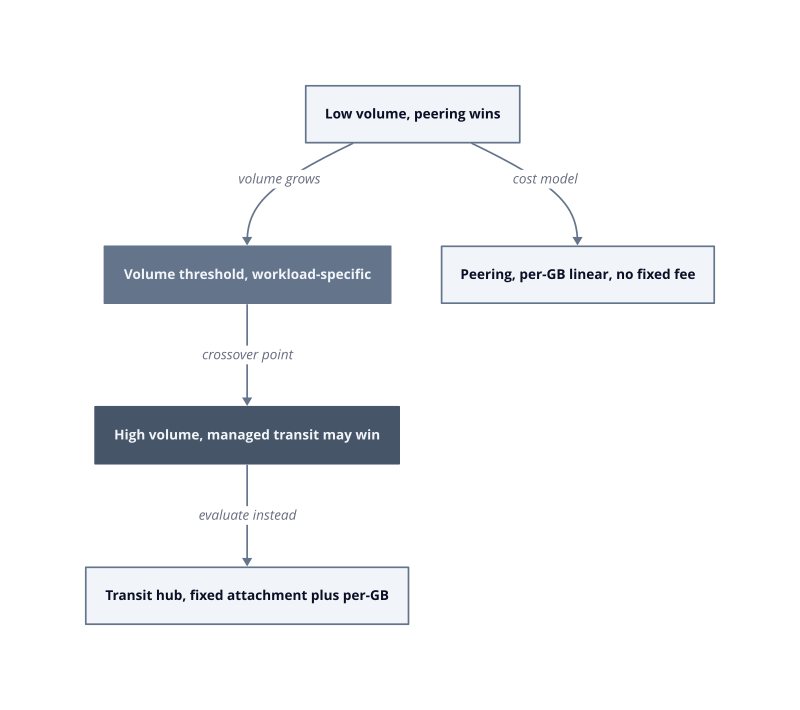
Run both models side by side before the architecture review, not after the peering connections are provisioned.
Actionable Rules for Architecting Around Peering Costs
Four rules determine whether peering costs stay predictable: pin to the same AZ on AWS, model both billing directions on Azure, verify GCP committed-use applicability before committing to scale, and audit topology before it reaches production.
Pin AWS workloads to the same AZ. AWS charges standard EC2 data transfer rates for traffic crossing availability zones regardless of whether a peering connection exists (Amazon VPC Pricing). The peering connection itself carries no fee, but each AZ boundary crossed adds a per-GB charge to both the sending and receiving side. The fix is to co-locate services that exchange high traffic volumes within a single AZ. This works when latency tolerance is low and the workload fits one AZ’s capacity. It breaks when you need geographic fault isolation, because a single-AZ design sacrifices the redundancy that multi-AZ exists to provide.
Model Azure global peering as two billing events, not one. Azure Virtual Network pricing confirms that global VNET peering charges the source zone’s outbound rate and the destination zone’s inbound rate on every transfer. Engineers who build cost models treating cross-region Azure traffic as a single outbound charge will undercount actual spend from the first month of operation. Model both directions explicitly for every region pair before provisioning. This works when traffic volume is known in advance. It breaks when bidirectional traffic ratios shift at runtime, because the inbound charge accumulates on a path that monitoring tools often do not surface by default.
Verify GCP committed-use coverage before scaling peering. GCP treats peered inter-region traffic as standard egress with no peering-specific discount (GCP VPC Network pricing). Whether committed-use contracts reduce the effective per-GB rate on that traffic is not confirmed in published documentation. At scale, the absence of a discount compounds linearly with every additional GB. Get written confirmation from a GCP account representative before building a cost projection that assumes committed-use terms apply to networking charges.
Audit peering topology before production, not after. Each peering connection that reaches production without a cost model attached becomes a fixed expense with no owner. The mechanism is that provisioning is fast and billing is deferred, so engineers close tickets before the first invoice arrives. Run a topology audit against published per-GB rates for every active peering connection as a gate in the architecture review, not as a remediation step after spend is already accumulating.
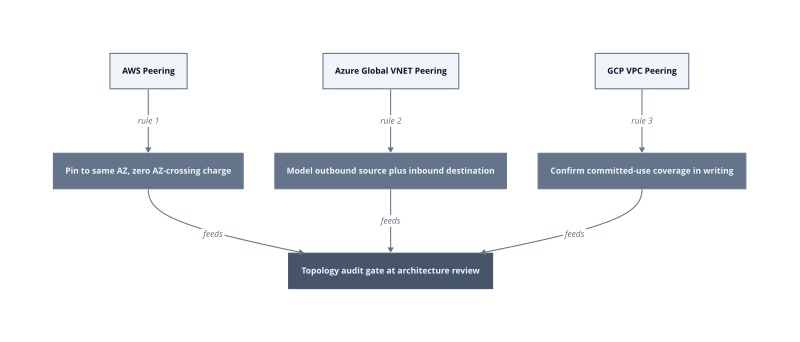
The specific next action is to pull every active peering connection from your cloud console today, map each one to its traffic direction and region pair, apply the published per-GB rate from the relevant pricing page, and confirm that a named engineer owns the cost model for each connection. Any connection without an owner and a cost model is a liability, not an asset.
