

The FinOps Tool Decision Is Really a Scale Decision
Picking a FinOps tool by comparing feature matrices is the wrong starting point. The decision that actually determines ROI is whether the tool’s pricing model and governance architecture match your current cloud spend scale and organizational complexity. A team managing five AWS accounts needs fast allocation visibility. A team managing five hundred accounts across three clouds needs policy enforcement, persona-level access controls, and audit trails. The same feature, say anomaly detection, costs and behaves differently depending on which of those realities you operate in.
The FinOps Foundation Framework defines FinOps as an operational framework and cultural practice that creates financial accountability through collaboration between engineering, finance, and business teams. That definition is load-bearing. Accountability at twenty people is a Slack message. Accountability at two thousand people is a governance engine with role-based cost centers, policy guardrails, and six distinct personas: FinOps Practitioner, Engineering, Finance, Leadership, Procurement, and Product. The tool you choose must support the accountability model your org actually runs, not the one you aspire to eventually.
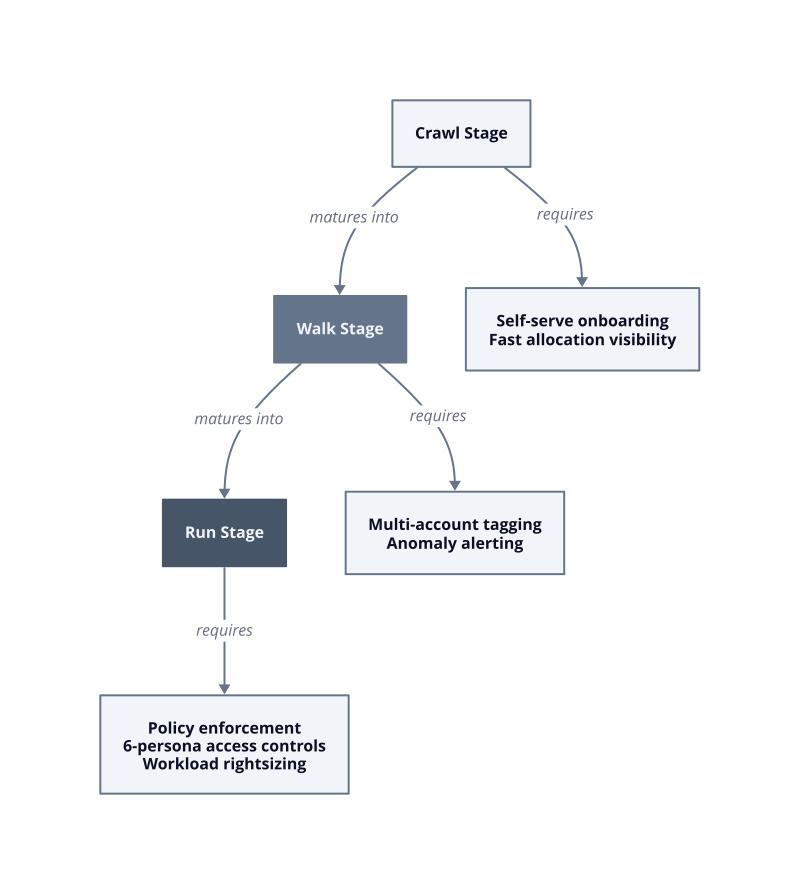
The Framework’s maturity model, Crawl, Walk, Run, exists precisely because scale changes what a tool needs to do. At the Crawl stage, self-serve onboarding and fast time-to-value matter most. At the Run stage, multi-account policy propagation and workload-correlated rightsizing become the critical path. Teams that pick a Run-stage tool at the Crawl stage pay for complexity they cannot operationalize. Teams that pick a Crawl-stage tool at the Run stage hit governance ceilings within the first deployment week.
Scale mismatch inflates cost. Percentage-of-spend pricing scales with you at low spend but becomes the dominant cost factor at high spend. A tool priced at a fixed percentage that felt negligible at a modest monthly spend becomes a budget line requiring its own justification as spend scales into the millions.
Org complexity drives architecture requirements. A single-team startup and a fifty-team enterprise both need cost visibility. The enterprise also needs the six FinOps personas to operate in isolated views with controlled write permissions. A tool without that access model forces manual workarounds that break down by sprint 3.
Tagging debt precedes tooling decisions. Untagged resources create allocation gaps no platform resolves retroactively. Teams that delay tagging enforcement before onboarding any FinOps tool end up with dashboards that surface totals but cannot attribute spend to owners. The tool looks broken. The tagging strategy was broken first.
The practical filter is this: define your account count, your monthly cloud spend, and the number of distinct teams who need write-level budget authority. Those three numbers narrow the field faster than any vendor demo.
Vantage’s Pricing Tiers Reward Early Adoption But Cap at Enterprise Complexity
Vantage structures its four pricing tiers to match spend volume to tool access, which means the limits on each plan are deliberate gates rather than arbitrary caps. Understanding what those gates block, and when you will hit them, determines whether Vantage fits your team’s current state or its six-month projection.
| Tier | Monthly Cost | Spend Cap | User Limit | Data Retention |
|---|---|---|---|---|
| Starter | Free | USD 2,500 | 3 | 6 months |
| Pro | USD 30 | USD 7,500 | 5 | 6 months |
| Business | Custom | Unlisted | Unlisted | 12 months |
| Enterprise | Custom | Unlimited | Unlimited | Unlisted |
That spend ceiling maps precisely to a solo engineer or two-person team running a staging environment and a small production workload. The 3-user cap is not a problem at that size. It becomes a problem the moment a finance contact or a second engineer joins the account, because the fourth seat does not exist.
The mechanism matters: USD 30 per month is effectively a fixed cost below that spend threshold, so the tool’s cost as a percentage of tracked spend shrinks as spend grows toward the ceiling. A team spending at the Pro plan’s cap pays a small fraction of their tracked spend for the tool, making the cost easy to justify relative to the visibility gained. A team spending well below the Pro plan’s cap pays a proportionally larger share of their tracked spend for the tool, since the fixed monthly fee is spread over a smaller base. Both tiers share a 6-month data retention window, which is enough for quarterly business reviews but insufficient for year-over-year variance analysis.
Business plan. The Business tier is where data retention doubles to 12 months. That shift is operationally important because annual budget cycles require twelve full months of cost history to identify seasonal patterns and justify headcount or reserved capacity purchases. After 30 days of data, anomaly detection improves. After 12 months, budget forecasting becomes defensible. The 6-month window on Starter and Pro cuts that cycle in half.
Enterprise plan. Enterprise removes both the spend cap and the user ceiling entirely at a custom price. That matters for large organizations where spend attribution crosses dozens of cost centers and dozens of stakeholders need read or write access simultaneously. This tier works when procurement controls the contract and FinOps practitioners manage rollout. It breaks when the organization lacks defined cost center ownership, because unlimited users accessing undefined cost boundaries produces noise, not governance.
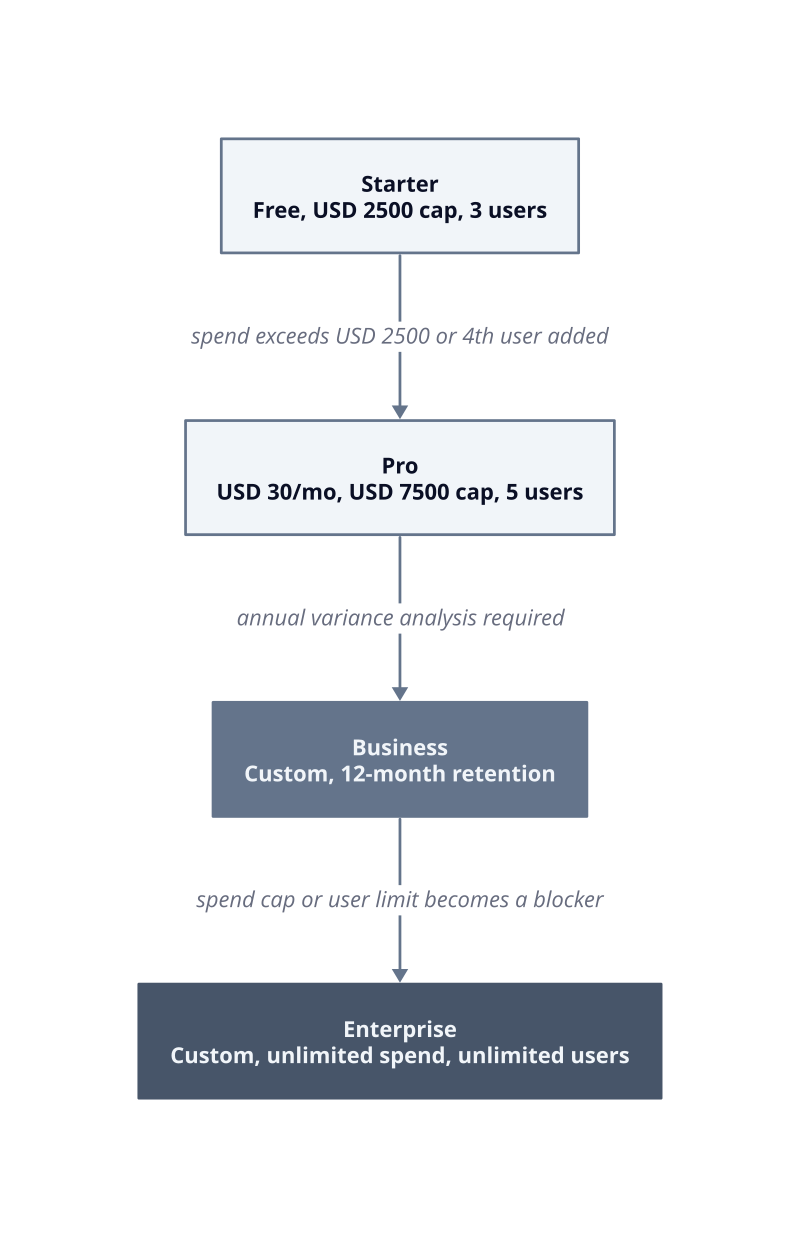
The concrete signal for a tier upgrade is not ambition. It is a specific constraint: the spend cap is within 20% of your current monthly bill, the user count is at the ceiling, or the retention window is shorter than your budget review cycle. Identify which limit you will hit first, then price the next tier against the cost of operating without it.
CloudHealth and Cloudability Serve Governance Complexity, Not Spend Transparency
CloudHealth and Cloudability were built for governance complexity, not spend transparency, and deploying them without that distinction clear produces expensive shelfware.
CloudHealth’s core value is its policy engine. Large enterprises running hundreds of AWS, Azure, and GCP accounts need automated guardrails that propagate across every account without manual configuration per team. The mechanism is structural: CloudHealth ties cost allocation to policy enforcement, so a budget threshold violation in one account triggers the same remediation workflow as one in any other account. That architecture requires organizational scaffolding, defined account hierarchies, and cost center ownership mapped before onboarding. Without that scaffolding, the policy engine has nothing to enforce against. Exact pricing requires a vendor quote, because CloudHealth scales its contract to account count and feature tier, not to a published rate card.
Cloudability’s differentiation sits in its integration with IBM Turbonomic. These are both Apptio products, and they share workload telemetry. The mechanism is data correlation: Turbonomic measures actual resource utilization and application performance, Cloudability maps that utilization data to cost, and the combined signal produces rightsizing recommendations grounded in both performance safety and spend reduction. A rightsizing call made on cost data alone risks degrading application performance. A rightsizing call made on correlated performance and cost data carries a defensible justification for engineering teams. That correlation is the specific reason the two-product pairing produces stronger ROI than either tool used independently. Cloudability pricing also requires a vendor quote.
What CloudHealth solves. Multi-account policy propagation across complex org structures is the problem CloudHealth was architected to address. It works when account hierarchies are defined, tagging is enforced, and a dedicated FinOps practitioner manages the policy engine. It breaks when account ownership is undefined, because a policy engine applied to unowned resources flags violations nobody acts on.
What Cloudability solves. Rightsizing recommendations correlated to application performance are Cloudability’s specific contribution. This works when Turbonomic is already deployed and feeding workload data. Without Turbonomic telemetry, Cloudability’s recommendations reduce to cost-only signals, which is a capability Vantage and other tools also provide without the two-product contract overhead.
The gap is explicit: Vantage offers no multi-account policy propagation and no workload performance correlation. A team at the Crawl or Walk maturity stage does not need those capabilities. A team at the Run stage does.
| Capability | CloudHealth | Cloudability | Vantage |
|---|---|---|---|
| Multi-account policy engine | Yes | Limited | No |
| Performance-correlated rightsizing | No | Yes (with Turbonomic) | No |
| Published pricing | No (quote required) | No (quote required) | Yes |
| Self-serve onboarding | No | No | Yes |
| Spend-centric cost reporting | Yes | Yes | Yes |
The practical decision point is this: if your organization needs policy enforcement across more than 50 accounts and already has defined cost center ownership, evaluate CloudHealth. If your organization needs rightsizing recommendations that engineering teams will actually act on, and Turbonomic is already in the stack, Cloudability’s data correlation justifies the contract complexity. If neither condition is true yet, paying for governance infrastructure you cannot operationalize delays the cost clarity you need first.
Integration Breadth vs. Integration Depth: Where Vantage’s 40+ Connectors Fit In
Breadth and depth pull in opposite directions, and Vantage’s over 40 native integrations across cloud, AI, SaaS, and data infrastructure providers make a deliberate bet on breadth. The architecture reflects a specific judgment: a team running AWS, Snowflake, Datadog, and a handful of LLM providers needs a single cost surface before it needs deep policy control over any one of them.
Vantage functions as a cost aggregation layer that pulls spend signals from heterogeneous providers into one normalized view. The mechanism is connector-first design: each integration maps provider billing APIs to a shared cost schema, so spend from a managed Kubernetes cluster sits in the same report as spend from an OpenAI API key. According to Vantage Documentation, the LLM price comparison tool includes data refreshed daily from provider APIs, which means the data is never more than a day stale. Stale pricing data produces miscalibrated model selection, specifically when a provider reprices mid-month.
By sprint 3 of a typical Vantage rollout, teams with five-plus provider relationships see the most immediate payoff. The connectors eliminate the manual export-and-reconcile work that otherwise consumes a FinOps analyst’s time. That said, breadth has a ceiling. Vantage normalizes cost data across providers, but it does not propagate policy rules across provider accounts, and it does not correlate workload performance signals to spending anomalies. Those two capabilities require dedicated infrastructure that breadth-first tools do not carry.
| Dimension | Vantage (40+ connectors) | CloudHealth | Cloudability |
|---|---|---|---|
| Provider coverage | Cloud, AI, SaaS, data infra | Primarily AWS/Azure/GCP | Primarily AWS/Azure/GCP |
| Integration model | Self-serve connector library | Managed onboarding | Managed onboarding |
| Policy propagation | None | Multi-account engine | Limited |
| Workload correlation | None | None | Via Turbonomic |
| Operational integration depth | Lightweight | Deep | Deep (with Apptio stack) |
Connector breadth. Vantage covers provider categories that CloudHealth and Cloudability treat as out-of-scope, specifically AI inference APIs, SaaS tooling, and data warehouse platforms. A team with spend across Snowflake compute and OpenAI inference gets both line items in one cost report, because Vantage supports over 40 native integrations across cloud, AI, SaaS, and data infrastructure providers. Neither CloudHealth nor Cloudability ingests those spend signals natively.
Policy depth. Cloudability integrates with Jira, Datadog, and PagerDuty to route cost anomalies into existing incident and project workflows. That operational depth means a budget breach can generate a Jira ticket and a PagerDuty alert without manual intervention. Vantage’s connector model does not replicate this workflow-routing behavior. Breadth of data ingestion is not the same capability as depth of operational remediation.
The integration fit test. This distinction defines the selection criterion cleanly. If the primary problem is “I cannot see what all my providers are costing me in one place,” Vantage’s connector library solves it faster than any alternative, with self-serve onboarding and no contract negotiation. If the primary problem is “I need a cost anomaly to trigger an automated remediation workflow in the tools my engineers already use,” Cloudability’s operational integrations are the right fit. The two problems are sequential: visibility precedes remediation. A team that cannot yet answer “what did Snowflake cost last Tuesday” is not ready to route PagerDuty alerts on Snowflake cost thresholds.
The specific next step is an integration audit. List every provider generating a bill, then check each against Vantage’s connector catalog. Any provider not covered represents a cost blind spot that breadth promises to close. Any remediation workflow that must connect to Jira or PagerDuty represents a depth requirement breadth will not satisfy.
Before You Choose Any Tool, Fix Your Tagging Strategy
Untagged resources are cost allocation dead weight, and no platform resolves that retroactively once you onboard.
The mechanism is straightforward. When a compute instance, storage bucket, or database carries no ownership tag, every FinOps platform treats it as unattributable spend. Cloudability cannot allocate it to a cost center. CloudHealth cannot bind it to a policy. Vantage cannot surface it in a team-scoped cost report. The FinOps Framework defines financial accountability as requiring collaboration between engineering, finance, and business teams. That collaboration collapses when the underlying resource data lacks the metadata those teams need to claim ownership.
The cost of this gap compounds after onboarding, not before. A team that purchases Cloudability expecting 100% allocation of multi-cloud program costs achieves that outcome only when the tagging substrate already exists. Untagged resources do not become tagged by passing through a billing aggregator. The gap is preserved, then surfaced repeatedly in every allocation report as an unassigned residual.
Tag enforcement before vendor selection. Define your tag schema, enforce it at resource creation through cloud provider policy, and audit existing resources for compliance before evaluating any tool. This works when your infrastructure-as-code pipeline gates deployments on required tag presence. It breaks when tagging is voluntary, because engineers under deadline pressure skip it, and the resulting gaps accumulate faster than any retroactive tagging campaign can close them.
Governance scope, not governance theater. Tag keys without enforced values produce noise, not signal. A tag key of owner populated with tbd, unknown, or a former employee’s name fails allocation just as completely as no tag at all. The fix is an allowlist of valid tag values enforced at the policy layer, not a naming convention document in a wiki.
| Tagging condition | Allocation outcome |
|---|---|
| Tagged, valid owner value | Fully allocatable to cost center |
| Tagged, invalid or stale value | Unresolvable without manual correction |
| Untagged resource | Permanently unattributable in any platform |
| Tag applied post-creation | Historical spend before tag date stays unallocated |
The last row in that table is the specific failure mode teams underestimate. Even if you tag a resource today, every billing period before that tag date remains a gap in historical allocation. Platforms report on what the billing API returns. They cannot backfill provider billing records with metadata that did not exist when the charge was incurred.
Treat tag compliance as a deployment gate, not a cleanup task. Run a tag compliance report against your current estate before scheduling any vendor demo. Any resource without a valid team, environment, and cost-center tag is a liability that your chosen platform will inherit and cannot fix.
