

The Billing Model Mismatch Most Teams Miss
Aurora Serverless v2 and provisioned Aurora share the same engine but bill through fundamentally incompatible models, and picking the wrong one for your workload pattern will cost you more than the alternative every single month.
The mismatch starts at the unit of measurement. 1 ACU delivers approximately 2 GiB of memory with corresponding CPU and networking (Amazon Aurora Pricing). That sounds like a clean abstraction until you realize ACU consumption is billed continuously against a floor you set at configuration time. If your minimum ACU is too high, you pay for that floor whether queries arrive or not. The variable-cost advantage disappears because the billing floor behaves exactly like a provisioned instance, without the reserved-instance discount that makes provisioned workloads economical at steady state.
The core tension maps to two workload shapes. Spiky or unpredictable traffic favors serverless because you avoid committing to a large instance that idles at off-peak hours.
The ACU floor trap. Teams raise their minimum ACU setting to prevent cold-start latency. The fix feels operationally safe, but the billing consequence is that costs approach or exceed a comparable provisioned instance. The minimum ACU acts as a committed capacity reservation without reservation pricing.
The sustained-load crossover. At consistently high utilization, per-ACU rates exceed the equivalent provisioned hourly rate. The mechanism is straightforward: serverless pricing is optimized for burstable headroom, not sustained throughput. Running a continuously saturated serverless cluster is paying a burstability premium you never actually use.
The I/O dimension teams ignore. Storage I/O costs interact with both models differently. If your I/O spend exceeds 25% of total Aurora database spend, Aurora I/O-Optimized pricing saves up to 40% on costs. This threshold changes the provisioned-versus-serverless breakeven calculation materially, yet teams rarely model it before choosing a billing model.
The provisioned billing floor. Provisioned instances bill in 1-second increments with a 10-minute minimum charge after a billable status change. For workloads that stop and start frequently, that 10-minute floor accumulates into a predictable but underestimated line item by the end of the first deployment week.
| Decision factor | Favors Serverless v2 | Favors Provisioned |
|---|---|---|
| Traffic pattern | Spiky, unpredictable | Steady, 24/7 |
| Minimum ACU setting | Low floor, true variable cost | N/A |
| I/O as share of total spend | Below 25% | Above 25% with I/O-Optimized |
| Pricing commitment available | None | Reserved Instance discount |
The specific action here is to pull 30 days of CloudWatch ServerlessDatabaseCapacity metrics before you choose a model. If the ACU trace spends more than half its time near your maximum ACU setting, you are paying serverless rates for provisioned-class utilization, and the fix is a migration to provisioned with a reserved-instance commitment.
How Aurora Capacity Units Actually Translate to Cost
An Aurora Capacity Unit is a billing atom, not an abstraction. Each ACU delivers approximately 2 GiB of memory with proportional CPU and network throughput (Aurora Serverless v2 Capacity Settings). Aurora Serverless v2 measures and bills capacity in these units per second (Amazon Aurora Pricing). The per-second granularity sounds favorable, but the minimum ACU floor is the number that actually determines your bill.
The minimum ACU floor is the quantity of ACUs your cluster holds reserved at all times, regardless of query volume. Because each ACU maps to roughly 2 GiB of memory, a minimum of 4 ACUs means 8 GiB of memory is allocated and billed continuously. That allocation does not wait for a connection. It runs the second the cluster is active, compounding across every hour of the month.
The floor-as-provisioned trap. When engineers raise the minimum ACU to prevent cold-start latency, the cluster stops behaving like a variable-cost resource. The billing floor charges for capacity at every idle second, which is mechanically identical to running a provisioned instance without a reserved-instance discount. The variable-cost benefit of serverless requires a minimum ACU low enough that the cluster genuinely scales toward zero during off-peak periods.
The global database constraint. Aurora global databases impose a minimum of 8 ACUs on the primary region cluster. This constraint is non-negotiable at the architecture level, so global database workloads with extended idle windows carry a fixed cost the serverless billing model cannot eliminate.
The max_connections coupling. Aurora Serverless v2 derives the max_connections limit from the memory allocated by the maximum ACU setting, not the minimum. Setting a high maximum ACU to gain connection headroom does not raise your idle-state bill. Setting a high minimum ACU to stabilize latency does. These two levers behave differently, and conflating them leads to over-specified minimums that inflate costs without improving connection capacity.
The sustained-load crossover. Per-ACU rates are priced for burstable consumption patterns. At consistently high utilization, the cumulative per-second ACU charges exceed the equivalent provisioned hourly rate. The mechanism is that serverless pricing builds in a headroom premium. When your workload claims that headroom continuously, you pay the premium without capturing the benefit.
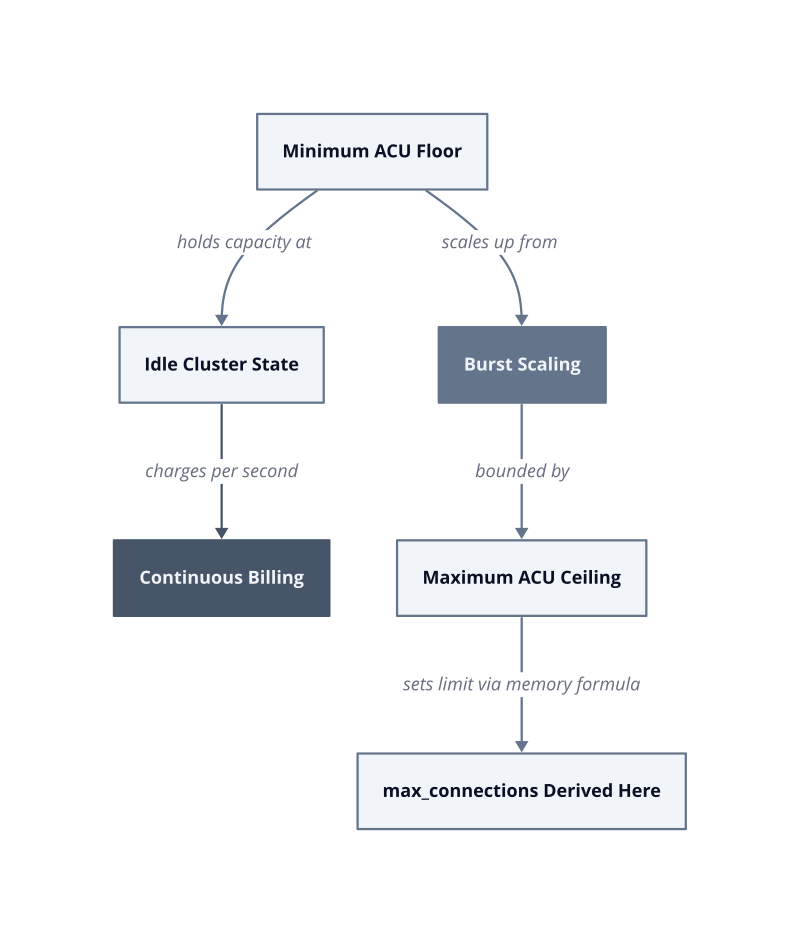
| ACU Setting | Memory Allocated | Billing Behavior |
|---|---|---|
| Minimum ACU floor | 2 GiB per ACU, billed continuously | Fixed floor cost at all times |
| Maximum ACU ceiling | 2 GiB per ACU, billed only when reached | Determines max_connections, not idle cost |
| Global DB minimum (primary region) | 8 ACUs, 16 GiB floor | Non-negotiable architectural constraint |
The specific diagnostic is to compare your cluster’s minimum ACU setting against its actual ACU consumption at the lowest traffic point in a 30-day window. If the floor and the trough are the same number, you are not running a variable-cost cluster. You are running a provisioned cluster priced at on-demand serverless rates.
Serverless Wins: Spiky and Unpredictable Workloads
The workload categories where this model pays off are concrete. Aurora Serverless v2 documentation names multitenant databases, distributed databases, and development and test systems as primary targets precisely because these environments share one trait: load arrives in bursts separated by genuine quiet periods. A provisioned instance running at a fraction of its CPU capacity for many hours overnight charges at the same hourly rate as the same instance running near full utilization during the morning peak. Aurora Serverless v2 charges per ACU-second, so the overnight trough actually reduces the bill instead of holding it flat.
The savings mechanism only works if the minimum ACU floor is kept genuinely low. A development database that runs only during business hours spends a minority of monthly hours in active use and the majority idle. A provisioned db.r6g.large (Aurora DB Instance Classes) running on-demand charges for every hour in the month, whether the database is busy or idle. Aurora Serverless v2 at a minimum of 0.5 ACUs (Aurora Serverless v2 Documentation) charges the floor rate for quiet hours rather than a full instance rate. The delta between a half-ACU floor and a full instance charge is where the savings accumulate.
For multitenant production systems where connection pooling is absent or inconsistent, this cap becomes an architectural constraint before the first sprint ends.
The floor-creep failure mode. Teams respond to connection pressure or latency complaints by raising the minimum ACU. Each increment moves the billing floor upward. By the time the minimum reaches 4 or 8 ACUs, the cluster bills for a correspondingly larger block of reserved memory at every idle second, since each ACU corresponds to approximately 2 GiB of memory. At that point, the variable-cost rationale has been engineered away, and the cluster costs more than a provisioned equivalent with a reserved-instance commitment.
The steady-state disqualifier. Workloads that sustain high utilization around the clock are specifically excluded from the serverless value case. Per-ACU rates carry a burstability premium that provisioned reserved instances do not. Amazon Aurora Pricing explicitly positions reserved instances for steady-state workloads. Running a continuously saturated Aurora Serverless v2 cluster means paying the burstability premium on every second of utilization you could have discounted through a reservation.
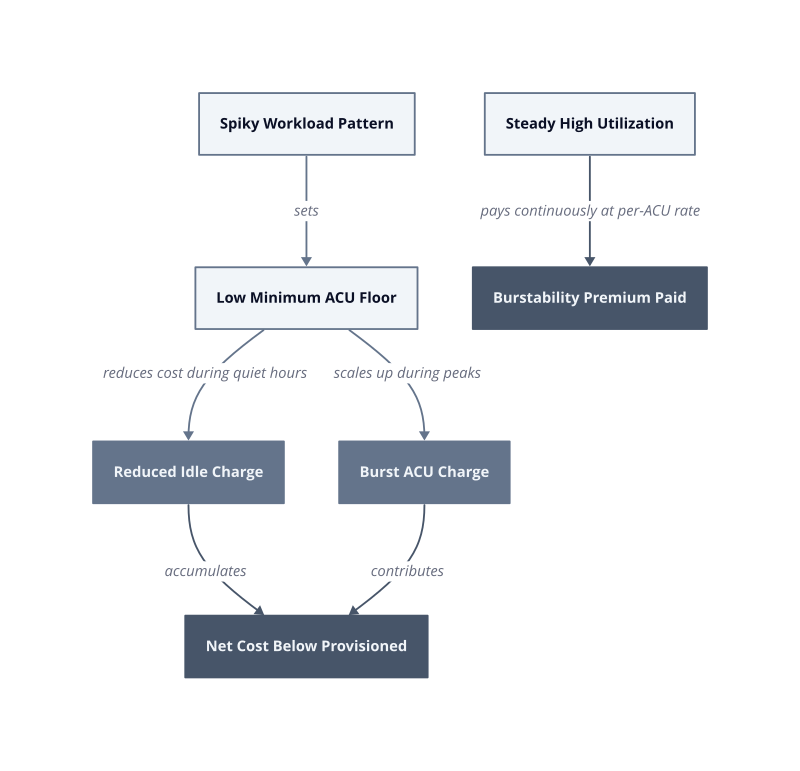
| Workload type | Serverless v2 outcome | Root cause |
|---|---|---|
| Dev/test, 8 hours active per day | Bill reduced during 592 idle hours monthly | Floor ACU rate below provisioned on-demand rate |
| Multitenant with unpredictable load | Cost tracks actual usage | Burst scaling charges only for consumed ACUs |
| Minimum ACU raised to 8 to prevent latency | Costs approach provisioned on-demand | 16 GiB billed continuously without reservation discount |
| Sustained 24/7 high utilization | Costs exceed provisioned reserved | Per-ACU burstability premium has no reserved-instance equivalent |
The diagnostic step after 30 days of data is to plot the ACU trough against the ACU ceiling for each day. If the daily trough never drops below half the ceiling, the workload is not spiky enough to justify serverless billing. Move it to provisioned and price a reserved-instance commitment against the actual utilization baseline.
Provisioned Wins: Steady Workloads and Reserved Pricing
Reserved-instance pricing creates a structural discount that Aurora Serverless v2 billing cannot access, and that gap determines which deployment model wins for steady, high-utilization workloads. Amazon Aurora Pricing confirms that provisioned reserved instances are the correct fit for steady-state database workloads, specifically because the discount tiers are unavailable to consumption-based billing. A 1-year commitment yields up to 45% off on-demand rates. A 3-year commitment reaches up to 66%. Neither figure is negotiable or approximate. It is a fixed price reduction baked into the reservation contract from day one.
The mechanism behind these discounts is capacity commitment. AWS reduces the per-hour rate because you absorb the demand-forecasting risk. Aurora Serverless v2 shifts that risk back to AWS, which is why per-ACU rates carry a burstability premium. That premium is priced into every second of consumption. When a workload runs at high utilization around the clock, the cumulative per-ACU charge exceeds what a provisioned instance costs at the discounted reserved rate. The serverless model never discounts your baseline.
The 3-year commitment ceiling. A 66% discount against on-demand pricing is the deepest reduction available in Aurora’s pricing structure. For a database that runs continuously at high CPU and memory utilization, a reservation discount compounds across the full duration of the commitment term. The break-even point against serverless per-ACU rates arrives well before the term ends, because the reserved rate applies from the first billable hour.
The 1-year commitment floor. A 1-year Reserved Instance provides a discount of up to 45% over On-Demand Instances (Amazon Aurora Pricing), and requires only a 12-month commitment, which is a reasonable planning horizon for any workload with a stable utilization history. The fix is to pull 30 days of CloudWatch ACU metrics, confirm the daily trough stays within 15% of the daily peak, then price the equivalent provisioned instance class at both on-demand and 1-year reserved rates. The delta is your minimum annual savings.
The minimum ACU trap in reverse. Teams running Aurora Serverless v2 at high sustained load sometimes raise the minimum ACU floor to stabilize latency. Each ACU carries approximately 2 GiB of memory. At 8 minimum ACUs, a substantial block of memory bills continuously at on-demand serverless rates, with no reservation discount applied. The provisioned alternative at the same memory footprint qualifies for the full 45% or 66% reduction. The gap between the two bills widens with every hour of sustained utilization.
The workload qualifier. This approach works when utilization history shows consistent, high load with no genuine off-peak troughs. It breaks when the workload has seasonal spikes or unpredictable bursts, because a provisioned reservation charges the full hourly rate during idle periods, eliminating the discount benefit through wasted capacity.
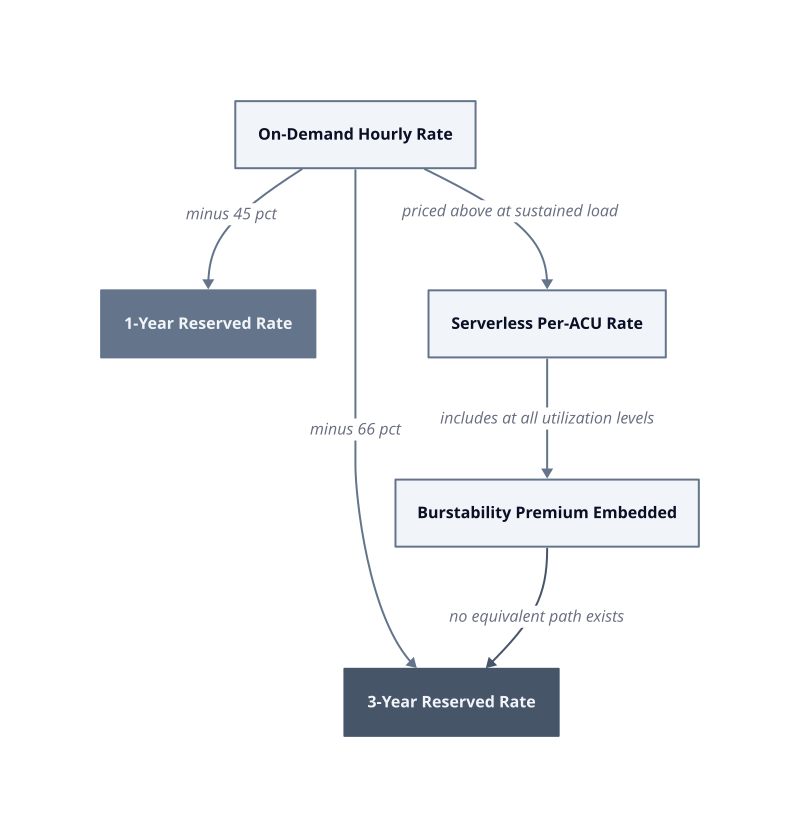
| Pricing model | Discount vs. on-demand | Applies to serverless |
|---|---|---|
| 1-year reserved | Up to 45% | No |
| 3-year reserved | Up to 66% | No |
| Serverless per-ACU | None, burstability premium included | Yes, always |
The specific next action is to identify every Aurora Serverless v2 cluster where the daily ACU trough exceeds a large fraction of the daily peak, then price the equivalent provisioned instance class at 1-year reserved rates. Those clusters are paying the burstability premium on capacity that never varies, and each one is a conversion candidate with a calculable annual saving.
The I/O-Optimized Variable Nobody Models
Aurora I/O-Optimized is a third pricing lever in the Aurora cost model, and most teams never pull it because official documentation treats it as a storage configuration rather than a billing switch that reshapes the serverless versus provisioned decision.
The mechanism is direct. Aurora’s default pricing model charges separately for storage and I/O requests. Every read and write operation accumulates per-million-request charges on top of the per-GB storage rate. When those I/O charges climb past 25% of total Aurora spend, switching to I/O-Optimized pricing eliminates the per-request charges entirely in exchange for a higher per-GB storage rate. Amazon Aurora Pricing confirms that crossing this 25% threshold unlocks savings up to 40%. The storage rate increase is fixed. The I/O charge elimination is total. For write-heavy workloads, the arithmetic favors the switch decisively.
What documentation does not resolve is how this interacts with ACU billing on serverless clusters. A serverless cluster scaling between 0.5 and 64 ACUs generates I/O proportional to its activity, but the ACU charge and the I/O charge appear on separate line items. Teams modeling the serverless versus provisioned breakeven rarely combine both line items into a single TCO figure before choosing a deployment model. The gap between what the pricing page documents and what a production cluster actually costs per month is where forecast errors accumulate.
The documentation gap. Official AWS sources do not publish exact ACU-to-instance-type equivalency ratios. Each ACU carries approximately 2 GiB of memory with corresponding CPU and network (Aurora Serverless v2 documentation), but converting that to a comparable provisioned instance class for breakeven analysis requires empirical measurement, not a lookup table. I/O-Optimized pricing interactions with serverless billing are absent from the official comparison matrices entirely.
The 40% lever. The up-to-40% cost reduction from I/O-Optimized pricing is not a marginal tuning exercise. With Aurora I/O-Optimized, if your I/O spend exceeds 25% of your total Aurora database spend, you can save up to 40% on costs (Amazon Aurora Pricing), which recalibrates the entire cost baseline for write-intensive analytics clusters where I/O charges constitute a large share of the total monthly bill. That recalibration applies equally to provisioned and serverless deployments. A provisioned cluster that looked unattractive against serverless per-ACU rates at standard pricing may become the cheaper option after I/O-Optimized pricing removes the per-request overhead.
The provisioned flip. Serverless v2 scaling granularity allows half-ACU increments when only marginal capacity is needed, which provisioned instances cannot match because adding capacity requires provisioning a full new DB instance. That granularity advantage weakens when I/O costs dominate the bill, because the per-request charges that serverless billing accumulates at high throughput scale with activity, not with ACU count. I/O-Optimized pricing eliminates that activity-proportional charge, restoring the cost competitiveness of a right-sized provisioned instance with a reserved commitment.
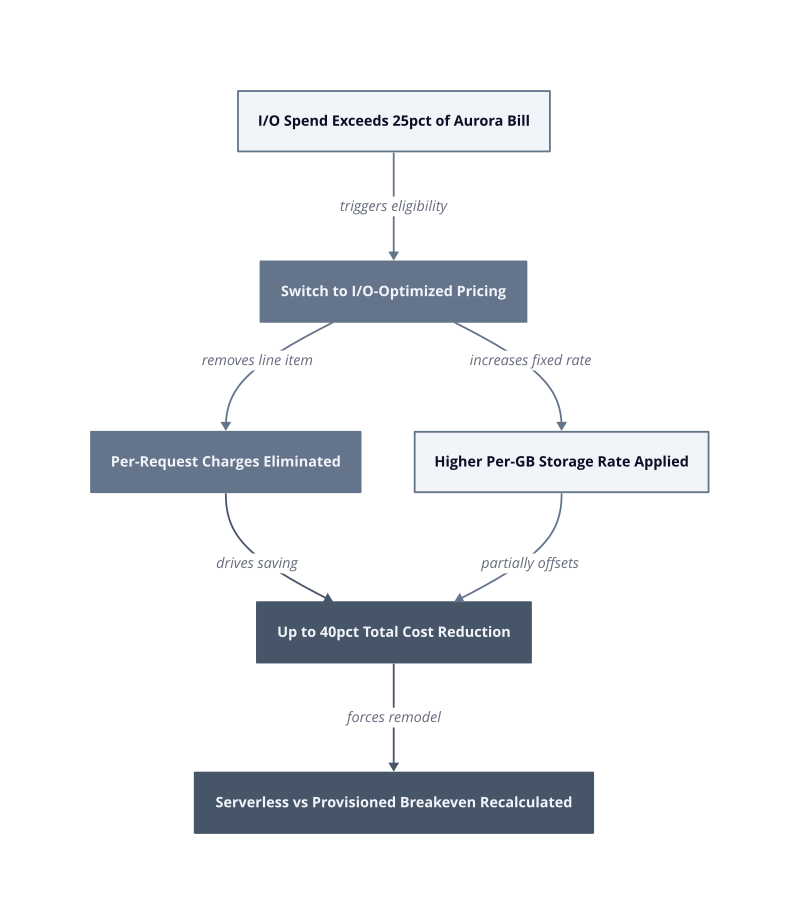
| Metric | Value |
|---|---|
| I/O spend threshold for eligibility | 25% of total Aurora spend |
| Maximum cost reduction after switch | 40% |
| ACU memory equivalent | 2 GiB per ACU |
The specific next step is to pull the last 30 days of Aurora cost explorer data, isolate the I/O request line item, and divide it by total Aurora spend.
A Decision Framework for Choosing Your Billing Model
The right billing model is determined by three variables: utilization pattern, commitment horizon, and I/O intensity. Getting any one wrong produces a bill that is structurally higher than it needs to be, regardless of how well the application performs.
Start with utilization pattern. Aurora Serverless v2 scales in half-ACU increments, where each ACU delivers approximately 2 GiB of memory with corresponding CPU and networking (Amazon Aurora Pricing). That granularity is valuable when load is genuinely unpredictable. It becomes a liability when load is steady, because per-ACU rates carry a burstability premium that provisioned reserved pricing never does. The mechanism is straightforward: serverless billing prices the scaling option into every billable second. A workload that never needs that option pays for it anyway.
Workload classification first. Pull 30 days of CloudWatch ACU metrics before touching any pricing configuration. If the daily trough stays within 15% of the daily peak across the full observation window, the workload is provisioned territory. If troughs drop below 50% of peak regularly, serverless retains a cost advantage because over-provisioned capacity on a reserved instance bills at the full hourly rate whether used or not.
Minimum ACU configuration as a cost lever. Setting the minimum ACU floor too high to avoid cold-start latency eliminates the variable-cost benefit that justifies serverless billing. After 30 days of data, identify the lowest sustained ACU count during off-peak hours and set the floor at that value, not at the peak. Every ACU above actual demand bills continuously at on-demand serverless rates with no reservation discount applied.
Reserved commitment sizing. Once a workload qualifies as provisioned, the commitment term determines the discount depth. A 1-year reserved instance cuts up to 45% from on-demand rates (Amazon Aurora Pricing). A 3-year reserved instance reaches up to 66%. The 1-year tier fits workloads with a stable utilization history and a reasonable product roadmap (Amazon RDS Reserved Instances). The 3-year tier fits core transactional databases with no plausible migration path in the near term. Avoid the 3-year commitment for any workload undergoing active schema or engine version changes, because a migration mid-term forfeits the unused reservation value.
I/O-Optimized as a final gate. Before closing the provisioned versus serverless decision, calculate I/O spend as a fraction of total Aurora cost. If I/O charges exceed 25% of the bill, model I/O-Optimized pricing against both deployment options before choosing. The switch eliminates per-request charges entirely in exchange for a higher per-GB storage rate. This recalculates the breakeven between serverless and provisioned, and it has ended several cases where serverless appeared cheaper under standard pricing but was not under I/O-Optimized pricing.
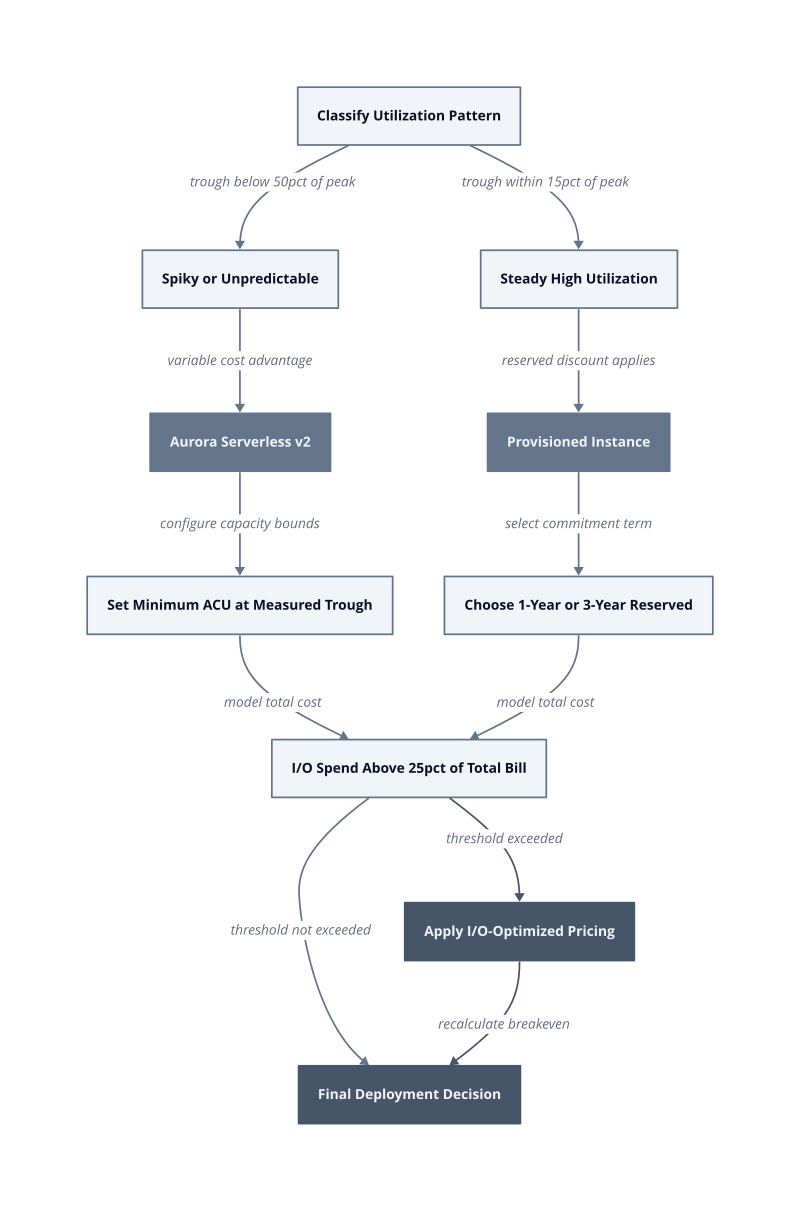
| Decision point | Signal | Action |
|---|---|---|
| Utilization pattern | Daily trough within 15% of peak | Move to provisioned reserved |
| Utilization pattern | Trough below 50% of peak | Retain serverless v2 |
| Minimum ACU floor | Floor exceeds measured off-peak trough | Lower floor to measured trough |
| Commitment term | 90 days of stable history | 1-year reserved |
, up to 45% discount | | Commitment term | Core transactional workload, no migration planned | 3-year reserved, up to 66% discount | | I/O spend fraction | Exceeds 25% of total Aurora bill | Model I/O-Optimized pricing before finalizing |
The table above is the decision sequence, not a checklist to complete in parallel. Run each gate in order. A workload that fails the utilization pattern gate never reaches the commitment term decision, because provisioned reserved pricing is the wrong instrument for a spiky workload regardless of the discount depth available.
The specific next action is to open Cost Explorer, filter to Aurora service charges, and segment by usage type to isolate ACU hours, instance hours, and I/O request charges as separate line items. Those three numbers, measured over the same 30-day window, produce every input the decision sequence above requires.
