v1.54.0Right-size OpenShift and see who uses your Copilot seats.
Your cloud advisor showed you 14%. The other 86% is where the savings live.
684 rules across AWS, GCP, Azure, and your data platforms. Connected in five minutes. Every finding is reconciled against your actual bill before it reaches your dashboard.
FMCG enterprises
5 of 20
India's top 20 FMCG enterprises
cloud spend
$15M+
under management
teams
154+
on the platform
audit rules
684
across AWS, GCP, Azure, and data platforms
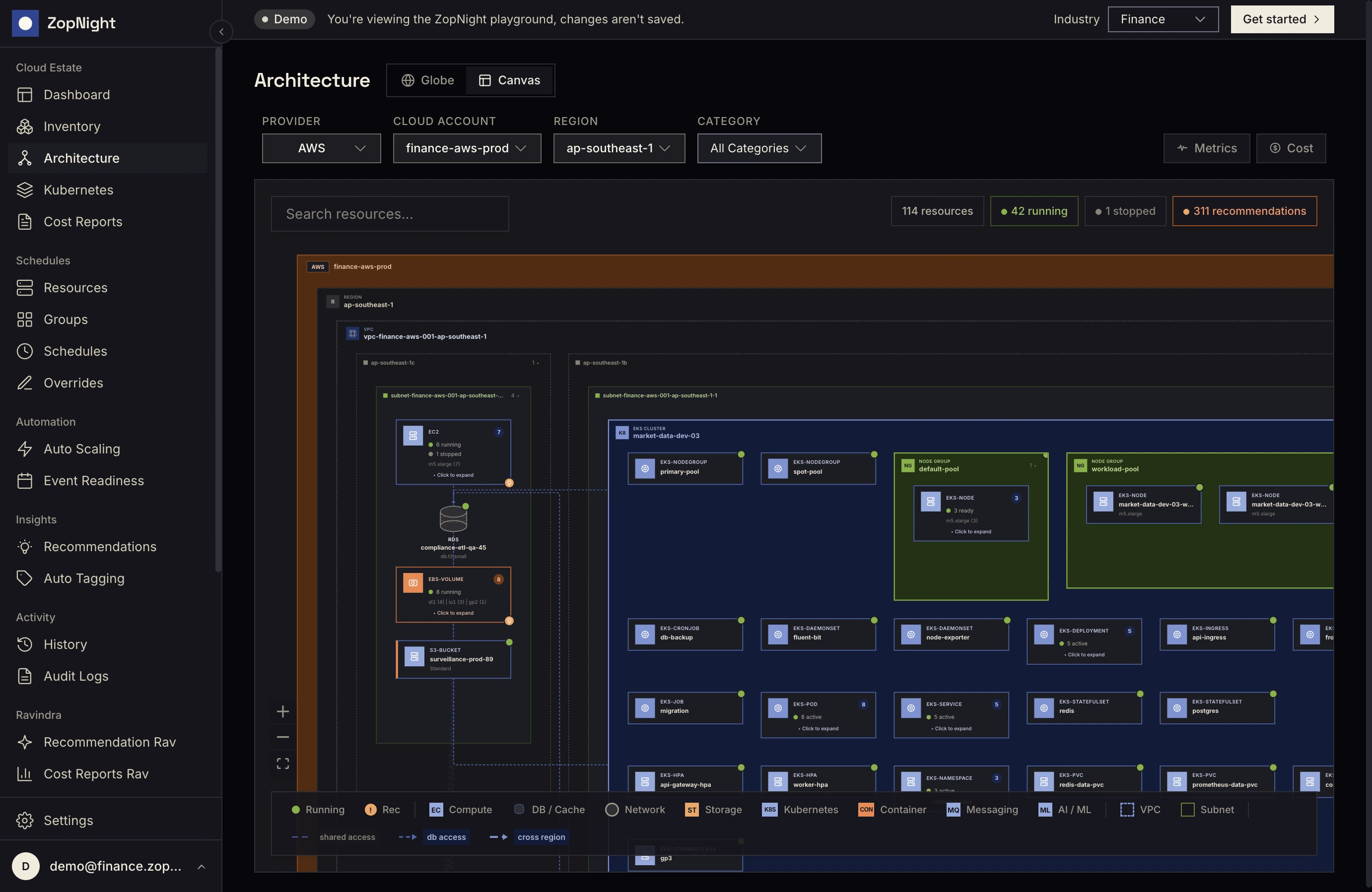
The architecture canvas.
Every resource, every dependency, mapped.
Architecture canvas view. Filter by provider and region. Click any resource to drill into its config + cost. (Live product includes Globe view, account / category filters, and the full inventory grid.)
PROBLEM
Cloud spend grew.
Cloud governance didn’t.
Three clouds. Eight dashboards. Thirty-plus engineering hours a week on manual start-stop and tag work nobody trusts. The waste isn’t dramatic, it’s quiet, distributed, and continuous.
- Non-prod running 24/7 Used 50 hours. Billed for 168.
- Orphan resources Detached disks, stale snapshots, unattached IPs.
- Over-provisioned production t3.xlarge at 8% CPU. The team that picked it left.
- Unclaimed rate optimisation Hybrid Benefit, RIs, Savings Plans untouched.
- Compliance drift IAM, encryption, public-access misconfigs.
Detect. Decide. Act. Every dollar your cloud advisor missed.
Detection across AWS, GCP, and Azure, with your inventory rescanned every 6 hours and costs checked daily. Every finding reconciled against your actual bill. Auto-fix where it’s safe; guided remediation for everything else. Database fixes are always guided.
SOLUTION
Three engines.
One workspace.
Recommendations find the waste. Smart Scheduling captures non-prod cycles. Tide sizes production to actual demand. CDCR, the loop around all three, keeps it fixed.
Recommendations
Finds the waste.
684 rules across AWS, GCP, Azure, and your data platforms. Eleven categories: idle, rightsizing, schedule, orphan, compliance, discount, security, reliability, governance, performance, and advisory. Every finding ships with the metric, the threshold, the action, and the dollar. No black-box ML.
Smart Scheduling
Captures non-prod cycles.
Cron-based, per-timezone, started and stopped in tier order with the delays you set. 50+ resource types, VMs, K8s, SQL, Databricks, Snowflake. Storage wakes before compute. Production-safe overrides.
Smart Autoscaling by Tide
Sizes for the moment, not the peak.
Auto Scaling groups, ECS services, VM scale sets, and managed instance groups. 30–40% compute reduction on eligible workloads. Three modes, monitor → recommend → autopilot. You decide where it gets the keys. Never silently overwrites scaling policies you already run: adopt them as-is, or replace them with the original config captured for byte-accurate restore.
A number you can take to finance.
A recommendation either carries a dollar figure backed by live rates and measured telemetry, or it doesn’t ship. No fabricated percentages, no $0 filler. Mutually exclusive levers never stack: savings on one resource never sum past what that resource costs. Stopped and part-time resources are priced at measured uptime, and a production tag is an absolute veto on Spot, on HA removal, and on multi-year lock-in.
CONCRETE OR ABSTAIN · CLAMPED · PRODUCTION-VETOED
DEPTH
The depth behind
the three engines.
Eighteen more features you’d otherwise build internally: reports, showback, smart tags, inventory, budgets, ownership, AI-native access, audited remediation, the cross-cloud map, data platforms, Kubernetes workload rules, commitments, blast radius, AI infrastructure, AI spend, Jira/ITSM, cloud IAM import, unit economics. All ship inside the same workspace, on the same audit trail.
Boardroom-ready cost reports.
Three Reports tabs, Organisation, Teams, Tags. Cost Flow Sankey, four columns deep. Cost anomaly detection across seven dimensions, root cause named. Four dashboard presets, Executive, Engineering, FinOps, All Widgets. Exports ship as CSV or a two-sheet Excel workbook with an executive summary, savings de-duplicated per resource so leadership never sees stacked levers.
ORG · TEAMS · TAGS
Every dollar, attributed.
Two attribution dimensions: team and tag. Shared resources split equally across owning teams. Reconciled to actual billing (Cost Explorer, Cost Management, BigQuery), not rack rate.
TEAM · TAG · RECONCILED
Tag every dollar, without the ticket.
Policy-driven tags for cost attribution. Write the policy once; the tag value derives from what the resource already is: provider, region, type, name. Accept or revoke per key; every refresh re-checks that an accepted tag still holds. Applied inside zopnight first; your cloud tags change only when you choose Apply to cloud.
POLICY · ACCEPT · RECONCILED
Search, filter, act on every resource, three levels deep.
Every discovered resource across AWS, GCP, Azure, Databricks, and Snowflake. Grouped account dropdown, cascade filters, nine type categories. Parent-child nesting (cluster → nodepool → VM). Bulk start / stop with a sticky selection banner.
5 PLATFORMS · 3 LEVELS
Budgets that compute themselves.
Budget per cloud account, resource group, resource, or AI provider, rolled up on each team’s page. Spend computed live from your actual cost records. Status colour-coded: green, yellow, red. Threshold-crossing alerts fire to the team’s channel.
GREEN · YELLOW · RED
Who created this? Already answered.
A daily sync reads CloudTrail, GCP Cloud Logging, and the Azure Activity Log to find who created and last changed each resource, and checks they are still in your directory. Human callers separated from service accounts. The “who owns this orphan disk?” question, finally answered.
CREATOR · LAST WRITE · HUMAN VS SERVICE
Your cloud, in your AI editor. Now with governed writes.
A Model Context Protocol server with 326 tools (183 read + 143 write): resources, schedules, costs, recommendations, teams, budgets, audit logs. Connect any MCP-capable AI client over OAuth 2.1 (recommended) or a personal access token. Reads by default; writes are opt-in per org, tiered from metadata-only to irreversible, enforced at the gateway, and audit-logged like every other action.
AI-NATIVE · 326 TOOLS · READS + GOVERNED WRITES
Certified rules. One click. Database fixes stay guided.
One click applies certified recommendations. A four-step check runs every time: precondition → approval → cloud action → validate. Customer databases are never resized, paused, or deleted by a fix. The only database fixes are guided ones you confirm: backup retention and RDS gp2 to gp3 storage.
CERTIFIED · DB FIXES GUIDED
Map every cloud. Trace every dependency. Automatically.
Atlas: a searchable inventory of every discovered resource across AWS, GCP, Azure, Databricks, and Snowflake. Canvas: an interactive dependency graph, live edges auto-derived from cloud metadata. Subnet swimlanes, security-group hubs, VPC peering, attached storage. The map maintains itself.
ATLAS · CANVAS · LIVE
Databricks and Snowflake, governed like the rest.
Databricks on all three clouds: clusters, pools, SQL warehouses, jobs, serving endpoints, with 15 rules per cloud for auto-termination, warehouse auto-stop, Photon, spot workers, orphan jobs, and missing cost tags. Snowflake warehouses suspend and resume on the same scheduler as your VMs, with 20 cost signals reconciled against your own ACCOUNT_USAGE.
DATABRICKS · SNOWFLAKE · SCHEDULED
Inside the cluster, not just around it.
78 rules per provider on EKS, GKE, and AKS: missing requests and limits, single-replica production, privileged containers, root users, unbound volumes, HPAs pinned at max, CPU and memory over-provisioned against live autoscaler signals. Every check is time-gated, so a mid-deploy blip never pages anyone.
RELIABILITY · SECURITY · RIGHTSIZING
Reservations, priced honestly.
1-year and 3-year Reserved Instance and Committed Use recommendations, priced from live public rates, never a flat discount. Gated on 60 days of history, measured uptime, and a break-even test: if the commitment doesn’t beat what you actually pay, it isn’t recommended. Every figure carries the evidence that produced it.
REAL RATES · BREAK-EVEN GATED · AUDITABLE
See what a fix touches, before you apply it.
One click maps the resources connected to any recommendation, on the architecture canvas: what breaks, what blips, what’s safe. A 0-100 risk score from impact, environment, and ownership. Applies to resources, autoscaling policies, and schedules.
TARGET · AFFECTED · SAFE
The AI stack is billable too.
SageMaker endpoints, notebooks, training jobs, and HyperPod clusters. Bedrock provisioned throughput, agents, guardrails, and knowledge bases. Vertex AI endpoints and notebooks. Azure OpenAI provisioned throughput. Idle detection, off-hours scheduling, and rightsizing, with the same discipline as everything else: a real dollar figure or no recommendation.
SAGEMAKER · BEDROCK · VERTEX · AZURE OPENAI
Your LLM bill, governed like your cloud bill.
Connect OpenAI, Anthropic, OpenRouter, or AWS Bedrock. Per-team virtual keys with hard budgets and model allow-lists; rotation without downtime. Spend by provider, model, and team in Cost Reports. A complexity router sends cheap prompts to cheap models and reports the share served cheap.
KEYS · BUDGETS · ROUTING
From finding to ticket, automatically.
One-click Jira tickets carrying the resource, the savings, and the fix. Policy-driven auto-ticketing for the findings you choose, with a live count of what a policy would ticket before you save it. Status and assignee sync both ways; one problem never becomes two tickets.
TWO-WAY SYNC · POLICY-DRIVEN
Your cloud IAM, imported, not re-typed.
Pull users, groups, and roles from AWS, GCP, or Azure into zopnight teams and roles, with a curated translation of cloud permissions to platform policies. Review before apply. Admin rights are never auto-granted, whatever the source policy says.
AWS · GCP · AZURE · REVIEW-FIRST
A bigger bill isn’t the problem. A bigger bill per customer is.
Define the denominator that matters to your business: orders, monthly active users, API requests, signups. Push the values from your pipeline, upload a CSV, or register an endpoint we poll daily. Cost per unit reads off the same trend chart as spend, forecast included, and scopes to a team or a tag.
PUSH · CSV · PULL
The fix that stays fixed.
CI/CD made code continuous. CDCR makes your cloud continuous. So the fix stays fixed.
01
DETECT
Detect, continuously.
Drift, cost anomalies, expired overrides and compliance gaps, across every cluster, account and region.
02
CLASSIFY
Classify, by impact.
684 rules across AWS, GCP, Azure, Snowflake and Microsoft 365. Every finding scored by severity and dollar impact: production drift ranks above an idle dev box.
03
REMEDIATE
Remediate, continuously.
Auto-fix where it’s safe; guided remediation for the rest. Production writes admin-gated.
04
VERIFY
Verify, every action.
Every change in the audit log with actor, time and outcome. Reviews read measured outcomes, never forecasts.
ACTIVE
$14,820/month recovered in 4 weeks.
Production untouched.
Anonymised Fortune 1000 estate. 2,140 resources across 3 Azure subscriptions. Read-only connect, then four weeks, line-by-line, reconciled against actual billing.


We find. We execute. We prove.
| Azure Advisor | CloudHealth | Flexera | Spot.io | zopnight | |
|---|---|---|---|---|---|
| Azure rules | 15 | ~50 | ~90 | - | 209 |
| Multi-cloud (AWS + GCP + Azure) | - | ✓ | ✓ | ✓ | ✓ |
| Cron scheduler | - | - | partial | - | ✓ |
| Ordered start/stop (storage before compute) | - | - | - | - | ✓ |
| Autoscale on prod | - | - | - | partial | ✓ |
| Continuous remediation (CDCR) | - | - | - | partial | ✓ |
| Automated execution | - | - | - | partial | ✓ |
| Kubernetes + Databricks + Snowflake | - | partial | partial | partial | ✓ |
| India residency | - | - | - | - | ✓ |
* AWS Trusted Advisor and GCP Recommender exhibit the same 14%-only pattern as Azure Advisor.
Priced on your cloud spend.
Free under $2,000about ₹1,76,000 a month.
Prices in
Free under $2,000/mo. 5% of cloud spend above.
zopnight is free while your monthly cloud spend stays under $2,000. From $2,000 to $50,000 a month, the price is 5% of your monthly cloud spend across every connected account. Above $50,000 a month, pricing is custom. Every tier gets the full product: no seats, no per-account fees, and no plan to pick.
Free under about ₹1,76,000/mo. 5% of cloud spend above.
zopnight is free while your monthly cloud spend stays under about ₹1,76,000. From about ₹1,76,000 to about ₹44,00,000 a month, the price is 5% of your monthly cloud spend across every connected account. Above about ₹44,00,000 a month, pricing is custom. Every tier gets the full product: no seats, no per-account fees, and no plan to pick. INR amounts exclude GST, which is added to the invoice.
Built for every seat in the room.
01
CFO / FinOps
Predictable variance. Verified against your bill.
stops the Friday "why is the bill up" meeting.
02
CTO / CPO
One platform. Three clouds. Four lifecycle stages.
stops the six-tool stack that doesn't talk.
03
VP Engineering
Ship product, not platform overhead.
stops the platform project "almost done" since Q1.
04
Platform / SRE
Cross-cloud inventory. CDCR auto-fix.
stops 3 AM pages from dashboard ↔ ticket gaps.
05
InfoSec / Audit
Roles you grant and can revoke. Every change logged.
stops "what exactly can this vendor change?"
How much is your cloud wasting right now?
Most teams overspend by 30–60%. Find out your number in 30 seconds.
zopnight · SAVINGS CALCULATOR
SELECT CLOUD PROVIDER
Get your savings summary
Enter your details to receive your savings estimate by email.
We’ll always send your savings estimate. Marketing emails are sent only with your consent.
Things teams ask before they sign.
Will zopnight ever touch production?
Not until you say so. You choose read-only or read + write for each cloud account when you connect it. The executor refuses every start, stop, or fix on a read-only account. To enable writes, switch the account to read + write and grant the published write policy. The audit trail captures every approval. Many teams stay read-only for several weeks before enabling their first writes.
What permissions does zopnight need?
A role on AWS, GCP, or Azure, with the full IAM policy published in the docs. You choose read-only, or read plus the published write and remediation policies. No agents installed and no proxy in the data path. Most connect methods are keyless roles; GCP One-Click creates one dedicated, zopnight-managed service account in your project, and you can supply your own key instead. Every granted and denied permission is listed per resource category, per account, so you can see exactly what we can and cannot read. Credentials rotate in place: swap keys or switch auth methods without losing resources, schedules, or history, and new credentials are verified against the same cloud identity before anything changes.
What happens during an incident?
Use an override to hold any resource or group on or off while you work. Overrides expire on their own, and every set, clear, and expiry is recorded in the audit log.
How is this different from native AWS / GCP / Azure scheduling?
Native schedulers are single-cloud, single-resource-type, and operator-defined. zopnight is multi-cloud and rule-derived. The cron syntax is the surface; underneath, the engine starts storage before compute and apps, spaces group members by the delays you set, and expires overrides on their own.
How long until the bill drops?
Connected in five minutes, with usage-based findings once your metrics load. Teams that enable writes typically see their first safe fixes in week one. Measurable bill movement by end of week four, the Fortune 1000 case study above ($14,820/mo recovered in 4 weeks) is the documented pattern, not the ceiling.
Is there a free tier?
Yes, the Starter plan. zopnight is free while your monthly cloud spend stays under $2,000, with the full product, every cloud, and the MCP server included. No credit card, and no time limit. Above $2,000 a month the price is 5% of your monthly cloud spend; above $50,000 a month it is custom. See the pricing page.