Transform your cloud economics with intelligent resource optimization.
If you’ve ever looked at your monthly cloud bill and wondered where all that money went, you’re not alone. Studies show that 30-60% of cloud resources are over-provisioned, with organizations paying for compute power, memory, and storage they simply don’t use.
The culprit? Poor right-sizing practices that drain budgets and waste valuable resources.
But here’s the good news: right-sizing your cloud infrastructure can reduce your compute and database costs by 25-45% before you even consider other optimization strategies.
Qentelli research analyzing 105,000 operating system instances across North America revealed a startling reality: only 16% were appropriately provisioned for their workloads. The remaining 84% were running on oversized infrastructure, resulting in potential annual savings of $55 million through optimal resource allocation.
What is Right-Sizing?
Right-sizing is the practice of matching your cloud resources to actual workload demand, ensuring you pay only for what you truly need.
Instead of the common “better safe than sorry” approach that leads to massive over-provisioning, right-sizing creates a precise fit between resources and requirements.
Right-Sizing vs. Downsizing: The Critical Difference
Many organizations confuse right-sizing with simple downsizing, but the distinction is crucial:
- Downsizing is a reactive cost-cutting measure that reduces resources across the board, often compromising performance.
- Right-sizing is a strategic optimization process that may involve scaling resources up or down based on actual usage patterns and performance requirements.
Right-Sizing Across Multiple Layers
Optimize costs across VMs, containers, and databases with intelligent, automated rightsizing.
VM and Instance Level
Select the optimal instance type, family, and size for workloads.
Example: Switching from an expensive m5.xlarge to a cost-effective m6g.large can reduce costs by 30% while maintaining performance.
Container and Pod Level
In Kubernetes, adjust CPU and memory requests/limits so the orchestrator can pack workloads efficiently.
Database and Storage Level
Recommend moves to cheaper tiers, smaller instance sizes, or serverless options.
Example: Migrating from over-provisioned RDS instances to smaller configurations or serverless solutions.
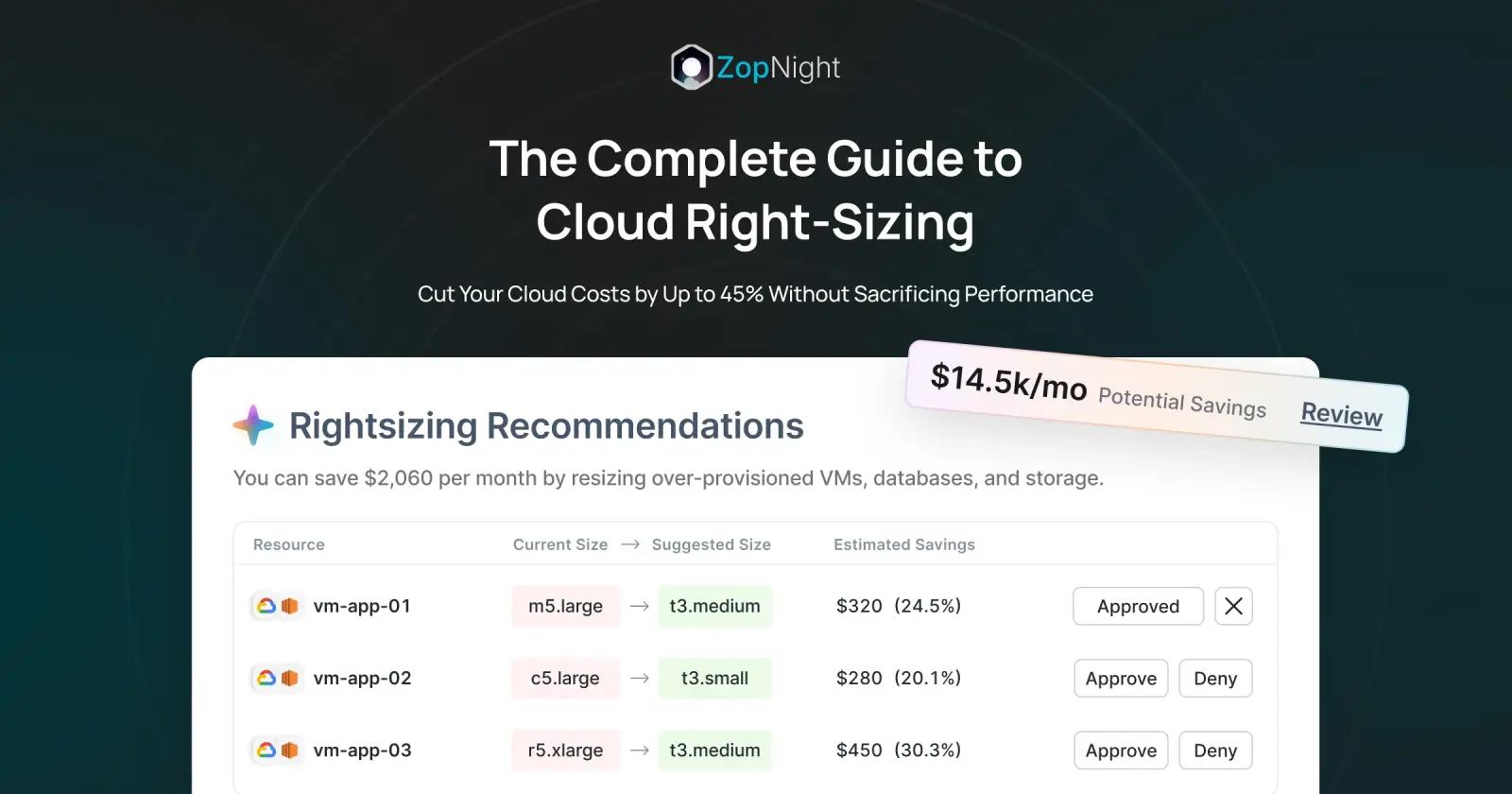
Solutions like ZopNight automate these recommendations and apply them safely at scale.
The Hidden Cost of Over-Provisioning
The cloud’s promise of infinite scalability has created dangerous habits:
- Fear-Based Provisioning – Teams request excess resources “just in case.”
- Lack of Visibility – 66% of engineers report significant disruptions due to poor cost visibility.
- Set-and-Forget Mentality – Resources provisioned for peak loads keep running at full capacity during quiet periods.
- Rapid Innovation Lag – Teams miss new, more efficient instance families without automation.
- Complex Multi-Cloud Environments – Fragmented billing formats obscure optimization opportunities.
Result: Organizations waste millions annually on unused capacity.
The Business Impact of Right-Sizing
Right-sizing delivers up to 70% cost savings, boosts efficiency, and strengthens governance—all without sacrificing performance.
1. Immediate Cost Savings
25–45% reduction in compute and database costs within the first month.
2. Compound & Sustainable Savings
When combined with reserved/spot instances and idle resource detection, 50–70% overall reductions are common.
3. Improved Resource Efficiency
Enhanced KPIs like cost per transaction, cost per user, and cost per request.
4. Operational Efficiency & Governance
Less manual capacity planning, better forecasting, budgeting, and compliance.
Real-World Success Stories
From GE Vernova to e-commerce and ticketing giants, rightsizing unlocked savings from $145K/month to $1M/year without sacrificing performance.
GE Vernova’s Million-Dollar Transformation
- $600,000 saved migrating to AWS Graviton processors
- $100,000 saved decommissioning idle instances
- $460,000 yearly savings from 80% non-production automation
E-Commerce Platform
Achieved 75% AWS budget reduction through rightsizing while maintaining peak performance.
Enterprise Ticket Distribution
Saved $145,000 monthly through systematic rightsizing at scale.
Best Practices for Successful Right-Sizing
Unlock lasting cloud savings by starting small, monitoring often, combining strategies, and enforcing clear governance.
- Start with Non-Critical Workloads – Test in dev/test first.
- Monitor Continuously – Right-sizing is ongoing, not one-time.
- Combine with Other Strategies – Spot, reserved, and idle detection amplify results.
- Set Clear Policies – Define thresholds, approvals, and rollback procedures.
The ZopNight Differentiation: Automated Intelligence Meets Business Reality
ZopNight transforms rightsizing into an intelligent, automated optimization engine.
Cross-Layer Optimization Engine
- Compute/VMs – Recommend or execute migrations (e.g.,
m5→m6g) - Kubernetes – Auto-adjust pod requests and limits
- Databases – Optimize class, move to serverless, pause/scale-down
- Storage – Recommend tier migrations (
gp3 vs gp2,S3 IA vs Standard)
Policy-Driven Safety Controls
- Guardrails like “never reduce prod workloads below 2 vCPUs”
- Environment-aware optimization across dev, staging, prod
Workload Intelligence
- Double Waste Detection – Flag workloads that are idle and oversized
- Seasonal Right-Sizing – Adjust for predictable cycles
- Predictive Optimization – Anticipate demand with ML insights
Right-Sizing: How It Works & 4-Phase Roadmap
Right-sizing works best when applied across VMs, containers, and databases—aligning every layer to actual demand.
Phase 1: Assessment & Discovery (Weeks 1–2)
- Analyze utilization across compute, storage, and databases
- Collect 2–4 weeks of usage data
- Identify oversized resources in non-prod
Phase 2: Pilot Implementation (Weeks 3–4)
- Rightsize dev/test workloads first
- Apply gradual, monitored changes
Phase 3: Production Optimization (Weeks 5–8)
- Enforce policies in production with approvals
- Use automated scaling for demand variation
- Track cost/performance metrics
Phase 4: Continuous Optimization (Ongoing)
- Apply automated recommendations
- Conduct quarterly reviews
- Adapt for seasonal cycles
Conclusion: The Right Size for Success
Every dollar saved on cloud infrastructure is a dollar reinvested in innovation.
42% of CIOs and CTOs identify cloud waste as their biggest challenge in 2025 — and poor rightsizing is the main cause.
Research shows organizations can save $55 million annually with proper resource allocation.
The question isn’t whether you can afford rightsizing — it’s whether you can afford not to.
Organizations that embrace rightsizing gain:
- Lower operational costs
- Improved efficiency
- Stronger governance
Next Step: Optimize with Confidence
Don’t let over-provisioning drain your budget.