
Key Takeaways
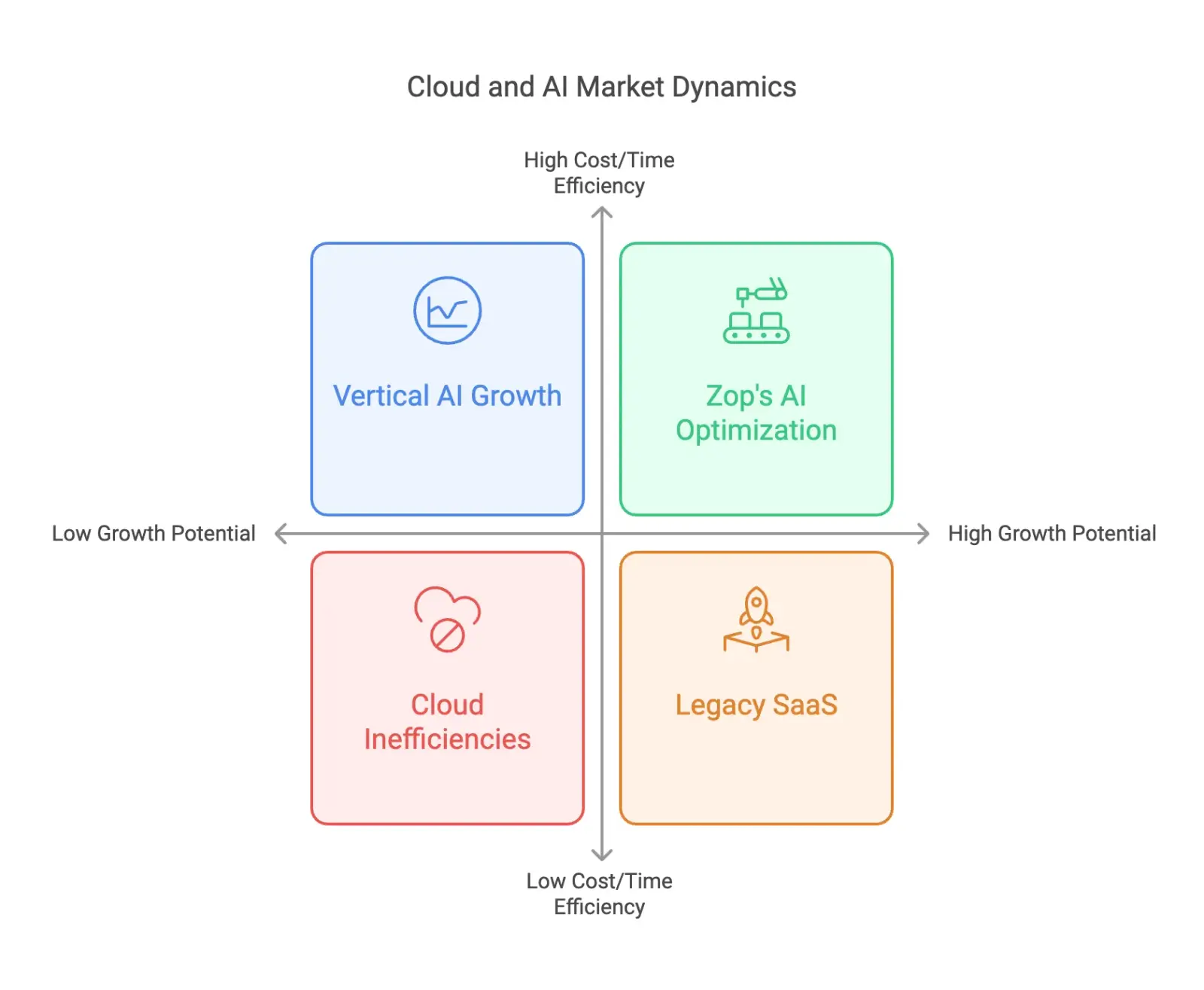
- Cloud inefficiencies cost businesses 27% of their cloud budgets annually (Flexera 2024).
- Only 8% of organizations have reached high cloud maturity (HashiCorp 2024).
- Zop reduces costs by 25% and deployment times by 40% with AI-driven optimization.
- Vertical AI is projected to grow 10x faster than legacy SaaS by 2025 (Bessemer).
Introduction
In 2024, the cloud ecosystem is thriving but grappling with a paradox of progress. A staggering 89% of organizations now embrace multi-cloud strategies [Flexera 2024 State of the Cloud Report], seeking flexibility and resilience. Yet, an estimated 27% of cloud spending is wasted due to inefficiencies like overprovisioning and idle resources [Flexera 2024 State of the Cloud Report]. This dichotomy raises a pivotal question: how can businesses harness the full potential of cloud computing without succumbing to its complexities?
“The challenge isn’t cloud adoption—it’s mastering it. Businesses are spending more but achieving less without the right tools and strategies,” said a senior analyst from HashiCorp.
As we approach 2025, transformative trends are shaping the cloud landscape. From AI-driven cloud management to Vertical AI solutions tailored for industries, and sustainability initiatives gaining momentum, the stage is set for profound change. But these opportunities come with challenges that demand thoughtful solutions.
This is where Zop quietly steps in. As a cloud-agnostic orchestration platform, Zop simplifies multi-cloud operations, optimizing costs while enabling organizations to achieve their broader goals. By focusing on usability and intelligence, Zop aims to make cloud management not just efficient but also accessible.
By the end of this article, you will gain a comprehensive view of the state of the cloud in 2024 and actionable predictions for 2025. We’ll also explore how Zop is empowering businesses to transcend complexity, allowing them to focus on what truly matters: innovation, growth, and impact.
The Current State of the Cloud (2024)
Cloud Adoption Trends
In 2024, multi-cloud strategies have become the standard for enterprises, with 89% of organizations leveraging these environments for resilience, disaster recovery, and regulatory compliance [Flexera 2024 State of the Cloud Report]. Hybrid cloud models, which combine public and private environments, have also experienced 23% YoY growth, underscoring the demand for flexible, scalable infrastructure.
“Enterprises are no longer debating whether to adopt multi-cloud but how to manage it effectively,” noted a cloud architect in the Bessemer report.
However, 16% of workloads remain on-premises, reflecting a slow but steady migration pattern. Legacy systems, data gravity, and compliance challenges continue to anchor these workloads, leaving a gap in achieving full cloud maturity.
Cloud Inefficiencies
Despite its transformative potential, cloud computing is rife with inefficiencies. 40% of resources are overprovisioned, and 35% remain idle, contributing to the 27% wastage in cloud budgets [Flexera 2024 State of the Cloud Report]. These inefficiencies highlight the need for better orchestration and resource optimization tools.
“It’s not enough to adopt the cloud—you need to use it smartly. The gap between what businesses spend and what they optimize is growing,” said a cost management expert in HashiCorp’s report.
Skills Gaps and Maturity Levels
Only 8% of organizations have achieved high cloud maturity, which is marked by advanced scalability, governance, and cost-efficiency practices [HashiCorp State of Cloud Report]. The majority struggle with talent shortages in areas like cloud architecture, DevOps, and FinOps.
“The skills gap is the hidden bottleneck in cloud transformation. Automation can help, but skilled teams remain irreplaceable,” commented a Flexera survey respondent.
Cost Management Challenges
For the first time, managing cloud spend has overtaken security as the top concern for organizations. With costs ballooning due to inefficiencies and rising complexity, businesses are under pressure to adopt FinOps practices and cost-optimization tools.
Zop’s Value Proposition
Zop addresses these challenges by providing a unified platform for multi-cloud orchestration and optimization. Its cloud-agnostic tools help organizations:
- Reduce idle and overprovisioned resources through intelligent allocation.
- Simplify cost management by offering actionable insights and real-time tracking.
- Enhance scalability while ensuring governance and compliance.
The Role of AI in Cloud Transformation
AI as the New Catalyst
In 2024, AI is no longer just a buzzword; it has become a transformative force in cloud management. Leveraging generative AI and predictive analytics, organizations are addressing longstanding issues such as resource inefficiencies, compliance bottlenecks, and workload scaling. According to HashiCorp, businesses utilizing AI in cloud operations report a 47% improvement in resource utilization and a 40% reduction in downtime.
“AI has turned reactive cloud management into a proactive, intelligent process,” said a lead engineer at a healthcare AI firm cited in the report.
Despite its promise, adoption remains uneven, with many companies still experimenting rather than fully integrating AI-driven solutions.
Key Use Cases
- Predictive Scaling: AI tools dynamically forecast usage patterns and adjust resources to prevent overprovisioning and ensure uptime during traffic spikes.
- Intelligent Governance: Automation enforces policies for security, data compliance, and operational benchmarks in real time.
- Cost Optimization: Advanced algorithms identify inefficiencies and recommend actionable steps to streamline cloud expenses.
“Without AI, you’re managing today’s cloud needs with yesterday’s tools,” observed a CTO at an e-commerce giant in Bessemer’s report.
Challenges to Adoption
Generative AI and predictive tools come with their own hurdles. High costs, limited expertise, and integration challenges slow adoption for many organizations. In fact, 33% of IT leaders cite a lack of AI-specific talent as a key barrier to achieving cloud maturity [HashiCorp State of Cloud Report].
Zop’s AI Edge
Zop integrates AI capabilities seamlessly into its multi-cloud orchestration platform, offering:
- Predictive Scaling: Automating resource allocation based on usage patterns to prevent downtime.
- Real-time Optimization: AI-powered insights that recommend and implement cost-saving measures without manual intervention.
- Compliance Assurance: Automating governance processes to ensure businesses meet regulatory standards effortlessly.
Vertical AI and Industry-Specific Solutions
The Rise of Vertical AI
Vertical AI has emerged as a critical driver of innovation, solving industry-specific challenges with precision and scalability. Unlike general-purpose AI, these solutions are tailored to niche, repetitive tasks in sectors like healthcare, finance, and legal services. According to Bessemer’s 2024 report, Vertical AI is growing 10 times faster than legacy SaaS, signaling a shift in how industries approach problem-solving.
“Specialized AI isn’t just a tool—it’s a competitive advantage for industries tackling complex, high-stakes problems,” remarked a senior analyst in Bessemer’s report.
State of the Cloud 2024 - Bessemer Venture Partners
Market Growth and Impact
The market for Vertical AI is set to explode, with predictions that five companies will surpass $100 million in ARR by 2025. Early adopters, such as EvenUp in legal tech and Abridge in healthcare, are already demonstrating 400% YoY growth. These companies use AI to handle tasks like medical transcription, legal research, and financial fraud detection, drastically improving efficiency and accuracy.

Challenges in Vertical AI Deployment
Despite its potential, deploying Vertical AI solutions across multi-cloud environments remains complex. Issues like vendor lock-in, latency, and infrastructure limitations can hinder scalability and reliability.
“The scalability of Vertical AI depends on flexible and interoperable cloud platforms. Without them, innovation stalls,” noted a CIO at a leading healthcare provider.
Zop as an Enabler
Zop addresses these challenges by providing:
- Low-latency Integration: Ensuring Vertical AI applications operate seamlessly across regions and cloud environments.
- Cross-cloud Interoperability: Removing vendor lock-in barriers to enable flexible, scalable deployments.
- Simplified Compliance: Automating region-specific governance requirements for industries like healthcare and finance.
Sustainability and Cost Optimization
The ESG Imperative
Sustainability has become a pressing priority for businesses as they align their strategies with Environmental, Social, and Governance (ESG) goals. Yet, only 29% of organizations actively prioritize sustainability in their cloud strategies, despite increasing regulatory and stakeholder pressures [Flexera 2024 State of the Cloud Report]. Reducing energy consumption and carbon footprints is no longer optional—it’s a strategic necessity.
“Sustainability is not just good for the planet; it’s good for business. Organizations with clear ESG strategies are better positioned to attract investors and customers,” said a sustainability consultant cited in the Flexera report.
FinOps: The Financial Lens on Cloud Sustainability
The rise of FinOps—financial operations focused on cloud cost optimization—is transforming how businesses approach resource efficiency. In 2024, 51% of organizations had a dedicated FinOps team, while 20% planned to establish one within the year [Flexera 2024 State of the Cloud Report]. FinOps practices emphasize real-time cost tracking, automated expense optimization, and alignment of cloud spending with business goals.
“Combining sustainability with FinOps creates a win-win. You save money while reducing your carbon footprint,” noted a FinOps lead at a retail enterprise in the HashiCorp report.
Challenges in Sustainability and Cost Optimization
Many organizations struggle to balance sustainability with operational performance. Common challenges include:
- Difficulty in tracking energy usage and carbon emissions across multi-cloud environments.
- Lack of automation in resource optimization, leading to inefficiencies.
- Limited visibility into how ESG goals align with cost-saving measures.
Zop’s Contribution to Sustainability and Cost Efficiency
Zop enables businesses to overcome these challenges with:
- Energy-efficient Workload Optimization: Automatically shifting tasks to lower-energy regions during off-peak hours to reduce environmental impact.
- Carbon Tracking Reports: Providing actionable insights into energy consumption and emissions.
- Automated Cost Savings: Identifying and addressing overprovisioned resources in real-time to minimize waste.
Predictions for 2025
Multi-cloud as the Default Operating Model
By 2025, multi-cloud will transcend being a strategy and become the default operating model for businesses globally. Driven by regulatory demands, disaster recovery needs, and data sovereignty laws, organizations will increasingly invest in tools that provide unified resource views and seamless integrations across cloud environments. This shift aims to reduce operational complexity while enabling agility.
“The future of cloud isn’t about choosing a provider—it’s about building resilience and flexibility across them all,” commented a cloud strategist in the Flexera report.
AI-Driven Cloud Management Maturity
AI’s role in cloud operations will evolve from an experimental tool to a cornerstone of organizational efficiency. Predictive analytics, autonomous scaling, and AI-powered governance will define high-maturity organizations, with early adopters reporting a 30-40% reduction in operational overhead. Generative AI, in particular, will enhance workload optimization and decision-making processes, ensuring resources align with real-time demands.
Vertical AI as a Growth Engine
The Vertical AI market will see unprecedented growth, with at least five companies surpassing $100 million in ARR by 2025 [Bessemer State of the Cloud Report]. Industries like healthcare, finance, and legal services will lead adoption, leveraging AI to tackle specialized, high-impact challenges such as fraud detection and compliance automation.
“Vertical AI isn’t just accelerating industries—it’s redefining them by automating tasks that were once considered irreplaceable,” remarked an AI innovator featured in the Bessemer report.
Sustainability and Cost Optimization Will Intersect
Cloud sustainability will become a core business requirement, with carbon footprint tracking and energy-efficient operations emerging as baseline expectations. The integration of FinOps practices with sustainability goals will reshape organizational priorities. By 2025, 75% of enterprises are expected to use automated cost governance tools, aligning financial efficiency with ESG commitments.
Consumer-Driven Cloud Innovation
AI-powered consumer applications will continue to redefine industries, offering hyper-personalized experiences and on-demand scalability. From generative design platforms to intelligent learning systems, these tools will drive demand for multi-cloud ecosystems that ensure low latency, global availability, and robust security.
Zop’s Vision for 2025
Simplifying Multi-cloud Complexity
Zop envisions a future where managing multi-cloud environments is no longer a source of frustration but a seamless enabler of innovation. By 2025, Zop aims to solidify its position as the central control plane for multi-cloud orchestration, providing tools that unify resources, optimize workloads, and reduce operational overhead.
“Our goal is to make multi-cloud as simple as single-cloud without compromising flexibility,” shared Zop’s leadership during a recent webinar.
AI-First Cloud Management
Zop is committed to integrating cutting-edge AI capabilities into its platform, making predictive scaling, compliance automation, and real-time cost optimization accessible to businesses of all sizes. By leveraging AI to anticipate and address operational needs, Zop will empower organizations to move from reactive to proactive cloud management.
Driving Sustainability Efforts
Recognizing the growing importance of ESG goals, Zop plans to enhance its platform with sustainability-focused features, including carbon footprint tracking, energy-efficient workload scheduling, and actionable insights to help businesses align their cloud operations with environmental commitments.
“Sustainability isn’t just an add-on—it’s a fundamental part of how we see the future of cloud management,” emphasized Zop’s product team in a sustainability roundtable.
Outcome-Driven Innovation
Zop’s mission is to enable businesses to focus on their core innovations without being bogged down by the complexities of cloud management. By 2025, Zop envisions itself as the go-to solution for organizations seeking effortless cloud operations that deliver measurable outcomes, whether in cost savings, operational efficiency, or sustainability gains.
The Path Forward
As businesses embrace 2025, the cloud landscape is poised for remarkable transformation. From the rise of multi-cloud as the default operating model to the integration of AI and Vertical AI solutions, organizations are presented with both unparalleled opportunities and significant challenges. Sustainability and cost optimization will continue to shape priorities, ensuring that cloud strategies align with broader ESG and financial goals.
Zop’s Role in Shaping the Future
At Zop, our vision is clear: to make cloud management simple, intuitive, and impactful. By providing a cloud-agnostic platform, we empower businesses to overcome operational complexity, achieve cost efficiency, and advance sustainability goals. Our commitment is to ensure that organizations can focus on innovation while we handle the complexities of cloud orchestration.
FAQs
Why are multi-cloud strategies gaining popularity?
Multi-cloud strategies offer enhanced resilience, disaster recovery, and regulatory compliance, making them essential for businesses navigating complex global demands.
What are the biggest challenges organizations face in cloud management?
The top challenges include inefficiencies leading to wasted budgets (27%), a lack of skilled cloud professionals, and managing cloud costs, which has become the primary concern for many businesses.
How does AI impact cloud management?
AI transforms cloud management by enabling predictive scaling, real-time cost optimization, and compliance automation, significantly reducing operational overhead and inefficiencies.
What is the role of sustainability in cloud strategies?
Sustainability is becoming a core focus, with businesses prioritizing energy-efficient operations and carbon tracking to align with ESG goals and reduce environmental impact.
As your organization prepares for the cloud demands of 2025, consider how Zop can partner with you to navigate this journey. With solutions designed to simplify, optimize, and elevate your cloud strategy, we’re here to help you turn challenges into opportunities.
Are you ready to transform your cloud strategy for 2025 and beyond? Let Zop be your guide to effortless multi-cloud management.