The “Easy” Script That Isn’t
Most teams start their FinOps journey the same way: spin up a tiny cron job or AWS Lambda to stop a few EC2 boxes after hours. It feels free, takes an afternoon, and the very first month’s bill drops a bit. Victory, right? Not quite. AWS itself lists “stop or downsize idle instances” as a top-ten cost move because the waste problem is huge — not because the fix is trivial.
Why Non-Prod Bloats the Bill
Only ~200 hours of a 720-hour month are active coding hours for most dev teams. Yet every dev and staging VM, RDS cluster, and test node hums 24 × 7, billing the full 720.
In one AWS case study, GE Vernova slashed $460,000 a year — over 60% of its non-prod compute — by automating nightly shutdowns.
DIY Scripts: Four Hidden Costs
- Tag Rot — A single forgotten
env=stagetag leaves a new instance forever-on. - Exception Creep — “Leave QA up this weekend” morphs into “leave it up forever.”
- Coverage Gaps — Cron handles EC2, but who writes the RDS, EKS, and ALB logic?
- Audit Fog — Security asks who shut a box off; your script has no answer.
FinOps Foundation calls these “invisible toil” that turns a 50-line helper into a maintenance liability.
Reliability Math Gets Ugly
A 2024 study of 200 GitHub projects found automation workflows need frequent fixes for dependency drift and silent failures — exactly what happens to cron pipelines.
Combine that with research showing cron misfires are among the top incident triggers in large SaaS estates, and the “free” script starts looking expensive.
Maintenance Hours vs. Savings Dollars
Assume a five-engineer startup:
- DIY path: each engineer spends ~1 hr/week nursing scripts ⇒ 20 hrs/mo.
- At a blended $70/hr, that’s $1,400 of engineering spend to maybe save $2,000 in cloud.
The margin vanishes the moment tags drift or a Friday deploy forces manual babysitting.
Purpose-Built Schedulers Change the Equation
Services such as AWS Instance Scheduler prove the pattern: tag-based selection, central policy, and audit logs beat one-off Lambdas. But you still manage CloudFormation stacks, per-region Lambdas, and updates.
That’s where ZopNight slots in — a cloud-agnostic, one-tap bedtime switch that lives outside your production blast radius yet inside your IAM guardrails.
What ZopNight Adds (Beyond On/Off)
- Five-Minute Setup – paste a scoped stop/start role—done.
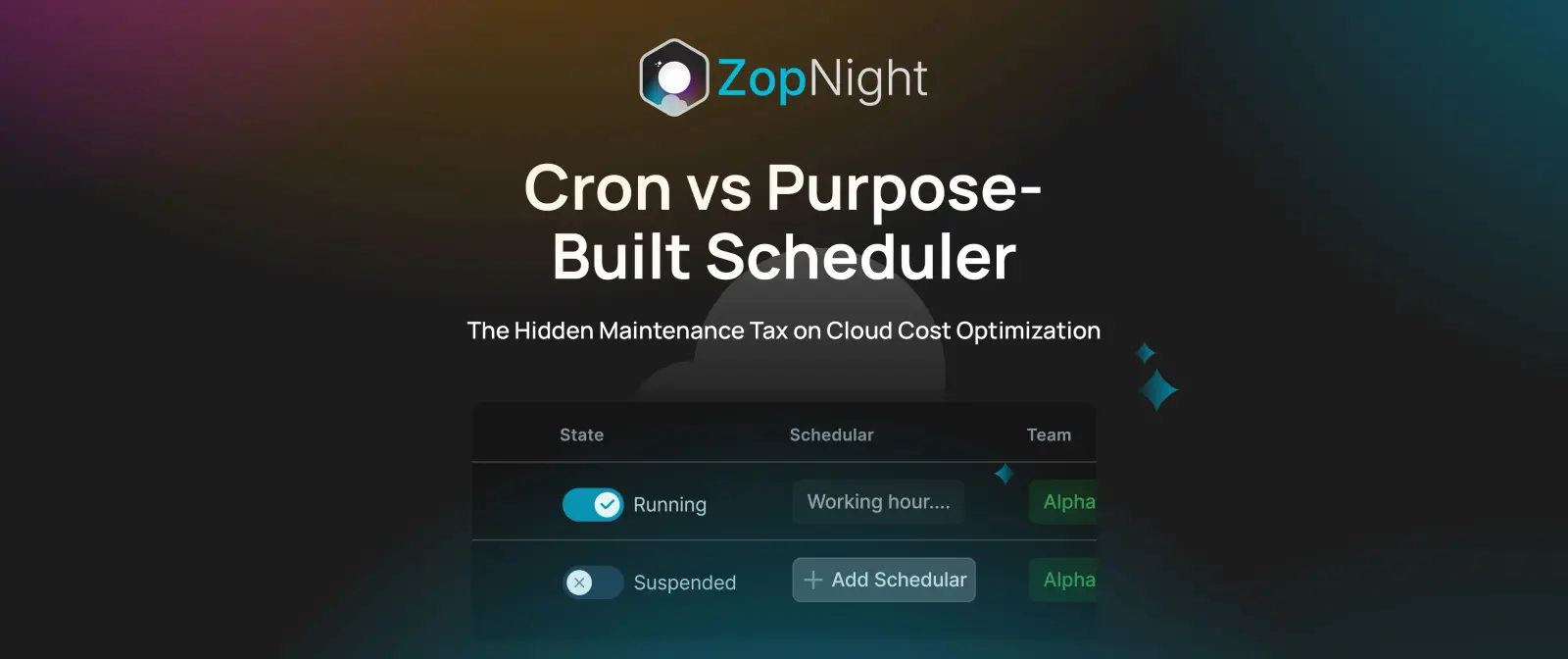
- Group Toggles – drag every dev box into the same “pillow fort” and flip one switch.
- Budget Guardrails – set a dollar cap; ZopNight tightens schedules automatically.
- Slack Overrides –
/zop wake 30mat 2 a.m. beats hunting the AWS console. - Rightsizing While You Sleep – down-shifts
xLargetoMediumwhen CPU < 10% (beta).
All without editing YAML or hoping a cron expression is correct at DST.
Case Snapshot: 20-Engineer SaaS Team
A mid-size startup replicated the GE pattern:
- 320 non-prod resources, $18k/month spend.
- After plugging in ZopNight, nightly hibernation plus weekend shutdowns cut the bill to $7.2k — a 60% drop — while the paid tier cost $960 (320 × $3).
- Net annual ROI: $125k.
Rightsizing Completes the Loop
Switching off solves idle time waste; rightsizing attacks idle capacity. AWS Compute Optimizer shows 35% of instances are oversized, but applying its JSON patches by hand is another scripting chore.
ZopNight pipes those recommendations into the same bedtime engine — scale down and sleep, no extra pipelines.
Security & Audit Get a Win Too
Because ZopNight runs with stop/start only, it can’t touch prod unless you tag it. Every action is logged with user, timestamp, and reason — giving your auditors the breadcrumb trail the bash script never had.
DIY vs ZopNight: 12-Month TCO Snapshot
| Team Size | DIY Script Maint. (hrs/yr) | Eng Cost (@$70/hr) | Cloud Saved | Net DIY Benefit | ZopNight Fee | Net ZopNight Benefit |
|---|---|---|---|---|---|---|
| 5 Devs | 200 | $14,000 | $24,000 | $10,000 | $3,600 | $20,400 |
| 20 Devs | 600 | $42,000 | $72,000 | $30,000 | $10,800 | $61,200 |
| 50 Devs | 1,200 | $84,000 | $180,000 | $96,000 | $27,000 | $153,000 |
| 300 Devs | 5,400 | $378,000 | $1.2M | $822,000 | $162,000 | $1.04M |
Engineers are happier, and finance sees an immediate delta.
Four Take-Away Rules
Turn Off First — idle hours beat any reserved-instance discount.
Automate Exceptions — a Slack snooze is cheaper than a weekend outage.
Shrink What Stays On — rightsizing plus sleep is the 1–2 punch.
Count Engineer Time — maintenance is part of your AWS bill; it’s just paid to payroll.
Let Your Cloud Nap
Cron jobs are great until they aren’t. When the hidden toil shows up on the incident page — or the payroll ledger — it’s time to hand the pillow to software that was born to hibernate clouds.
ZopNight has one job: flip the “Do-Not-Disturb” sign on every non-prod resource, then wake them before Jenkins notices. Your developers keep shipping; your CFO keeps sleeping.
Ready to power down the spend? Put your cloud to bed with ZopNight tonight.
Sources