After working with dozens of enterprise cloud environments, we realized 100% tag compliance isn’t happening. Here’s how we fixed the data layer without modifying a single cloud resource.
The $47,000 Mystery Instance
Three months ago, one of our potential clients found an EC2 instance that had been running for 11 months. No tags. No owner. No team. No environment label. Just a cryptic name: jenkins-exp-v2-final-REAL.
Monthly bill: $4,200. Total waste: $47,000.
We eventually tracked down the owner through SSH key forensics and git blame archaeology. Their response was familiar: “I spun it up for a quick experiment. It was supposed to be temporary. I forgot it existed.”
This wasn’t special. We kept seeing this with our POC clients.
The Enforcement Trap
For two years, our clients tried the textbook approach: enforcement. They did everything the industry recommends:
- CI/CD gates: Terraform wouldn’t apply unless resources had mandatory tags
- Automated Slack reminders: Weekly pings to teams with untagged resources
- Policy engines: AWS Config rules flagging non-compliant resources
- Tagging Days: Quarterly cleanup campaigns where they begged engineers to fix their metadata
- Documentation: A detailed tagging standard that nobody read
Tag coverage plateaued at 27%.
The real breakdown:
- 31% had tags in the wrong format (
env:prdvsEnvironment:production) - 18% had partial tags (environment but no owner)
- 24% had something indecipherable (
project:misc-testing) - 27% had nothing
According to industry data, this is pretty normal. A 2024 Flexera State of the Cloud Report found that only 23% of organizations have comprehensive tagging strategies, and 451 Research estimated enterprises typically achieve 20-30% meaningful tag coverage.
The issue wasn’t discipline. Manual tagging doesn’t scale when:
- Resources spin up and down in seconds
- Teams ship 50+ deployments per day
- Experiments become production workloads overnight
- Engineers switch teams and contexts change
- Deadlines override metadata hygiene every time
Two years of trying to change human behavior. It never worked.
The Post-Mortem That Reframed Things
We had a post-mortem for a failed shutdown automation.
Our script was supposed to stop all non-production EC2 instances overnight to save money. Instead, it shut down a production Redis cache because someone had tagged it env:staging six months ago during testing and never updated it.
Someone in the post-mortem said: “The problem isn’t that the tag was wrong. The problem is that we expected the tag to be right.”
We’d been solving the wrong problem. We weren’t going to fix tagging by making humans better at tagging. We needed to fix the data layer itself.
Decision Point 1: The Virtual Layer vs. Write-Back
When we started designing AutoTagging, we had two options.
Option A: Write-Back Architecture
The tool scans your cloud accounts, figures out what resources are, and writes corrected tags back to AWS/Azure/GCP.
- Pros:
- Tags are “real” in the cloud provider
- Works with existing tools that read native tags
- Simple mental model
- Cons:
- Configuration drift: If ZopNight writes
Environment:productionbut your Terraform expectsenv:prod, the next apply sees drift - Production risk: Modifying resources directly can trigger side effects
- Permission hell: Requires write access across all accounts
- Tag limits: AWS has a 50-tag limit per resource; adding system tags burns that quota
- Configuration drift: If ZopNight writes
We prototyped this in two weeks. The first test run modified 400 resources, and Terraform immediately threw drift warnings. Engineers revolted.
Option B: The Virtual Layer (Sidecar Architecture)
We treat the cloud provider’s metadata as read-only. ZopNight maintains its own database of interpreted tags and projects them as a clean overlay.
- Pros:
- Zero production risk: We never touch your actual cloud resources
- No drift: Your IaC doesn’t know we exist
- Unlimited metadata: No tag limits
- Cons:
- Complexity: We need our own metadata storage and sync system
- Dependency: Automation must integrate with ZopNight’s API, not just read cloud tags
- Education: Teams need to understand that “real” tags and “ZopNight” tags are different
We went with Option B.
The principle: The source of truth for cloud resources is your cloud provider. The source of truth for tags is ZopAI - AutoTagging.
Decision Point 2: The Essential Tags Framework
Once we committed to the virtual layer, we had to decide which tags we actually needed.
We looked at Google Analytics’ UTM parameters - the system that became the standard for tracking marketing campaigns. UTM worked because it answered five essential questions: where did this traffic come from, what campaign drove it, what medium, what specific link, what variant.
Cloud resources need the same thing: a minimal set of universal dimensions that answer the questions every automation system needs. After analyzing 50+ POC clients’ tags and talking to DevOps teams, we identified four universal questions:
- What environment is this? (Development, Staging, Production)
- Determines automation behavior, cost sensitivity, uptime requirements
- Which team is responsible?
- Accountability, incident response, cost allocation
- Who is the owner?
- Accurate chargeback, budget forecasting, financial reporting
- Should we stop it?
- Prevents automation disasters.
These became our Essential Tags, inspired by UTM’s “minimum viable metadata for maximum operational utility.”
In ZopNight:
zop:env(environment)zop:team(team)zop:owner(owner)zop:no-stop(automation safeguard)
Everything sits on this four-tag foundation.
Decision Point 3: Regex Hell -> Intent Inference
Building the XGBoost Model: Reading Metadata, Not Rewriting It
The approach is straightforward: We predefined the four essential tag keys. The model’s job is to read your existing metadata and determine the correct values.
We chose XGBoost because it handles:
- Mixed data types (strings, booleans, numerical values)
- Missing or incomplete features
- Non-linear decision boundaries
- Fast inference at scale
The model was trained on 150,000+ labeled resources from client environments across fintech, healthcare, e-commerce, and SaaS.
How It Works: Signals -> Understanding -> Decisions
Step 1: We Observe the Signals the Cloud Already Exposes
When a resource appears, ZopNight passively observes the information the cloud platform already maintains about it. We don’t inject data, enforce rules, or modify configuration in any way.
This includes a broad mix of descriptive, historical, and contextual signals that clouds naturally generate as part of normal operation, things related to how the resource is configured, where it lives, how long it’s existed, and how it behaves over time.
- No single signal is trusted on its own.
- Individually, each signal is noisy, incomplete, or misleading.
- Taken together, they start to form a reliable picture.
- The key principle: we read, we don’t write.
Step 2: We Derive Operational Context (Not Human Intent)
Instead of assuming that names, labels, or hand-maintained fields reflect reality, ZopNight focuses on the operational truth of how a resource actually behaves, not what someone once intended it to be.
From the raw signals, we derive higher-level context about:
- Lifecycle & longevity (e.g. uptime: 187 days)
- Workload intensity & stability (e.g. steady load, low variance)
- Scaling & capacity posture (e.g. auto-scaling enabled)
- Exposure & dependencies (e.g. public endpoint, downstream links)
- Safety & recoverability (e.g. backups + delete-protection)
- Usage & utilization (e.g. consistently active)
These exist regardless of cloud provider, service, or team discipline. In other words, even in environments with poor naming, inconsistent standards, or zero tags, the operational footprint of a resource still tells a story.
Step 3: The Model Predicts Values for the Four Essential Keys
The XGBoost model runs four separate classifiers (one per essential tag):
Predictions:├── zop:env → "production"│ └── Top signals: 'prd' in tag, 'prod' in name, prod VPC, long uptime│├── zop:team → "engineering"│ └── Top signals: Team tag matched directory, repo activity│├── zop:owner → "account-owner@company.com"│ └── Top signals: owner helps in escalation & accountability default│└── zop:no-stop → "true" └── Top signals: production env, public-facing, stable uptimeStep 4: We Store These As Virtual Tags
The four predictions become ZopNight’s control tags stored in our database, never written to AWS.
Decision Point 4: Human-in-the-Loop vs. Fully Automated
The biggest fear with governance automation is the “Silent Killer” scenario: a script that confidently destroys a production database because it was mistaken.
We had two options:
- Option A: Fully Automated: ZopNight automatically applies inferred tags. No human approval needed. Maximum speed, maximum risk.
- Option B: Human-in-the-Loop: ZopNight generates tag suggestions. Engineer reviews and approves. Slower, but safer.
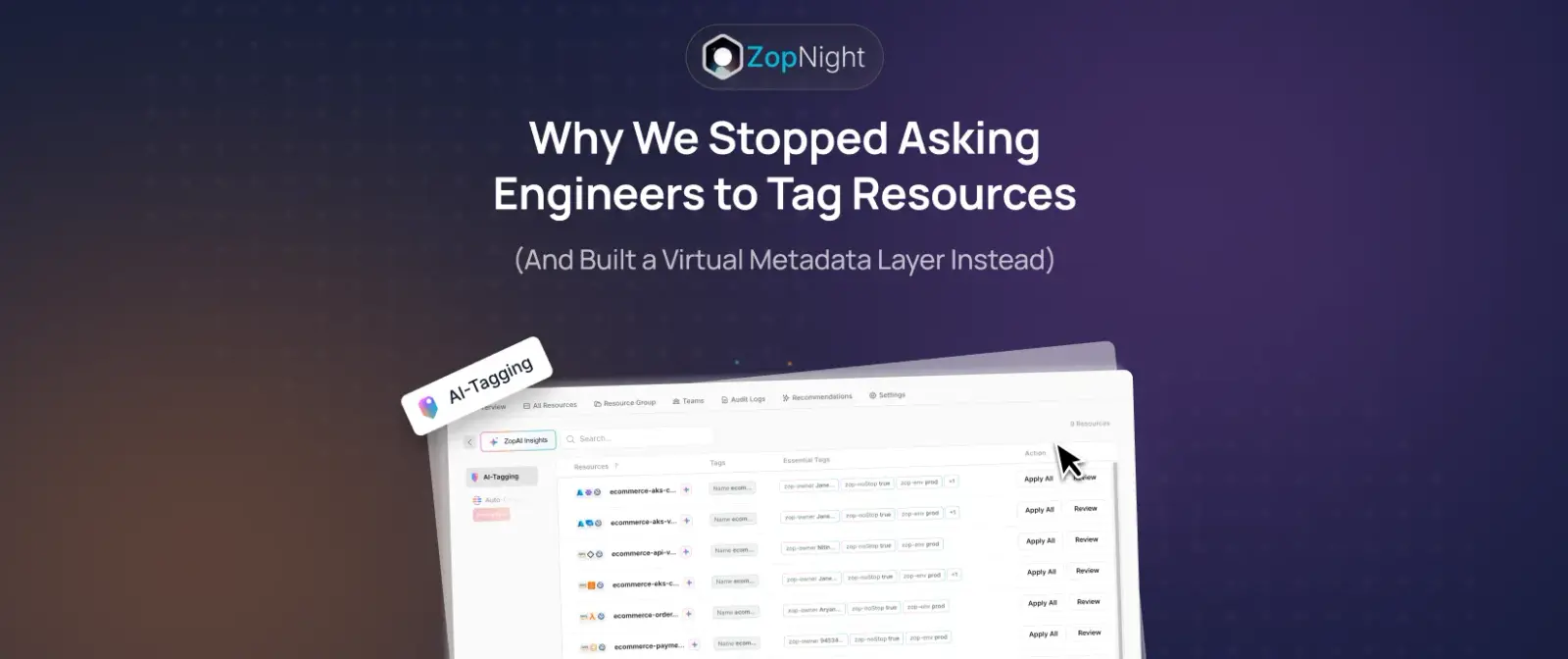
We went with Option B, but made it low-friction. This takes coverage from 20% to 95% in under 30 minutes, but keeps the human in control.
The Results (The Beta Evidence)
We deployed ZopNight internally and to 8 POC partners.
Speed
| Organization | Before Coverage | After Coverage (30 min) | Time Investment |
|---|---|---|---|
| Company A | 14% | 97% | 23 minutes |
| Company B | 19% | 94% | 18 minutes |
| Company C | 27% | 96% | 31 minutes |
| Internal | 22% | 95% | 26 minutes |
Average: 27% -> 95% in under 30 minutes.
For context: Before ZopNight, our quarterly “Tagging Days” took 40+ engineering hours and improved coverage by about 5% (which degraded back to baseline within 2 weeks).
One partner: “We’ve been trying to implement chargeback for 2 years. We finally had to estimate costs because we couldn’t tag everything. ZopNight gave us accurate attribution in 30 minutes. We found 19% waste we didn’t know existed.”
Safety
Zero production incidents caused by metadata changes across all beta deployments. Because we never touched the underlying cloud tags, we couldn’t accidentally trigger:
- Terraform drift
- CloudFormation stack updates
- Auto-scaling group reconfigurations
- Security policy changes
The virtual layer is a read-only lens over your infrastructure.
Automation Reliability
Before ZopNight, our shutdown automation had a 68% success rate (percentage of resources that should have been stopped that actually were).
After ZopNight: 96% success rate.
The 4% failure rate came from:
- Network dependencies (can’t stop web server if database is still running)
- Manual overrides (engineer explicitly disabled automation)
- Legitimate edge cases we’re still tuning
The Philosophy: Tagging Shouldn’t Be a Tax
For years, the cloud industry has treated tagging as a hygiene problem - if engineers just tagged better, everything would work.
We think tagging is an infrastructure problem. The resource exists. The metadata should exist automatically.
ZopNight removes humans from the tagging loop but keeps them in control. And tagging stops being your problem.
You can connect your first account and see your suggestion panel in about 5 minutes.