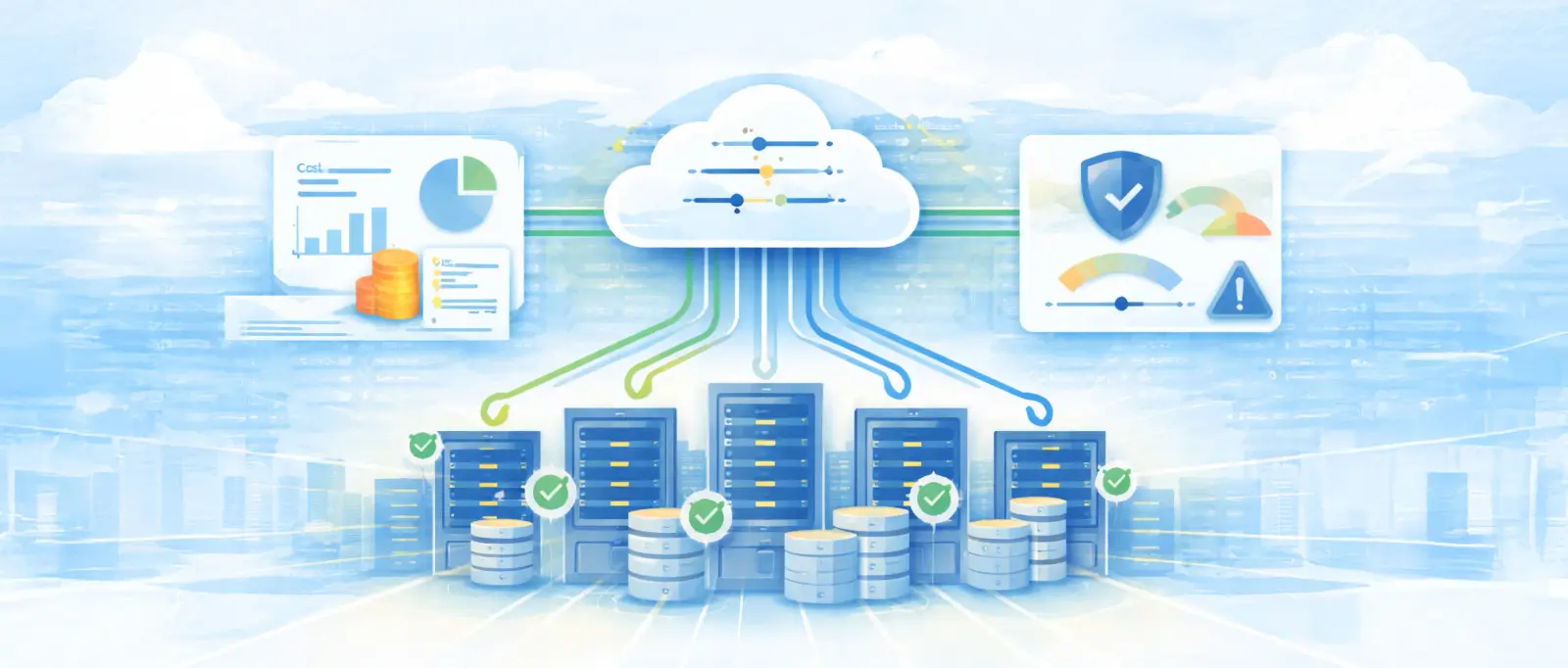
Most leaders think scale is about more servers. It isn’t. Scale is about better decisions.
Every time a user clicks your app, a silent system decides: “Which machine in the world should handle this request, right now without breaking performance, cost, or reliability?”
That system is the load balancer. And it is not just a network gadget. It is a real-time economic and reliability control system.

From Faster Machines to Smarter Systems
In early computing, applications lived on one machine. Bigger traffic meant buying a bigger server. That worked until:
- Traffic spikes became unpredictable
- Downtime started costing millions
- Customers expected 24/7 availability
The industry hit a wall: Hardware scaling has limits. So architecture evolved: Single Machine → Server Pool → Orchestrated Decision Layer
That decision layer is where modern infrastructure lives.

The Core Business Problem: Where Should Work Go?
When 200 servers can answer a request, choosing the wrong one is expensive. The “Traffic Distributor” is actually a risk manager.
| Bad Decision | Business Impact |
|---|---|
| Send traffic to overloaded server | Latency, Churn, SLA Breach |
| Send traffic to failing server | Outage, Public Incident |
| Send heavy work to weak node | Cascading Failure (The “Thundering Herd”) |
| Send users to distant region | Cart Abandonment / Lost Revenue |
| Send uneven load | Overprovisioning (Cloud Waste) |
So the real job isn’t distributing packets. It is making the best possible decision under uncertainty, millions of times per second. That is load balancing.
Reality Check: “Load Balancer” Is Not One Thing
What we casually call a load balancer is actually a stack of decision layers working in concert:
| Layer | Technical Name | What It Decides |
|---|---|---|
| Global | GSLB | Which data center or country handles the user? |
| Network | L4 (Transport) | Which server IP, based on connection speed? |
| Application | L7 (App Layer) | Which specific service, based on URL or ID? |
| Internal | Service Mesh | Is this microservice healthy enough to receive traffic? |
Different systems, same mission: Send traffic to the safest place possible.
The Evolution: From Fairness to Survival
Early systems (like DNS Round Robin) were optimized for fairness. Everyone got a turn. Modern systems powering AWS, Google Cloud, and Azure optimize for survival.
They continuously evaluate:
- Who is alive?
- Who is fast?
- Who is throwing errors?
- Who is dangerously close to a limit?
Traffic is a risk, not just demand. The goal is to mitigate that risk.
Health Checks: The Gatekeepers of Reliability
Servers must constantly prove they deserve traffic. Tools like NGINX, HAProxy, and Envoy use probes to test responsiveness.
The Nuance:
While modern service meshes can look at CPU or Memory usage, the most reliable signal is usually external. The Load Balancer asks: “Are you answering quickly? Are you throwing 500 errors?”
If behavior degrades, traffic is rerouted quietly. That quiet decision prevents a visible outage. The user never knows a server failed.
Load Balancing Is Now Traffic Orchestration
In a microservices world, infrastructure becomes a real-time traffic control network. Requests are routed using complex logic:
- /payment -> goes to the high-security PCI-compliant cluster
- User ID: 101 -> goes to the “Canary” deployment (beta features)
- iPhone Users -> go to the mobile-optimized fleet

The Algorithms That Decide Everything
| Strategy | What It Optimizes |
|---|---|
| Round Robin | Fairness (Dumb but simple) |
| Least Connections | Overload avoidance (Smart) |
| Fastest Response | Latency (User Experience) |
| IP Hash | Session consistency (Sticky Sessions) |
| Geo Routing | Data Sovereignty & Speed |
Every choice is a trade-off between speed, cost, and stability.
Why This Matters to FinOps
Bad traffic decisions create cost spikes.
- Hotspots trigger unnecessary autoscaling events.
- Uneven load leaves capacity idle (you pay for servers doing nothing).
- Poor routing forces overprovisioning “just to be safe.”
Good load balancing smooths utilization. It is a cost optimization engine in disguise.
Why This Matters to DevOps & SREs
Most outages aren’t caused by a lack of capacity. They are caused by misdirected traffic during stress. Load balancers act as your:
- Blast Radius Container: Isolating failures to one zone.
- Pressure Valve: Rejecting excess traffic to save the core database.
- Shock Absorber: Smoothing out spikes before they hit the app.
Why CFOs Should Care
Every request represents:
- Revenue
- Customer Experience
- Infrastructure Cost
The system deciding where that request goes directly controls your risk exposure and gross margin. This is financial governance embedded in infrastructure.
The Big Idea
A load balancer is not: ❌ Just traffic distribution ❌ Just networking gear
It is a real-time decision engine balancing performance, risk, and cost. Cloud scale is not built on hardware. It is built on millions of small, correct decisions about where work should go.
That invisible layer - making those decisions every millisecond - is what keeps the digital economy standing.