Introduction
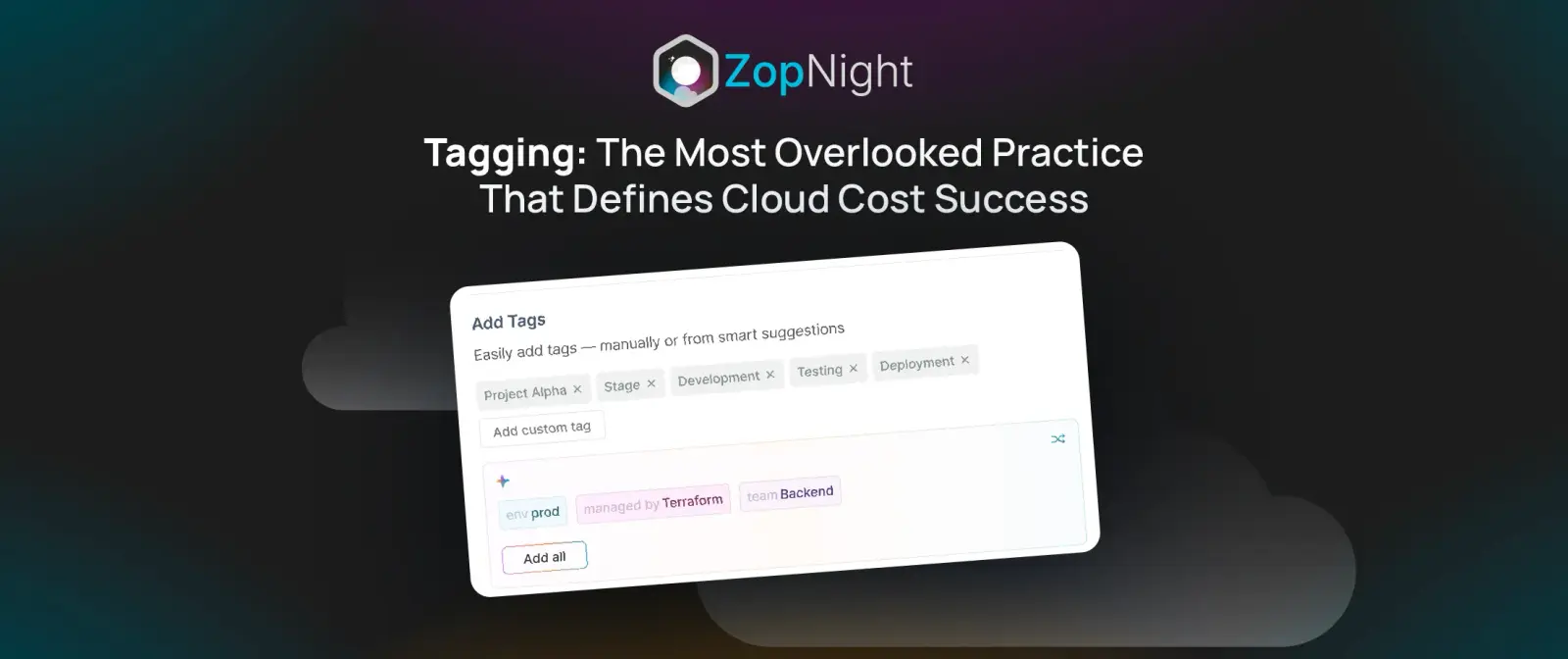
Most cloud teams obsess over dashboards, credits, and cost alerts. But they often miss the simplest, most powerful control lever: consistent resource tagging.
If your cloud resources aren’t tagged correctly, even the most advanced cost optimization tools become blind. This isn’t just an ops hygiene issue — it’s a business-critical failure point.
If your startup or enterprise is struggling to understand cloud spend, it’s not because you lack visibility. It’s because your infra lacks context. And that context is created through tags.
Let’s unpack why tagging matters, where teams go wrong, and how platforms like ZopNight make cost-saving automation possible only after tagging discipline is enforced.
Why Tagging Is the Foundation of FinOps
Cost visibility is impossible without proper categorization. Tags are how you:
- Map resources to teams, products, environments
- Attribute spend accurately
- Track ROI by feature, service, or customer cohort
Without them, your billing data is a soup of EC2 instances, S3 buckets, and GKE nodes. Clean tagging gives your finance, engineering, and leadership teams a shared language.
Example: A well-tagged EC2 instance might have:
- team=backend
- env=staging
- product=checkout
- owner=alice
Now you know who, why, and where that cost lives.
What Happens When You Don’t Tag
If your tagging is inconsistent or missing:
- Shared infra becomes a black box
- Zombie resources accumulate because no one knows who owns them
- Cost anomalies go undetected because you can’t isolate causes
- No automation can run: platforms like ZopNight depend on tags to identify what to schedule
In short: untagged infra is unactionable infra.
And worse: engineers fear touching it.
Why Most Teams Struggle with Tagging
-
Tagging is not enforced at provisioning
Engineers spin up resources via console or CLI without standards.
Terraform and Helm charts don’t enforce tag rules. -
Lack of a tag taxonomy
Teams don’t agree on a standard schema likeenv,team,cost-center,owner.
Tags liketeam=backendvsteam=BEvsgroup=backendcreate chaos. -
No retroactive tagging
Older resources never get fixed.
Orphaned workloads accumulate silently. -
No incentive to tag
Engineers don’t see immediate benefit, so they skip it. -
No tag-based guardrails or alerts
Tag drift goes unmonitored.
What a Good Tagging Strategy Looks Like
Start with a Tag Matrix:
| Tag Key | Description | Example | Mandatory? |
|---|---|---|---|
| env | Environment | dev, prod | Yes |
| team | Owning team | frontend | Yes |
| owner | Individual owner | alice | Yes |
| product | Feature or product area | payments | Optional |
| cost-center | Internal billing code | fin-001 | Optional |
Tag via Infrastructure-as-Code:
- Enforce tags in Terraform, Pulumi, Helm templates
- Validate tagging during CI/CD pipelines
Audit Regularly:
- Run daily/weekly reports for untagged or mis-tagged resources
- Alert teams with ownership gaps
Use Automation to Fix Drift:
- ZopNight and other platforms can only act if the tag logic is reliable
- Retagging old resources must be a monthly ritual
How ZopNight Depends on Clean Tagging
ZopNight’s core feature — automated scheduling of non-prod infra — relies on identifying environments through tags like env=dev or env=staging.
If tags are missing or wrong:
- Resources stay running 24/7 even if unused
- Schedulers can’t group infra logically
- Budget guardrails become noisy or misleading
ZopNight works best when infra is tagged predictably. That’s how it:
- Finds idle environments
- Applies schedules automatically
- Groups resources by team/product for dashboarding
Think of tagging as the fuel, and ZopNight as the engine.
Tagging Isn’t Just for Engineers
Everyone in your org depends on clean tags:
- Finance: maps infra cost to business units
- PMs: measure cost of features
- Security: isolate risk by environment
- Data: understand lineage and impact
Make tagging visible across dashboards. Integrate it into your review and OKR cycles.
The Cost of Inaction
Poor tagging leads to:
- $10K+ monthly in zombie resources
- Infra that can’t be safely turned off
- Broken cost allocation reports
- Missed savings from automated tools like ZopNight
It’s not just a DevOps issue — it’s a company-wide blind spot.
Quick Wins: What You Can Do This Week
✅ Publish a tagging policy with 5 mandatory keys
✅ Update your IaC modules to enforce them
✅ Retag top 50 most expensive resources
✅ Run an untagged resource report
✅ Configure ZopNight to ignore untagged infra (and alert it)
Final Thoughts
Tagging is the lowest-effort, highest-leverage move in cloud cost optimization. It’s how you make your infrastructure legible to humans and automation platforms.
If you’re struggling to get your cloud budget under control, start not with cost dashboards, but with tagging discipline. It’s the simplest move you can make today to unlock serious savings tomorrow.
ZopNight isn’t just a scheduler; it’s a cost culture enforcer. But it only works if your infra speaks a language it can understand — and that language starts with clean, consistent tagging.
Need help tagging or enforcing discipline across teams? Our team at ZopNight can help you audit, standardize, and automate the whole lifecycle. No pitch, just pragmatic help.