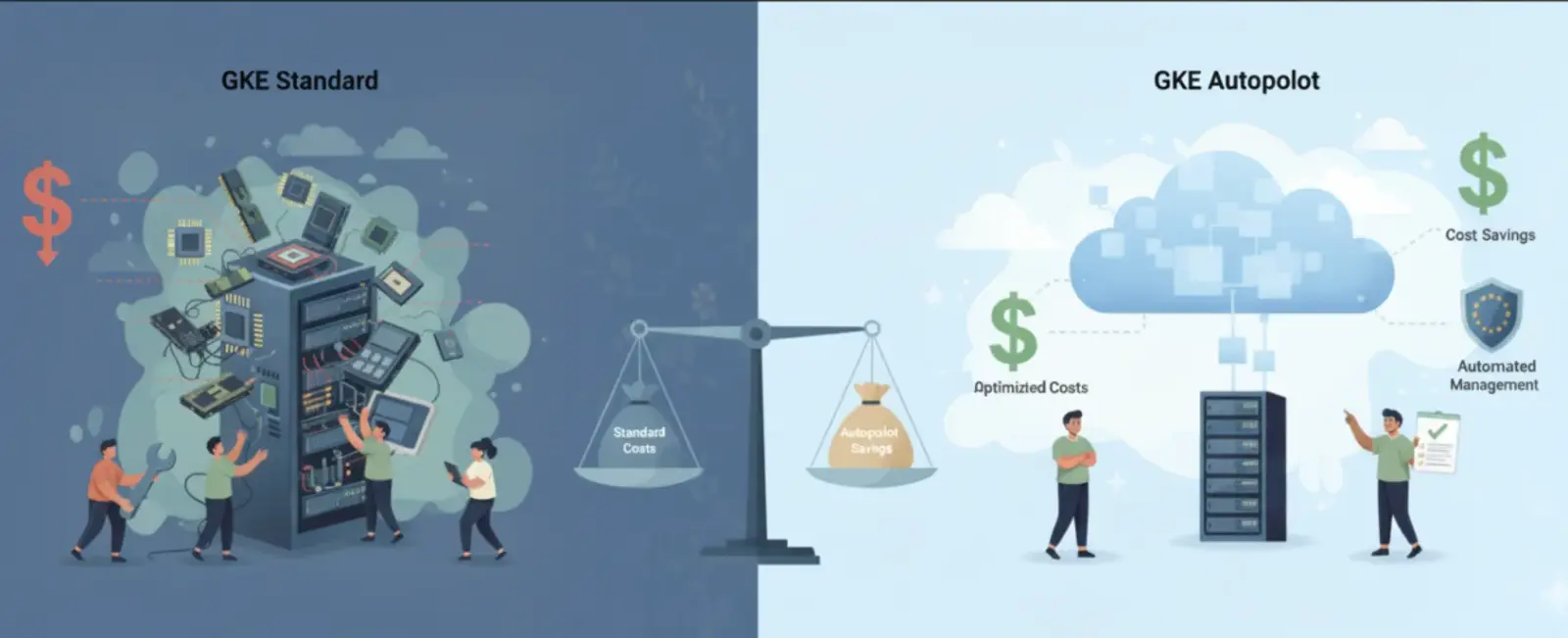
Google Cloud markets Autopilot as a simpler, more cost-efficient way to run Kubernetes. For some teams, it is. For others, the first invoice is a shock.
The difference comes down to the billing model. Standard charges you for nodes. Autopilot charges you for pod resource requests. That sounds like a reasonable trade, until your workload profile does not match Autopilot’s assumptions.
How Each Mode Actually Bills You
In GKE Standard, you provision node pools. Each node is a Compute Engine VM. You pay for the VM whether your pods use its resources or not. Unused CPU and memory on a node is a waste you absorb. The upside: you choose machine types, you can use Spot VMs at a 60-80% discount, and you control everything from the kubelet up.
In GKE Autopilot, there are no node pools you manage. Google provisions the underlying infrastructure automatically. You pay per pod, based on the CPU, memory, and ephemeral storage that the pod requests. As of 2024, Autopilot charges $0.0587 per vCPU-hour and $0.00587 per GiB-hour for memory in us-central1.

Figure: GKE Standard bills per VM regardless of utilization
The Autopilot control plane is free. Standard’s control plane costs $0.10/hour, which is $73/month per cluster. For small or short-lived clusters, this alone can make Autopilot cheaper before you look at compute at all.
The Autopilot Minimums That Will Surprise You
Autopilot enforces minimum resource requests per pod. If your pod requests less than the minimum, Autopilot silently bills you at the minimum. You do not see this in your pod spec. You see it in your invoice.
| Declared CPU Request | Declared Memory Request | Autopilot Billed CPU | Autopilot Billed Memory |
|---|---|---|---|
| 10m | 64Mi | 250m (minimum) | 512Mi (minimum) |
| 100m | 256Mi | 250m (minimum) | 512Mi (minimum) |
| 250m | 512Mi | 250m | 512Mi |
| 500m | 1Gi | 500m | 1Gi |
| 1 vCPU | 2Gi | 1 vCPU | 2Gi |
A pod requesting 10m CPU gets billed at 250m. That is 25 times the declared request. For a microservices fleet of 50 lightweight pods, each genuinely needing only 10m CPU, Autopilot bills you as if each runs at 250m. Your compute cost for that fleet is 25 times higher than your pod specs suggest.
DaemonSets are another Autopilot constraint. Most system DaemonSets (Datadog agent, Fluentd, node exporters) are not permitted in Autopilot. Google runs its own managed equivalents, and you pay for them implicitly through the compute rate. In Standard, DaemonSets add per-node overhead. In Autopilot, that overhead is bundled into the per-pod rate. Whether this is cheaper depends on how many DaemonSets you run and how many nodes you have.
Autopilot also does not support privileged containers, host networking, or custom kubelet flags. If your workload requires any of these, Standard is not optional.
Cost Comparison by Workload Type
Three workload profiles where the math differs meaningfully.
Scenario A: 50 small microservices (10m CPU, 64Mi memory each)
In Standard, these pods pack efficiently onto a single n2-standard-4 node (4 vCPU, 16Gi memory). That node costs $0.19/hour on-demand, or $0.07/hour on Spot. Monthly on-demand cost: $139. Monthly Spot cost: $51.
In Autopilot, each pod is billed at the 250m CPU / 512Mi minimum. 50 pods x 250m = 12.5 vCPU-hours per hour. 50 pods x 512Mi = 25 GiB-hours per hour. Monthly cost: (12.5 x $0.0587 x 730) + (25 x $0.00587 x 730) = $535 + $107 = $642.
Standard wins here by a large margin. The small-pod penalty in Autopilot is severe.
Scenario B: 10 compute-heavy batch workers (4 vCPU, 8Gi memory each)
In Standard with Spot n2-standard-8 nodes ($0.10/hr Spot), 10 workers need roughly 3 nodes. Monthly Spot cost: 3 x $0.10 x 730 = $219.
In Autopilot with Spot pods enabled, 10 workers x 4 vCPU x $0.0587 x 0.6 (Spot discount) x 730 = $1,024. Plus memory: 10 x 8Gi x $0.00587 x 0.6 x 730 = $206. Total: $1,230.
Standard with Spot wins again, by 5x. Compute-heavy workloads with well-declared resource requests get no bin-packing benefit from Autopilot, and Spot VMs on Standard are significantly cheaper per vCPU-hour.
Scenario C: Mixed production cluster (varied pod sizes, team without node-tuning expertise)
A team of 5 engineers running 30 pods across varied sizes in an over-provisioned Standard cluster on demand. Their Standard cluster runs 3 n2-standard-8 nodes at $0.38/hr each: $832/month. Utilization averages 40%, meaning they waste $499/month in idle node capacity.
The same workload in Autopilot, billed at actual pod requests (assuming requests are accurately set for medium and large pods): roughly $380/month. Autopilot wins here because it eliminates the idle node overhead the team was paying for but not using.

Figure: Cost comparison across three GKE configurations over-provisioned Standard, Autopilot, and right-sized Standard with Spot
Autopilot beats over-provisioned Standard. It loses to right-sized Standard with Spot VMs. Standard’s ceiling is lower cost, but it requires more engineering effort to reach.
Where Autopilot Wins on Operational Cost
Computing cost is not the whole story. Autopilot removes a category of engineering work.
| Capability | GKE Standard | GKE Autopilot |
|---|---|---|
| Control plane cost | $73/month per cluster | Free |
| Node pool management | Manual (you choose types, sizes) | Automatic |
| OS patching and upgrades | Your responsibility | Google managed |
| Bin packing optimization | Manual (node pool sizing) | Automatic |
| Security defaults | Configurable | Enforced by default |
| Spot VM support | Full (node pool level) | Yes (pod annotation) |
| Scale-to-zero nodes | Yes (node pool autoscaler) | Yes (no pods, no billing) |
| Custom kubelet config | Yes | No |
For a team without a dedicated platform engineer, managing node pools, choosing machine types, monitoring utilization, and tuning cluster autoscaler parameters is real work. Autopilot handles all of it. If that work was previously done poorly (resulting in over-provisioning), the Autopilot premium may be worth paying.
For teams with a platform engineer who actively right-sizes node pools, runs Spot VMs, and uses Karpenter or Cluster Autoscaler well, Standard almost always wins on pure compute cost.
Non-Production Environments: Neither Mode Saves You By Default
This is where both modes have the same problem: they charge for what is running.
In Standard, idle non-prod clusters still have nodes provisioned. Those nodes run at full cost overnight even if no developer is using them. Cluster Autoscaler can scale node pools to zero, but only if you configure it correctly and have no workloads with podDisruptionBudgets blocking eviction.
In Autopilot, there are no nodes to worry about. But pods still run. A staging environment with 20 pods running overnight in Autopilot is still generating $0.0587 per vCPU-hour across all those pods. Scale-to-zero only happens if the pods themselves are removed.

Figure: real-world system state, showing how configuration and runtime signals interact in production
The solution is the same in both modes: explicitly suspend non-production workloads during off-hours. In Standard, that means scaling node pools to zero. In Autopilot, that means scaling deployments to zero replicas. Neither happens automatically.
How to Decide
Autopilot is not cheaper by default. It is potentially cheaper if your team was over-provisioning Standard nodes and lacked the bandwidth to fix it. If you have the engineering capacity to right-size node pools and use Spot VMs, Standard is almost always the lower-cost option.
Autopilot’s real value is operational simplicity, not cost reduction. If operational simplicity frees up engineering time that you redirect to product work, the premium can be justified. Make that trade-off consciously, not because Google’s marketing says Autopilot is cheaper.
Verify current pricing on the GKE pricing page before making a decision. Rates change, and the per-vCPU figures in this post reflect 2024 us-central1 pricing.