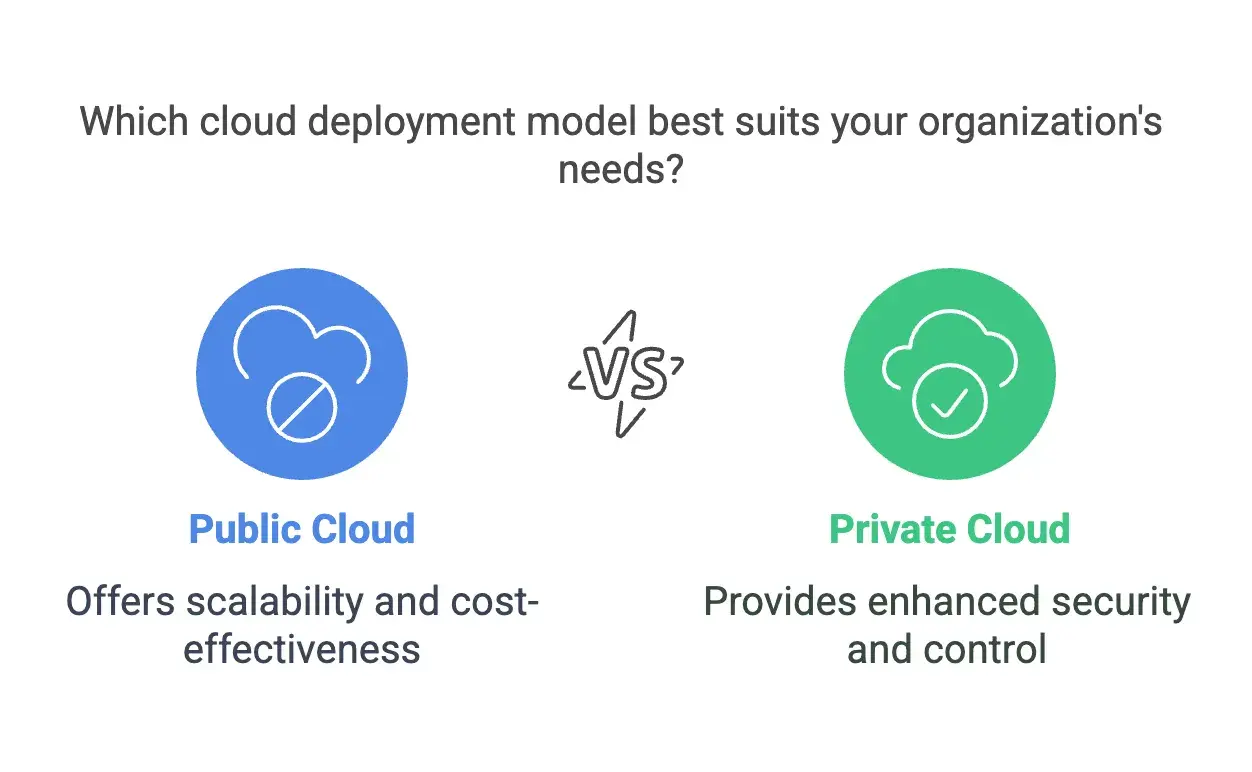
Despite the apparent simplicity of the “cloud,” organizations face a complex decision when it comes to choosing the right deployment model. In fact, a recent survey found that 72% of organizations struggle with selecting the optimal cloud deployment model (Forrester, 2024). This statistic underscores the complexity of making the right choices when it comes to deciding how and where to run your infrastructure. But what exactly are the technical trade-offs of public, private, hybrid, and multi-cloud deployments? This blog post will delve into these core architectural models, exploring their technical underpinnings, common use cases, advantages, and limitations, so that you can make informed decisions about the correct type of architecture for your needs.
Understanding Public Cloud: Scalability and Flexibility at a Shared Cost
Public cloud provides access to shared infrastructure owned and maintained by a third-party provider, with resources being available on demand via the internet. While this often makes it the most cost-effective option, it’s not without its challenges:
- Technical Architecture: Public clouds utilize large data centers optimized for massive scale, including features such as virtualization, software-defined networking, and load balancers. They also provide APIs that allow users to provision, manage, and scale their resources as needed.
- Implementation Details: Public cloud implementations involve shared infrastructure, multi-tenancy, and economies of scale. These environments can often scale almost infinitely. However, because resources are shared, organizations must often adhere to specific policies and constraints, since they do not have full control of the underlying infrastructure.
- Use Cases: Public clouds are ideal for startups, small and medium-sized businesses, or enterprises that require scalability and have more relaxed security requirements. They are also suited for applications that have unpredictable or fluctuating resource needs.
- Challenges: They also present some unique challenges such as ensuring security compliance, preventing vendor lock-in, and managing unpredictable costs, which may spike as resource utilization increases.
Delving into Private Cloud: Control and Customization at a Cost
Private cloud deployments are operated and controlled by a single organization and can be built on-premise or in a private data center. This provides greater control and flexibility but also requires significant investment and maintenance.
- Technical Architecture: Private clouds are usually built on top of virtualization technologies such as VMware or OpenStack and rely on software-defined networks to segment and control traffic.
- Implementation Details: Implementation involves creating dedicated infrastructure and managing it within your own environment, often based on pre-defined configurations. Private cloud requires specialized personnel to manage the complex underlying hardware and software.
- Use Cases: Highly regulated industries, enterprises with stringent security requirements, or organizations that require highly customized environments or have strict data locality requirements often choose private cloud over other options.
- Challenges: Private clouds require a high upfront investment in hardware and software, and a continuous need for technical expertise in areas such as networking, server management, and more.
Exploring Hybrid Cloud: Blending the Best of Both Worlds
Hybrid clouds combine the benefits of public and private cloud models, allowing organizations to maintain a degree of control while also leveraging the scalability and agility of public cloud environments. This is often seen as a “best of both worlds” approach but also adds a new layer of complexity.
- Technical Details: Hybrid deployments use APIs and direct connections to connect public and private clouds and often use a mixture of virtualization and containerization to deploy and run applications.
- Implementation Details: These require specialized hybrid cloud platforms or tools, and a strong understanding of network configurations and connectivity strategies. Also, you must decide how to manage security policies, user access, and more across both platforms.
- Use Cases: Hybrid clouds are popular for organizations that require a blend of on-premises infrastructure and public cloud services, for workloads such as handling sensitive data locally while also leveraging other services in the public cloud.
- Challenges: Complexity in integrating various cloud environments, managing consistent security policies, and ensuring data transfer speeds and stability between different platforms.
Unraveling Multi-Cloud Strategies: Avoiding Vendor Lock-in
Multi-cloud architectures involve using multiple public cloud providers to avoid vendor lock-in and also leverage specific benefits offered by different cloud platforms. A multi-cloud approach, when implemented properly, can add a lot of value but also a higher level of complexity in its implementation.
- Technical Details: Multi-cloud relies on standardized tools and APIs to create a degree of interoperability across various cloud platforms. It also uses techniques such as Infrastructure as Code (IaC) to create templates that can easily deploy applications across different providers.
- Implementation Details: This involves using management tools that can provide a unified view across all cloud platforms. Also, it involves using a variety of techniques to manage and deploy resources across different environments while also maintaining a strong security and compliance posture.
- Use Cases: Organizations that want to avoid vendor lock-in or need to use specific services or features offered by particular cloud providers often use a multi-cloud approach.
- Challenges: Managing multiple interfaces and APIs, dealing with inconsistencies between platforms, and a greater need for technical expertise in each of the chosen platforms.

Key Considerations when Choosing a Deployment Model
Choosing the right deployment model is a crucial step in your cloud adoption journey. Here are some key aspects you should consider:
Security Requirements:
- Technical Details: Consider the sensitivity of your data and the security requirements of your applications to determine which is the best model.
- Public Cloud: Provides security but with shared responsibility.
- Private Cloud: Provides more control over security but requires more management overhead.
- Hybrid and Multi-Cloud: Require a consistent security policy across all cloud environments.
- Implementation: Requires a careful evaluation of access controls, encryption, and compliance requirements.
Scalability and Performance:
- Technical Details: Consider the scalability needs of your applications and how they must perform under load.
- Public Cloud: Provides high scalability.
- Private Cloud: Limited by the size of the physical infrastructure.
- Hybrid and Multi-Cloud: Offers flexibility to balance performance with cost while optimizing for resource utilization.
- Implementation: This should be done by using metrics to continuously assess performance and optimize resource allocation.
Budget and Cost:
- Technical Details: Consider budget constraints and carefully consider the different cost structures of each cloud environment.
- Public Cloud: Offers pay-as-you-go pricing but requires careful management to avoid cost overruns.
- Private Cloud: Requires upfront investment, which is a major barrier for smaller organizations.
- Hybrid and Multi-Cloud: Offers more flexibility to manage costs but requires expertise to optimize for multi-cloud environments.
- Implementation: Requires a deep understanding of cloud pricing models and should include cost-tracking tools.
Technical Expertise:
- Technical Details: Ensure your team has the required skills to manage each environment and has a deep understanding of cloud technologies.
- Public Cloud: Often less management overhead but still requires cloud expertise.
- Private Cloud: Requires a high level of specialized skills.
- Hybrid and Multi-Cloud: Requires specialized skills across multiple technologies.
- Implementation: This often involves investing in personnel and tools.

Actionable Takeaways:
Choosing the right cloud deployment model is a critical step that will dictate your ability to innovate and grow.
- Start with an Assessment: Begin by understanding your business needs and requirements for security, performance, budget, and scale.
- Evaluate Your Options: Carefully consider the different deployment models (public, private, hybrid, multi-cloud) and choose the best fit for your organization.
- Balance Control and Flexibility: Be mindful not to over-optimize for one component, such as cost savings. Try to ensure that you are also meeting your security, compliance, and performance requirements as well.
- Prioritize Security and Compliance: Ensure your chosen model meets your security and compliance requirements and create policies to ensure they are implemented correctly.
- Test and Iterate: Continuously test your infrastructure and make improvements as you learn more.
- Focus on the Future: Choose an approach that will also support future innovations and growth, and not just be optimized for the current requirements of your business.
By carefully considering these different options, your organization can build a cloud infrastructure that supports your objectives and helps you stay competitive. If you are looking to explore your options and find out what type of cloud strategy is right for you, consider working with a platform that can implement and manage various environments.
Call to Action: Ready to decide on your cloud deployment model? Discover how different approaches can impact your organization and how to plan for the future. Schedule a demo today.
Citations:
Flexera. (2023). 2023 State of the Cloud Report. Gartner. (2022). Top Strategic Technology Trends for 2022: Distributed Cloud. Forrester. (2024). The State of Enterprise Cloud Adoption in 2024.