# The Hidden Price Tag Inside Your VPC
> A VPC costs nothing to create. The charges arrive the moment you attach primitives to it, and teams rarely audit those primitives until a bill lands.
Source: https://zop.dev/resources/blogs/do-vpcs-cost-money-aws-vpc-pricing-explained
Published: 2026-11-16 · Author: riya-mittal · Tags: aws, devops
---
## The Hidden Price Tag Inside Your VPC
A VPC costs nothing to create. The charges arrive the moment you attach primitives to it, and teams rarely audit those primitives until a bill lands.
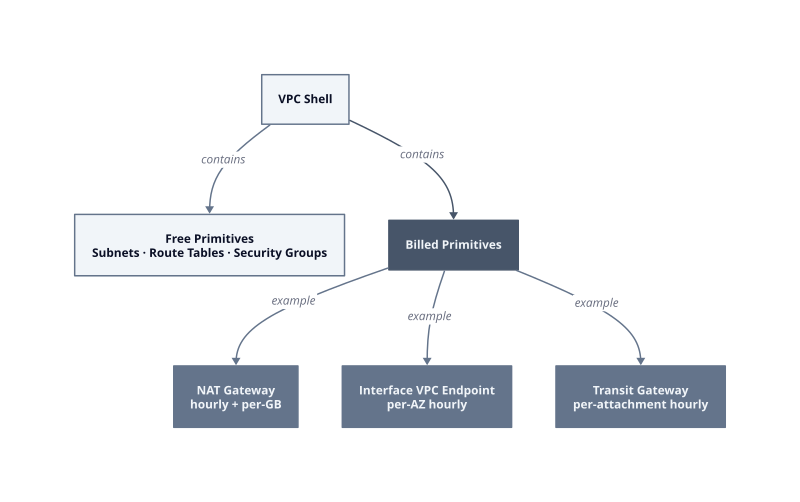
The mechanism is straightforward. The VPC construct itself, its subnets, route tables, and security groups, carries no hourly or per-GB fee. Add a NAT Gateway, an Interface Endpoint, or a Transit Gateway attachment, and each one starts an independent billing clock. Worse, those clocks run per Availability Zone. A three-AZ deployment multiplies every per-hour charge by three, before a single byte of traffic flows.
Three billing traps appear repeatedly in production architectures.
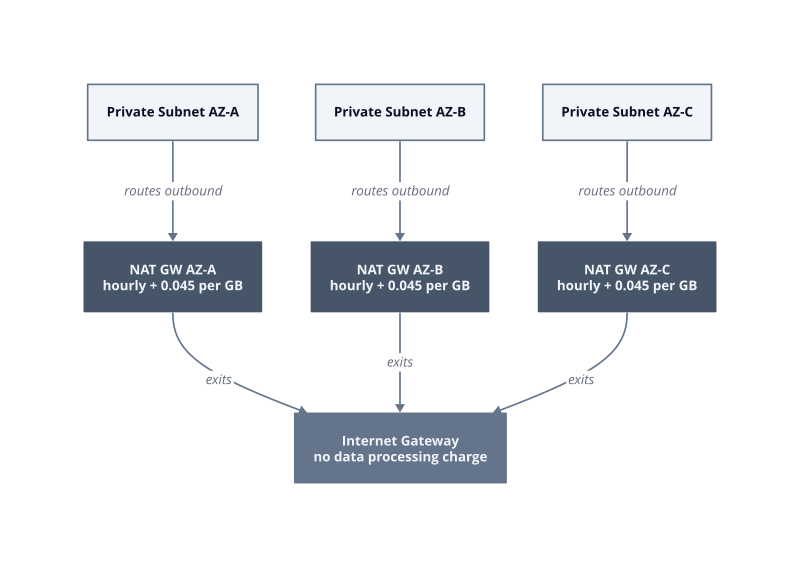
**NAT Gateway double-billing.** Each NAT Gateway charges an hourly rate plus a per-GB data processing fee, separately from any EC2 instance costs. A three-AZ deployment running continuously accumulates hourly charges across all three gateways around the clock, independent of actual throughput. Teams discover this after 30 days of data, once the monthly invoice reflects the full calendar of provisioned hours.
**Interface Endpoint per-AZ fees.** AWS bills for each hour a VPC endpoint remains provisioned in each Availability Zone, regardless of its association state with the service ([AWS PrivateLink Pricing](https://aws.amazon.com/privatelink/pricing/)). An endpoint deployed in three AZs but serving a low-traffic internal tool still generates three concurrent billing lines. Interface Endpoints reduce NAT Gateway data processing charges at sufficient traffic volume, but the AZ-hour cost is unconditional.
**Transit Gateway attachment accumulation.** The VPC account owner is billed hourly for each hour their Amazon VPCs are attached to an AWS Transit Gateway ([AWS Transit Gateway Pricing](https://aws.amazon.com/transit-gateway/pricing/)). Attachment counts grow quietly as teams add spoke VPCs, and the attachment charge compounds with data transfer fees when traffic crosses regions.
One free path does exist. [Data transfer charges are not incurred when accessing AWS services such as Amazon S3 via your VPC's Internet Gateway](https://aws.amazon.com/vpc/faqs/). Similarly, all data transfer over a [VPC peering](https://zop.dev/resources/blogs/cross-vpc-datastore-connectivity-psc-cloud-sql) connection that stays within an Availability Zone is free, even between different accounts ([VPC Peering Documentation](https://docs.aws.amazon.com/vpc/latest/peering/what-is-vpc-peering.html)). These free paths matter because they define the routing decisions that actually reduce spend.
The first action is an inventory query against AWS Cost Explorer filtered by the `NatGateway`, `VpcEndpoint`, and `TransitGateway` usage types. Run it today, before the next sprint allocates more AZ-scoped primitives.
## NAT Gateway: The Costliest Default Choice
NAT Gateway runs two independent billing meters simultaneously, and deploying one per Availability Zone turns that double charge into a multiplier that compounds before any workload traffic justifies it.
The first meter is hourly. Each NAT Gateway accrues an hourly charge for every hour it remains provisioned, regardless of whether a single connection passes through it. The second meter is consumption-based. [Amazon VPC Pricing](https://aws.amazon.com/vpc/pricing/) sets the data processing rate at $0.045 per gigabyte processed, applied to every byte the gateway inspects in either direction. Neither meter pauses when traffic drops to zero. Both meters run in parallel, so a quiet gateway still generates a continuous hourly burn.
The per-AZ deployment pattern amplifies both meters. Architects deploy one NAT Gateway per AZ to eliminate the cross-AZ data transfer fee that would otherwise appear when private subnet traffic routes through a gateway in a different zone. The intent is correct. The consequence is that every AZ starts its own pair of billing clocks. Three AZs means three hourly charges accumulating in parallel, plus three independent data processing tallies. By the end of the first deployment week, the provisioned-hour cost exists entirely apart from whatever the workloads actually consumed.
| Metric | Value |
|---|---|
| Data processing rate | USD 0.045 per GB |
| Billing meters per gateway | 2 (hourly plus per-GB) |
| Meters active on a zero-traffic gateway | 2 |
The [cost structure](https://zop.dev/resources/blogs/after-the-free-credits-run-out-how-to-transition-from-startup-cloud-programs-to-production-pricing-without-bill-shock) becomes particularly punishing when NAT Gateway traffic is destined for AWS-owned endpoints such as S3 or DynamoDB. Every byte sent through a NAT Gateway to those services incurs the $0.045 per-GB processing charge. The fix is a Gateway Type VPC endpoint, which carries no data processing or hourly charges at all, as stated in the [Amazon VPC Pricing](https://aws.amazon.com/vpc/pricing/) documentation. Traffic routed through a Gateway endpoint bypasses the NAT Gateway entirely, so the processing meter never starts. This works for S3 and DynamoDB. It does not extend to services that require Interface endpoints, which carry their own per-AZ hourly fee.
**The dual-meter trap.** NAT Gateway charges hourly and per-GB independently, so a low-traffic gateway is not "cheap." It is merely cheaper on the consumption meter while the hourly meter runs at full rate. A gateway sitting nearly idle still accumulates provisioned-hour [costs across](https://zop.dev/resources/blogs/the-egress-illusion-28k-month-you-approved-without-knowing) every AZ where it is deployed.
**The per-AZ multiplier.** Deploying one gateway per AZ is architecturally sound for resilience, but each deployment is a fully independent billing entity. Three gateways in three AZs do not share a billing bucket. Each one starts its own hourly clock at provisioning time, and each one tallies its [own data](https://zop.dev/resources/blogs/hidden-cloud-costs-that-pricing-pages-never-show-egress-api-calls-and-support-tiers-compared) processing total.
**The S3 bypass opportunity.** Because [Gateway Type VPC endpoints](https://aws.amazon.com/vpc/pricing/) carry zero data processing and zero hourly fees, any NAT Gateway traffic currently destined for S3 or DynamoDB represents recoverable spend. The mechanism is a route table update that directs that destination prefix through the Gateway endpoint instead of the NAT Gateway. After 30 days of data under the new routing, the data processing line in Cost Explorer for those destinations drops to zero.
Identify S3-bound NAT Gateway traffic first. Pull the NAT Gateway data processing cost from Cost Explorer, then cross-reference VPC flow logs filtered by destination IP ranges in the S3 managed prefix list. That intersection shows exactly what a Gateway endpoint deployment recovers.
## VPC Endpoints: Free Paths and When They Pay Off
Gateway endpoints are free routing constructs. Interface endpoints are hourly subscriptions. Choosing between them is arithmetic, not architecture preference.
A Gateway endpoint routes traffic to S3 or DynamoDB through the AWS backbone without touching any billable network primitive. [Amazon VPC Pricing](https://aws.amazon.com/vpc/pricing/) confirms there are no data processing or hourly charges for Gateway Type VPC endpoints, full stop. The mechanism is that AWS embeds the route directly into your VPC route table, so packets destined for S3 or DynamoDB bypass the NAT Gateway entirely. The NAT Gateway data processing meter, set at $0.045 per GB, never starts for that traffic class. A Gateway endpoint deployed in a three-AZ VPC costs the same as one deployed in a single-AZ sandbox: zero.
Interface endpoints work differently. They provision an ENI inside each Availability Zone where the endpoint is active, and AWS bills an hourly fee for each of those ENIs regardless of traffic volume. On top of that, data processing costs apply at [$0.01 per GB for the first 1 PB processed per month](https://aws.amazon.com/privatelink/pricing/), dropping to $0.006 per GB for the next 4 PB, then $0.004 per GB beyond 5 PB. The break-even calculation against NAT Gateway depends on two inputs: how many AZs the endpoint spans, and how much of the displaced NAT Gateway traffic was previously absorbing the $0.045 per-GB rate. At sufficient volume, the lower Interface endpoint data processing rate undercuts the NAT Gateway processing rate and the hourly ENI fees become a fixed overhead that the per-GB savings cover.
The two endpoint types solve different problems, and misapplying them produces predictable waste.
**Gateway endpoints for S3 and DynamoDB.** These two services are the only valid targets for Gateway endpoints. Deploy one for each service in every VPC that sends traffic to them. The route table update takes under a minute. After the first full billing cycle, the data processing line for those destination prefixes in Cost Explorer disappears. This fails only when DNS resolution inside the VPC does not resolve S3 bucket endpoints to the private prefix, which breaks in split-horizon DNS configurations where custom resolvers bypass AWS-provided DNS.
**Interface endpoints for high-volume private service access.** Interface endpoints justify their per-AZ hourly cost when the volume of NAT Gateway data processing charges they eliminate exceeds their own hourly and per-GB fees. This calculation holds for high-throughput workloads calling services like SQS, SNS, or EC2 API endpoints. It breaks for low-traffic internal tooling, where the fixed hourly ENI cost across three AZs accumulates without enough displaced NAT processing to offset it. By sprint 3 of a new service, traffic patterns are stable enough to run the comparison with real numbers.
| Endpoint Type | Hourly Fee | Data Processing |
|---|---|---|
| Gateway (S3, DynamoDB) | None | None |
| Interface (first 1 PB/month) | Per AZ | USD 0.01 per GB |
| Interface (next 4 PB/month) | Per AZ | USD 0.006 per GB |
| Interface (above 5 PB/month) | Per AZ | USD 0.004 per GB |
Start with Gateway endpoints. They require no traffic volume justification and eliminate NAT Gateway processing charges for the two most common internal AWS API destinations immediately.
## Cross-AZ and Cross-Region Peering Charges That Compound
VPC peering charges do not replace NAT Gateway or Transit Gateway fees: they stack on top of them, creating a compounding cost structure that only becomes visible after the first full billing cycle.
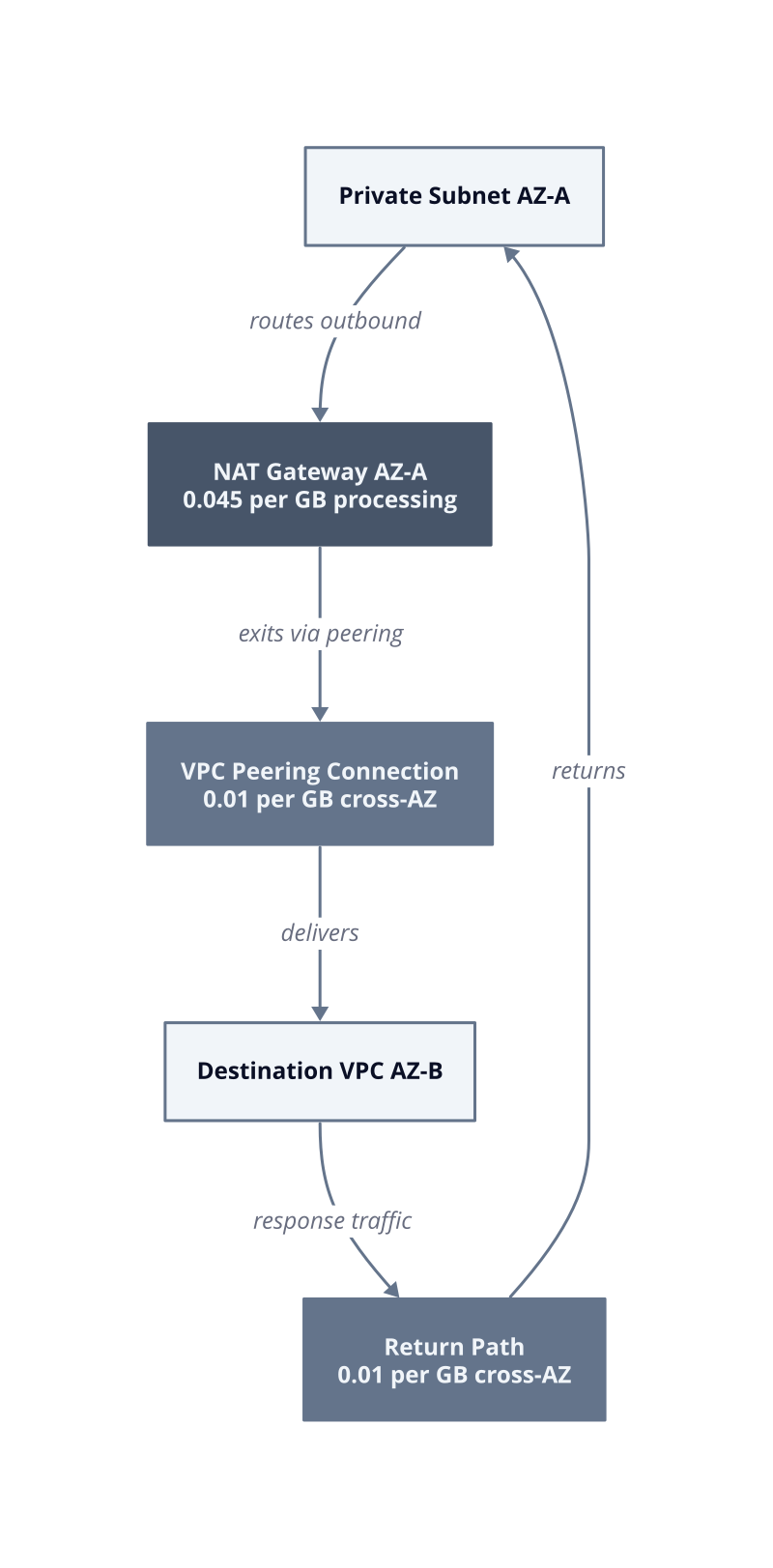
The core mechanism is straightforward. [Amazon VPC peering](https://docs.aws.amazon.com/vpc/latest/peering/what-is-vpc-peering.html) connections are free to create, but the traffic crossing them is not. Data sent over a VPC peering connection that crosses an Availability Zone within the same AWS Region is charged at [$0.01 per GB in both directions](https://aws.amazon.com/vpc/pricing/). Both the sender and the receiver pay that rate.
The compounding problem emerges when that peering traffic also passes through a NAT Gateway. A packet that originates in a private subnet, routes through a NAT Gateway to reach a peered VPC in a different AZ, pays two separate charges simultaneously. The NAT Gateway data processing meter runs at $0.045 per GB. The cross-AZ peering meter runs at $0.01 per GB in each direction. The effective per-GB cost for that traffic path combines the cross-AZ peering rate with NAT Gateway data processing charges, each billed separately and independently of one another. Neither meter is aware of the other. AWS applies them independently.
| Fee Layer | Rate |
|---|---|
| NAT Gateway data processing | USD 0.045 per GB |
| Cross-AZ VPC peering (each direction) | USD 0.01 per GB |
| Combined rate on this traffic path | USD 0.055 per GB |
Transit Gateway introduces a different variant of the [same problem](https://zop.dev/resources/blogs/iac-drift-vs-config-drift-which-one-burns-you-at-500-resources). [AWS Transit Gateway pricing](https://aws.amazon.com/transit-gateway/pricing/) does not apply data processing charges for data sent from a peering attachment to a Transit Gateway. That exemption is narrower than it sounds. It applies specifically to the attachment-level processing fee. Standard inter-region data transfer rates and cross-AZ transfer rates still apply to the traffic itself once it reaches its destination. Teams that consolidate inter-VPC routing onto Transit Gateway to simplify the network topology frequently discover that the per-GB transfer charges on high-volume east-west flows were not part of the architecture review.
**Cross-AZ peering symmetry.** The $0.01 per GB rate applies in both directions. A microservice architecture where Service A calls Service B in a different AZ and receives a response pays the peering rate twice per round trip. Request-heavy, response-light protocols such as queue polling pay less than streaming or bulk-transfer patterns that move similar volumes in both directions.
**Inter-region compounding.** When VPCs in different AWS Regions peer directly, inter-region data transfer rates apply on top of whatever local charges exist at each end. These rates vary by region pair and are set at the standard inter-region transfer prices rather than the cross-AZ rate. Teams that transfer data between VPCs in different regions encounter costs from both peering and regional data transfer that compound with no offset mechanism.
**The Transit Gateway exemption boundary.** The data processing exemption for peering attachments to Transit Gateway does not eliminate all charges on that path. It removes one specific fee. The underlying transfer charges for traffic crossing AZ or region boundaries remain. Architects who interpret the exemption as "Transit Gateway peering is free" will find the error in their first Cost Explorer report after the topology goes live.
**Routing path as cost control.** Traffic between two services in the same VPC but different AZs costs nothing in peering fees because no peering connection is involved. Architectures that co-locate communicating services within a single VPC, even across AZs, avoid the peering meter entirely. This works when service ownership maps cleanly to VPC boundaries. It breaks when compliance or organizational requirements mandate separate VPCs per team or per environment, at which point the peering fee becomes structural.
Audit VPC flow logs filtered by peering connection IDs, then cross-reference against AZ placement of the source and destination ENIs. That query identifies exactly which service-to-service call patterns are generating the cross-AZ peering charges and gives you a ranked list of traffic flows worth re-architecting first.
## Actionable Steps to Cut Your VPC Networking Bill
Three actions deliver the fastest return: deploy Gateway endpoints for S3 and DynamoDB, audit NAT Gateway placement against actual AZ traffic, and eliminate the routing paths that stack billable primitives on the same packet.
The VPC itself costs nothing. Subnets, route tables, security groups, and the VPC resource itself carry no hourly or per-GB charge. Costs enter the picture the moment traffic touches a NAT Gateway or crosses an AZ or region boundary through a billable construct. That means every dollar recovered comes from routing packets away from those metered primitives, not from resizing or deleting the VPC itself.
**Gateway endpoints first.** [Amazon VPC FAQs](https://aws.amazon.com/vpc/faqs/) confirms that accessing S3 through a VPC Internet gateway incurs no data transfer charges, and [Amazon VPC Pricing](https://aws.amazon.com/vpc/pricing/) confirms Gateway endpoints carry zero data processing and zero hourly fees. Deploy one for S3 and one for DynamoDB in every VPC that calls either service. The route table update propagates immediately. After 30 days of data, the data processing line items for those destination prefixes drop to zero in Cost Explorer. This breaks only when a custom DNS resolver inside the VPC bypasses AWS-provided DNS and fails to resolve S3 addresses to the private prefix range.
**Interface endpoints for high-volume non-S3 traffic.** For services like SQS, SNS, or EC2 API endpoints, [AWS PrivateLink Pricing](https://aws.amazon.com/privatelink/pricing/) sets the data processing rate at $0.01 per GB for the first 1 PB [per month](https://zop.dev/resources/blogs/the-shadow-compute-bill-28k-month-nobody-approved), then $0.006 per GB for the next 4 PB. That rate undercuts NAT Gateway processing for workloads where displaced NAT charges exceed the per-AZ hourly ENI fees. The break-even point depends on traffic volume and AZ count. It fails for low-traffic internal tooling where the fixed hourly ENI cost across multiple AZs accumulates without sufficient displaced NAT processing to offset it.
**NAT Gateway AZ consolidation.** Each NAT Gateway incurs an hourly charge plus a per-GB data processing fee independent of EC2 instance count or size. Teams that deploy one NAT Gateway per AZ for every environment pay that hourly fee multiplied by AZ count multiplied by environment count. For non-production workloads, a single NAT Gateway per VPC removes redundant hourly charges. This breaks for production workloads where AZ failure of the NAT Gateway would isolate private subnets, so apply it only where the availability trade-off is acceptable.
**Eliminate stacked billing paths.** A packet that exits a private subnet through a NAT Gateway and then crosses a peering connection to a VPC in a different AZ pays the NAT Gateway data processing rate and the cross-AZ peering rate simultaneously, with no offset between them. The fix is to co-locate communicating services in the same VPC where ownership and compliance rules permit, removing the peering meter from that traffic path entirely.
| Action | Prerequisite | Breaks When |
|---|---|---|
| Gateway endpoints for S3 and DynamoDB | AWS-provided DNS active in VPC | Custom split-horizon DNS bypasses private prefix resolution |
| Interface endpoints for high-volume APIs | Traffic volume justifies hourly ENI cost | Low-traffic tooling where fixed cost exceeds displaced NAT charges |
| NAT Gateway AZ consolidation | Non-production or fault-tolerant workload | Production subnets that cannot tolerate single-AZ NAT failure |
| Remove stacked peering paths | Services sharable within one VPC | Compliance or org rules mandate separate VPCs per team |
Pull a Cost Explorer report filtered to the `NatGateway` and `VpcEndpoint` usage types, sorted by daily spend. The top three line items in that report identify the routing paths worth addressing in the first deployment week.